
Gear range and ring alignment are separate
A top selector and side ring show displayed numbers and the fixed alignment arrow.
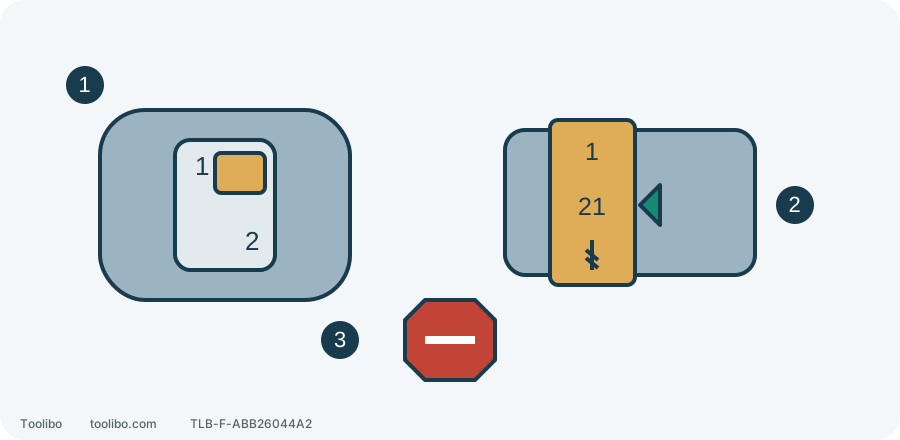
1. Displayed gear
Fully select 1 or 2 while stopped.
2. Fixed arrow
Align one ring setting with the housing arrow, not between marks.
3. No powered changes
Wait for complete stop before changing either setting.
Control relationships only, not exact housing geometry. Stop and remove the battery for setup.
Identify XFD16 and its two settings
This covers XFD16 controls in 885A01-940. It has rotation-only drilling and clutch-controlled screwdriving, not hammer drilling. Do not borrow the XPH16 ring layout or assume all 18V models operate alike.
The displayed gear number matters: 1 is low speed/high torque for heavier loading; 2 is high speed/lower torque for lighter loading. The adjusting ring instead aligns a number or drill mark with the housing arrow. Transmission range and operating mode are separate decisions.
Disconnect for fitting, then select the range
Release, wait for a complete stop and remove the battery for accessory fitting and setup. Use a sound, suitable accessory within shank and task limits, fitted securely by the tool’s hand-operated method. Shank fit alone does not approve a large cutter.
Move the speed lever fully to display 1 or 2, never halfway. Do not shift while running or force engagement against a cutting accessory. If normal selection is unreliable, stop rather than striking it or adding leverage.
A severe speed drop in gear 2 calls for release and a load/accessory check. If the task remains suitable, consider gear 1 only after stopping. This is not an instruction to shift while drilling or hide a jam with lower gearing.
Use numbers for driving and the drill mark for drilling
The ring offers 1–21 screwdriving settings, lowest at 1 and highest at 21. Align the selected graduation accurately with the body arrow; between marks is not an extra precise setting. Stop before changing mode.
The drill mark means rotation-only drilling, not the same clutch behaviour. Once drilling mode is selected, do not expect the previous low clutch number to limit screw penetration.
There is no universal screw-size-to-number rule. Timber, pilot preparation and fittings change the result. Specified-torque or load-bearing connections need their prescribed method; this ring is not a torque wrench.
Complete a matching-scrap trial
- Clamp the same material in similar thickness and use the intended screw, pilot and countersink preparation. Decide the intended head seat first.
- With the battery removed, fit the correct bit, select gear 1 and a low clutch number. Check direction, retention and clear work/exit paths.
- Finger off trigger, refit a compatible battery by the normal procedure and verify retention. Seat the bit fully and align it with the screw before a gentle start.
- Ease off near the target; release at clutch operation or seating and wait to inspect. Do not leave the clutch chattering.
- For a proud head with sound material/recess and no abnormal resistance, disconnect and increase a little. Stop and investigate overdriving, splitting, cam-out or a spinning screw instead of increasing further. After each disconnected adjustment, repeat step 3 to reinstall and secure the battery before another trial; use that same sequence for the confirmation run.
Confirm a sound, correctly seated result on similarly prepared scrap before adopting it as a starting point. Repeat when the screw or material changes.
Retain stop conditions throughout setup
Release immediately for twisting, binding, loss of control or repeated automatic stops. Once stopped and safe to handle, remove the battery to investigate; do not repeatedly trigger through a fault. Allow normal cooling after overheating, without water or forced refrigeration.
A compatible auxiliary handle can improve support under heavier load but must be properly fitted to this tool and secured, not improvised from an unsuitable collar. Unreliable controls, failed bit retention or persistent abnormal behaviour require service. Correct marks are only part of preparation, not permission for every accessory or material.
Models referenced