
Two protection groups, not three diagnoses
Pulse diagrams contrast the grouped overload/RFC indication with temperature protection.
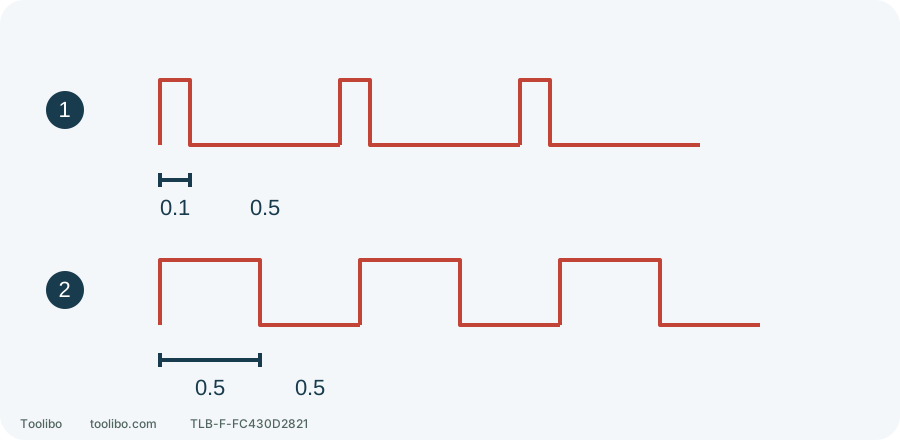
1. Load or RFC
On 0.1 / off 0.5; about 3 seconds after release. Find the cause first.
2. Temperature
On 0.5 / off 0.5 while protection remains active. Cool tool and battery.
DS18DEX/DV18DEX C99268561G Table 9. Numbers are seconds; each row is scaled separately for legibility. Rapid flashes alone do not separate overload from RFC.
Control the tool before considering restart
Release immediately and stop feeding when the accessory stops or the housing twists. Maintain safe grips without reaching for chuck, bit or moving work. Remove the battery only after standstill with stable equipment safe to handle. Smoke, leakage or worsening abnormal heat means move away, not approach for removal or charging.
Do not keep pulsing in hope of progress. DeWalt’s stall guidance rejects repeated trigger cycling while stalled. Support trapped tool and work; do not use the drill as a lever or permit sudden falling during release.
Separate three observed events
Swipe or scroll horizontally to see all columns.
| What already happened | First direction of investigation | What it does not prove |
|---|---|---|
| Repeated clutch release while screwdriving, motor still driving | Current clutch threshold or abnormal joint resistance | Not automatically failed battery or need for maximum setting |
| Speed falls then motor stops with protection indication | Load, supply or temperature | Not permission to swap packs and continue |
| Accessory suddenly trapped with tool reaction | Binding and reaction risk | Electronic intervention does not establish safe workholding |
Use existing observations without reenactment. If uncertain about clutch action, remain at inspection. Unexpected hard resistance in an unknown wall requires identifying the target, not further exploratory drilling.
Inspect four load factors while isolated
Check a sound, sharp, straight accessory of permitted type and size for the material and drill. Shank fit does not establish the whole cutter’s permitted load.
Check work movement, chip blockage and side loading. Clear only safely accessible debris after stopping and isolating. No hands on moving flutes or metal probing of unknown holes.
Check mode and full gear engagement. Heavier loading may require low range, but shift only stopped and never to force through a blockage. Screwdriving clutch release calls for matching-scrap seating assessment, not drilling mode to bypass it.
Review continuous work. A replacement battery does not cool the motor. Abnormal warmth or repeated protection means end the current work period and review duty suitability.
DS18DEX/DV18DEX: use the protection table
This is the North American C99268561G Table 9 grouping for the tool light, not a UC18YKSL charger’s red lamp. Blink codes are not universal.
Swipe or scroll horizontally to see all columns.
| Protection group | Table 9 indication | Action |
|---|---|---|
| Overload or reactive force control RFC | On 0.1 second/off 0.5 second, about 3 seconds after release | Release, identify and remove excess load or binding; review grips and restraint |
| Temperature protection | On 0.5 second/off 0.5 second while protection remains active | Let tool and battery cool thoroughly, then assess task and cause |
Rapid blinking alone does not reliably separate overload from RFC; consider whether the event involved binding, twisting or gradually increasing load. Do not deliberately bind to test it. If gear 2 was used, change to 1 only stopped, after excluding binding/accessory problems and confirming task suitability, not by forcing a powered shift.
After continuous wood-screw driving, this manual also calls for about 15 minutes of tool rest when replacing the battery. This is a specific duty instruction, not a universal cooling countdown. Remaining heat or an unknown cause still prevents resuming.
End the check with a clear decision
Only an identified corrected external cause, sound equipment, stable work, suitable temperature and permitted task justify full preparation again. Keep the finger off the trigger while reinstalling and securing the compatible pack, then operate normally rather than reset into a trapped condition.
Immediate repeat shutdown, unreliable controls, poor retention, new noise or unexplained cause ends the trial and calls for inspection. Record model, accessory type/size, material, gear, preceding symptom, light group and checks. A light that later stops flashing is a changed indication, not proof of repair.