
Three power arrangements, three planning needs
An integrated-battery pen, a mains-connected gun and a residual-heat gun are shown separately with their respective charging, cable and retained-heat symbols.
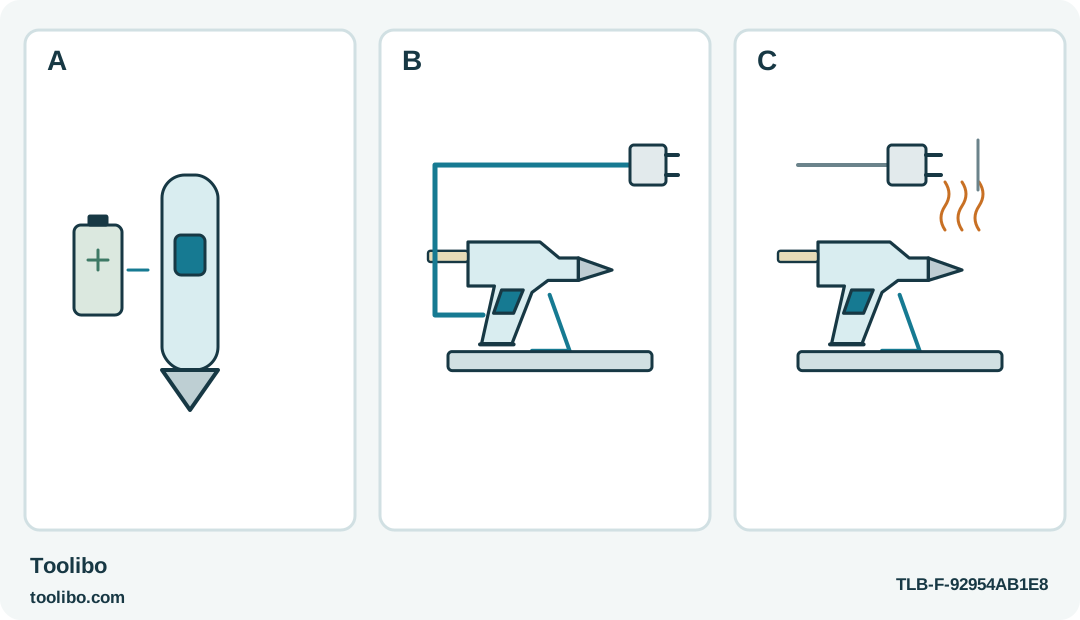
A · Integrated battery
Plan charging separately from the glue application session.
B · Corded heating
Arrange a clear lead route and deliberate shutdown at the bench.
C · Retained heat
Off-cord operation does not mean a battery is maintaining temperature.
Conceptual systems comparison, not measured shapes or a performance ranking. Actual adhesive, regional supply and operating instructions remain model-specific.
Start with the job that is awkward today
If your current craft setup works, a different power source is not automatically an improvement. Identify the actual difficulty first. Perhaps a cable crosses the paper layout, the tool is bulky beside a small joint, or the session involves many pauses while pieces are positioned. Those are useful requirements. “More powerful” is not, unless it is tied to a documented task the existing tool cannot perform.
For a small dry indoor project, compare complete systems: gun, compatible adhesive, supply or charger, resting position and materials. The examples here are the Bosch GluePen, Einhell TC-CG 3,6/1 Li, Dremel 930, STEINEL GlueMatic 1007 and Rapid EG Point in their identified regional forms. Compare their configurations and working routines rather than assuming a ranking for speed, durability or bond strength.
Keep the intended work noncritical. None of these choices turns hot glue into a universal solution for structural furniture, electrical repairs, food-contact items or wet joints. Decide that the joining method is suitable before choosing which gun makes the work more convenient.
Separate battery heating from stored heat
The GluePen and the Einhell use integrated batteries. Their cordless working arrangement removes a mains lead from the immediate application area, but it adds a charging routine and a finite session between charges. The GluePen cannot be used while charging. The Einhell has its own charging and operating indications, including a protective low-battery stop that should not be repeatedly overridden with the switch.
The Rapid EG Point is a different idea. Its cordless capability uses retained heat after mains heating, not an onboard battery maintaining temperature. That can serve a short nearby task, but an advertised off-cord interval is not guaranteed working time for every material, bead or room condition. Exact connection and reheating procedures belong to its own instructions.
These differences suggest a practical question: do you need sustained heating away from a lead, or simply a brief movement without the cable in the way? Answering that question prevents buying a residual-heat gun while expecting a battery tool, or dismissing a corded setup that could be improved by moving the work closer to the bench.
Compare the rhythm of the whole session
A small battery pen can suit a few prepared attachment points, especially when the pieces are already cut and arranged. It is less convenient if every session begins with a depleted battery and a search for the correct supply. Decide where charging and cool storage will happen before treating cordless operation as effortless.
A corded gun keeps a supply lead in the workspace but may fit a longer bench-based sequence of small joints and pauses. The Dremel 930 heats while plugged in, and its selector is not an off switch. The STEINEL 1007 is a fixed system rather than a gun with the LT model’s low-temperature mode. Either still needs a stable support and deliberate shutdown.
Rehearse the work cold with a similarly sized object in the proposed position. Can you approach the joint straight, park the tool and place the piece without crossing your other hand? A comfortable sequence matters more than a headline heat-up number. No specification compensates for a cramped workspace that encourages contact with the hot nozzle.
Let adhesive compatibility narrow the shortlist
The same nominal stick diameter does not make the tools interchangeable. Match the actual adhesive’s temperature requirement and material limits to the exact gun. The Dremel 930’s low and high selections can be useful when the identified compatible adhesive families require different settings, but they also add a choice that must be made correctly before use.
If your main work is delicate paper decoration, test for strike-through and distortion with the intended low-temperature system. Do not assume that a slim battery pen is low-temperature merely because it resembles a writing instrument. Conversely, a high-temperature label is not proof of a stronger bond on the materials you own.
Keep packaging and small successful samples. They show whether a combination suits your finish and joint shape far better than an unsupported online ranking. If a tool requires an adhesive you cannot reliably identify or obtain, include that inconvenience in the decision rather than planning to use mixed leftover sticks.
Choose a manageable system, then qualify the actual joint
Make a short shortlist around four practical needs: access to the joint, length and pattern of the session, the required adhesive, and a safe place to charge or route the lead. Add the correct regional supply and the condition of any existing tool. The retired Dremel 930 is useful as an existing-owner comparison here, not a promise that a current retailer stocks it.
Once you have a suitable system, make a small trial with the actual material faces. Check appearance, fit and ordinary light handling after cooling. Do not transfer a successful test from one adhesive to another just because both guns use the same diameter. Keep the tool supported during pauses and let it cool fully before storage. The better choice is the one that makes the complete safe workflow easier to repeat, not the one with the most persuasive cordless label.
Models referenced