
Three independent checks for a glue-stick choice
A stick-diameter fit section, a distinct adhesive-temperature pairing and a pair of labelled material faces form three separate checks rather than one universal approval.
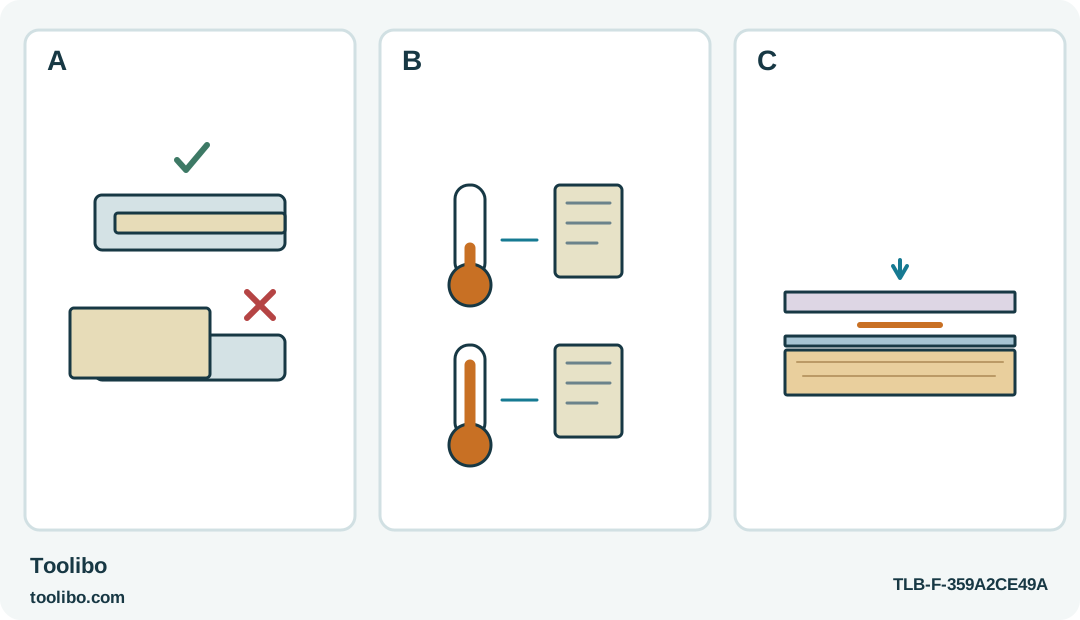
A · Physical fit
Use the specified diameter and a suitable stick length; do not force or reshape a stick.
B · Heat pairing
Match the actual adhesive family to the gun or selected temperature.
C · Material pair
Confirm both surfaces and their coatings, then test only permitted combinations.
Conceptual compatibility check. The drawing contains no universal diameter or temperature value; use the exact gun and adhesive instructions.
Start with three separate questions
A drawer of clear glue sticks often looks like one interchangeable supply. In practice, you need to answer three different questions: does the stick physically fit the gun, does its required working temperature match that gun, and is the adhesive suitable for the actual materials? A yes to one question does not answer the others.
This guide compares identified systems rather than recommending a universal stick. The Bosch GluePen, Dremel 930, STEINEL GlueMatic 1007, Einhell TC-CG 3,6/1 Li and Rapid EG Point are examples with their own instructions. Keep the exact model and regional version in view. A similar name, a different package or an online photograph of a gun is not enough to establish a match.
Put unidentified leftovers aside. Trying them in the tool to see whether they feed turns a simple purchasing question into a hot mechanical problem. A labelled supply that costs a little more is usually more useful than a mixed bag that cannot be traced to its intended gun and temperature.
Check diameter without stretching the meaning of mini
Read the diameter specified for the gun and compare it with the actual adhesive packaging. These examples use 7 mm systems, but “mini” is a broad retail description rather than a universal engineering standard. Do not sand a thick stick down, wrap a thin one or force it through the opening.
Length also matters to practical feeding. A short remnant may no longer engage the feed mechanism as intended. That does not justify pulling the hot remainder backwards or pushing a screwdriver into the inlet. Follow the exact tool’s instructions for introducing the next correct stick and keep improvised pushers out of the gun.
Keep separate storage compartments for different products and preserve their packaging. If two sticks look alike, write the adhesive’s real identification on the storage container rather than marking both simply “clear.” The goal is to make the correct choice easy when you return to a half-finished project weeks later.
Match the adhesive to the heat system
The Dremel 930 demonstrates why diameter alone is insufficient. Its low and high settings serve different compatible adhesive families. The matched instructions place GG02, GG04 and GG05 with the low-temperature use, while GG01 and GG03 belong with the higher setting. Colour and glitter sticks are not to be moved to high heat merely to obtain faster flow.
The ordinary GlueMatic 1007 provides a different lesson: the 1007-LT is a separate low-temperature body, not a mode that can be selected on the standard gun. Choosing an LT stick does not turn a normal 1007 into the LT model. Likewise, a battery pen’s compact size says nothing by itself about a low working temperature.
Use the actual gun and adhesive instructions together. If they disagree, or if a packet is too vague to establish compatibility, stop before loading it. Do not resolve the uncertainty by selecting the hottest setting or assuming that slower trigger pressure will make a mismatched adhesive safe.
Decide whether the material combination is sensible
A correct stick-and-gun pairing can still be the wrong joining system. Identify both surfaces, including any paint, varnish, laminate or fabric backing. The glue may contact that coating rather than the material you think you are bonding. A neat-looking result on bare wood does not establish adhesion to a coated tray.
Check the expected service conditions as well as the initial bond. A decorative indoor joint is a different task from a wet repair, a hot object, a hanging load or a surface touching food. The GluePen instructions, for example, exclude several plastics and Styrofoam and identify moisture-related limits. Another brand’s broad material list cannot override those restrictions for a Bosch setup.
Use matching scraps for a small trial only after the documents permit the combination. Keep the scraps supported on a suitable heat-resistant surface, allow the adhesive to cool and inspect both appearance and ordinary light handling. Reject melting, distortion, persistent lifting or a brittle interface rather than hiding it with a larger bead.
Buy for a useful result and keep the evidence with the stock
Before buying, make a short note with the exact gun model, permitted diameter, adhesive identification, working-temperature requirement and intended material pair. That is more useful than ranking sticks by the size of the pack. Include whether you need a decorative coloured finish or a hidden bond, because those are different outcomes.
Buy a manageable quantity until the actual combination has passed its trial. Keep the successful sample and label together, and do not mix a new formula into the old container without checking it again. If the gun later develops abnormal feed or persistent leakage, stop and investigate safely; an adhesive match is not proof that the mechanism is sound. Finish by switching off or unplugging the tool as required and allowing complete cooling before storage.
Models referenced