
Published body lengths
Lengths are in inches; include the bit, battery, hands and withdrawal space when checking access.
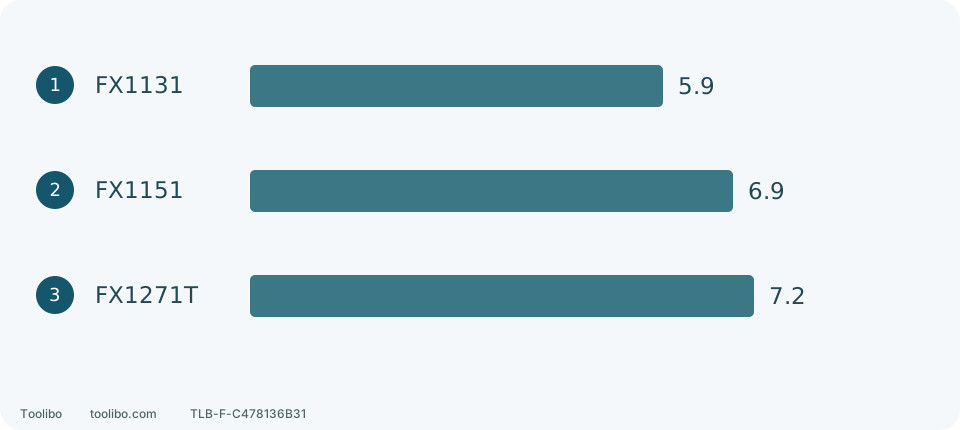
FX1131Cordless drill/driver
- FLEX 24V
- Compact drill/driver; 18 driving settings plus drill mode.
- FX1131-1A — US listing
FX1151Cordless drill/driver
- FLEX 24V
- 22 driving settings plus drill mode; no hammer or Turbo.
- FX1151-2A — US listing
FX1271TCordless hammer drill/driver
- FLEX 24V
- Hammer drill/driver with a separate Turbo setting.
- FX1271T-1H — US listing
1 · FX1131
5.9
2 · FX1151
6.9
3 · FX1271T
7.2
Lengths are in inches; include the bit, battery, hands and withdrawal space when checking access.
Compare the three on one basis
These are US models. Weights exclude batteries; dimensions are published values. Do not mix shipping weights or a tool with a large pack into the bare-tool comparison.
Swipe or scroll horizontally to see all columns.
| Item | FX1131 | FX1151 | FX1271T |
|---|---|---|---|
| Actions | Driving, rotary drilling | Driving, rotary drilling | Driving, rotary and hammer drilling |
| Body length | 5.9 in | 6.9 in | 7.2 in |
| Weight without battery | 2.5 lb | 3.2 lb | 3.8 lb |
| Normal no-load ranges | 0–500 / 0–1,800 RPM | 0–600 / 0–2,200 RPM | 0–550 / 0–2,000 RPM |
| Turbo ranges | None | None | 0–700 / 0–2,500 RPM |
| Clutch/action positions | 18 + drilling | 22 + drilling | 24 + drilling + hammer |
| Maximum torque label | 650 in-lb | 750 in-lb | 1,400 in-lb |
| Example package | -1A: one 2.5Ah, 160W, bag | -2A: two 2.5Ah, 160W, bag | -1H: one 6Ah Stacked Lithium, 280W, case and side handle |
All have 1/2-in chucks. Clamping a bit’s shank does not prove that its working diameter is allowed: check large wood bits, hole saws and masonry accessories against their own capacity and operating requirements.
The table follows the FX1151 specification page, which says 22 plus drilling. Its full manual is internally inconsistent: printed page 9 gives 22, while page 14 describes 23 torque settings and numbers 1–23. Match the actual ring and applicable version, start low on representative scrap and adjust gradually; do not buy it for an assumed precisely calibrated extra setting.
Restricted cabinet access: check FX1131 first
FX1131 is about 25.4 mm shorter and 318 g lighter without a battery than FX1151. That can help screen a tool for hinges or hardware with little room behind the screw, but include bit, battery and hand clearance.
Disconnect the battery, position the intended accessories and workpiece, check straight access, then trigger, finger and pack clearance. Leave room to withdraw. A short nose blocked by the pack has not passed the fit check. If neither tool fits, change the tool or installation method rather than driving at an angle.
For such work, size may matter more than the torque label. Within approved accessory and hole-size limits, an unused extra action need not justify more bulk.
Ordinary repeated work: price the FX1151 two-pack kit
For bench pilot holes, cabinet assembly or ordinary hardware without hammer action, FX1151 is the middle option. It is larger and heavier than FX1131, not automatically faster at every job. A concrete purchasing difference is the two 2.5Ah packs in -2A.
A first buyer needing rotation should compare FX1151-2A with FX1131-1A plus a spare pack. Existing owners should price exact tool-only contents to avoid duplicates. Rotation improves scheduling flexibility, but does not guarantee that charging always keeps up with consumption.
More clutch positions do not mean calibrated torque precision. For delicate surfaces, correct bits, pilot holes and a scrap test are more useful than selecting a supposedly more precise machine from a count of positions.
Consider FX1271T for an identified hammer-drilling need
For suitable masonry, establish material, diameter, depth and fastening requirements and exclude concealed wiring or pipes. Unknown walls, tile and fragile finishes do not all accept hammer action. For heavier concrete work, assess whether an SDS rotary hammer is the appropriate category rather than treating torque as a substitute.
FX1271T provides 0–8,800 / 0–32,000 BPM normally and 0–11,200 / 0–40,000 BPM with Turbo. Turbo changes the speed state; it is not itself the hammer selector. Wood and metal drilling still require the appropriate rotary settings.
The trade-offs are a longer, heavier body and side-handle clearance. Anti-kickback does not eliminate a jam’s reaction torque. Use the handle as instructed, secure the work and establish a controlled stance; do not omit a required handle to squeeze into a gap.
Compare complete equipment, not three torque numbers
List the exact tool/package, usable existing packs, spare-pack need, charger input, required handle and bits. FX1271T-1H has one 6Ah pack, not two batteries. The older -2B is a different configuration. A large pack may also be unnecessary for short, light work.
Eliminate unsuitable actions and capacities first, then setups that cannot access the work, and finally compare ready-to-work cost. The 650, 750 and 1,400 in-lb figures are not universal quality rankings. A clear account of your actual tasks tells you whether to pay for compactness, a second battery or genuinely needed hammer action.
Models referenced