
Rotation versus optional hammer action
The lower diagram shows hammer action, not Turbo. Select the action for the identified material; Turbo changes speed.
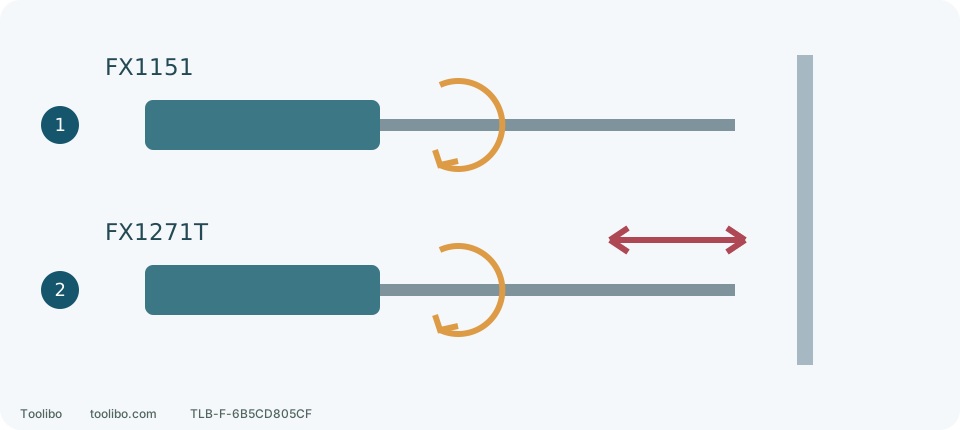
1 · FX1151
Rotary drilling
2 · FX1271T
Rotary drilling or selected hammer drilling
The lower diagram shows hammer action, not Turbo. Select the action for the identified material; Turbo changes speed.
Separate rotation, hammer action and Turbo
The FX1151 provides screwdriving and ordinary rotary drilling. The FX1271T adds hammer drilling and Turbo. Hammer is an action; Turbo is a speed state. Selecting Turbo does not automatically mean hammer drilling, and ordinary wood or metal drilling does not call for hammer simply because the tool offers it.
Swipe or scroll horizontally to see all columns.
| Item | FX1151 | FX1271T |
|---|---|---|
| Normal no-load ranges | 0–600 / 0–2,200 RPM | 0–550 / 0–2,000 RPM |
| Turbo no-load ranges | None | 0–700 / 0–2,500 RPM |
| Normal hammer rates | None | 0–8,800 / 0–32,000 BPM |
| Turbo hammer rates | None | 0–11,200 / 0–40,000 BPM |
| Clutch/action positions | 22 + drilling | 24 + drilling + hammer |
| Published length | 6.9 in / 174 mm | 7.2 in / 182 mm |
| Weight without battery | 3.2 lb | 3.8 lb |
| Maximum torque label | 750 in-lb | 1,400 in-lb |
The manufacturer’s inch and metric dimensions are rounded; do not mix them to calculate false precision. Using the listed metric values, the FX1271T is about 8 mm longer. Bare-tool weight increases by about 272 g; different installed packs change the complete-tool comparison.
The table follows the FX1151 specification page, which says 22 plus drilling. Its full manual is internally inconsistent: printed page 9 gives 22, while page 14 describes 23 torque settings and numbers 1–23. Match the actual ring and applicable version, start low on representative scrap and adjust gradually; do not buy it for an assumed precisely calibrated extra setting.
Ordinary assembly may need only the FX1151
Furniture installation, pilot holes in wood and ordinary metal drilling do not inherently require hammer action. Within the approved bit, material and capacity limits, the shorter, lighter FX1151 can be suitable. For repeated pilot holes at a bench, secure workholding, a sharp bit and backing the exit may matter more than maximum no-load speed.
The FX1271T actually has a lower normal high-speed ceiling than the FX1151, reaching the higher ceiling with Turbo. That neither makes it worse in normal operation nor guarantees faster work with Turbo. Follow the bit manufacturer’s working-speed, feed and chip-clearing requirements rather than always choosing the fastest setting.
Answer four questions before masonry drilling
- Is the material suitable brick or block, or tile, fragile finish or an unidentified wall? The latter cannot simply inherit a hammer-drilling plan.
- What diameter, depth and drilling method does the fixing require? Match these to the tool and bit’s permitted use.
- Are concealed wires, pipes or other services excluded at the location? Stop while this remains unknown; exploratory drilling is not a checking method.
- Does the material and workload call for an SDS rotary hammer instead? An ordinary-chuck hammer drill is not that tool, and an SDS shank is not a regular round shank to clamp directly.
After those conditions are established, the FX1271T’s extra action can be useful. Fit and use the side handle as required, allowing space for hands and stance. Anti-kickback is supplementary protection, not elimination of reaction torque or a substitute for secure holding.
Compare complete kit contents
The US FX1151-2A includes two 2.5Ah packs, a 160W charger and bag. The FX1271T-1H includes one 6Ah Stacked Lithium pack, a 280W charger, case and side handle. Both also include bit holder and belt clip. One large pack does not automatically suit every buyer better than two smaller ones.
If you need battery rotation, add the cost of a spare to the -1H. If suitable FLEX 24V equipment is already available, compare the exact tool-only contents and price. The older FX1271T-2B is a different package; verify its full suffix and written contents instead of borrowing the -1H photograph.
Check the complete working envelope
With the battery disconnected, check the intended bit, side handle, hand position, pack and withdrawal route. A few millimetres of body length are not the only constraint: the handle may hit a wall first, and a larger pack may block cabinet access. Do not omit a required handle just to make the tool fit.
For ordinary driving and drilling within the FX1151’s limits, the 1,400 in-lb label alone is not a reason to accept a larger setup. For a clearly identified, suitable hammer-drilling task, the FX1271T has a real additional function. Write down required action, available space, spare-battery needs and complete cost before choosing.
Models referenced