
Published body lengths
Lengths are in inches; include the bit, battery, hands and withdrawal space when checking access.
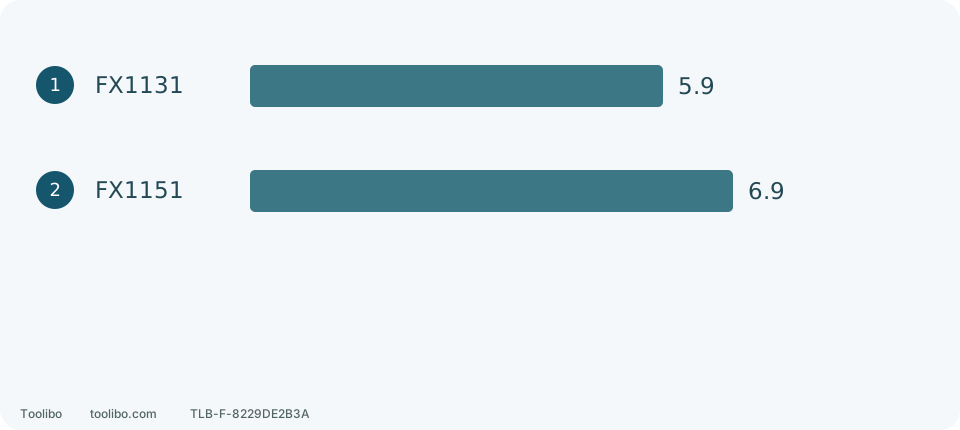
1 · FX1131
5.9
2 · FX1151
6.9
Lengths are in inches; include the bit, battery, hands and withdrawal space when checking access.
Put the differences side by side
Both US models belong to FLEX 24V and handle screwdriving and rotary drilling. Neither has hammer drilling or Turbo. The FX1231 and FX1251 names in their shared manuals refer to other models, not extra functions on these tools.
Swipe or scroll horizontally to see all columns.
| Item | FX1131 | FX1151 |
|---|---|---|
| Published body length | 5.9 in | 6.9 in |
| Weight without battery | 2.5 lb | 3.2 lb |
| Two no-load speed ranges | 0–500 / 0–1,800 RPM | 0–600 / 0–2,200 RPM |
| Clutch positions | 18 plus drilling | 22 plus drilling |
| Maximum torque label | 650 in-lb | 750 in-lb |
| Chuck | 1/2-in metal ratcheting | 1/2-in metal ratcheting |
| Example kit | FX1131-1A: one 2.5Ah, 160W charger, bag | FX1151-2A: two 2.5Ah, 160W charger, bag |
The length difference is about 25.4 mm and the bare-tool weight difference about 318 g. These are comparable dimensions, not a comfort test. The maximum torque figure is not a screw-tightening setting, and its difference cannot be converted into a drilling-speed advantage.
The table follows the FX1151 specification page, which says 22 plus drilling. Its full manual is internally inconsistent: printed page 9 gives 22, while page 14 describes 23 torque settings and numbers 1–23. Match the actual ring and applicable version, start low on representative scrap and adjust gradually; do not buy it for an assumed precisely calibrated extra setting.
For cabinet work, check whether the FX1131 actually fits
For a hinge mounting screw inside a cabinet, measure the clear distance behind the screw axis. Include the intended bit, extension and battery rather than comparing body length alone.
- Remove the battery and position the workpiece and intended accessories. Check that the bit can approach along the screw axis.
- Check clearance for fingers, trigger and battery. The pack can hit the cabinet before the nose does.
- Leave room to withdraw, realign and remove the tool. Reaching at an angle is not a usable straight approach.
- If the FX1151 hits the panel while the FX1131 enters and withdraws straight, the shorter body provides a definite benefit. If neither fits, change the tool or method rather than driving crooked.
With the same battery, lower bare-tool weight also lowers total weight. Whether it suits prolonged holding still depends on the pack, posture and job; a weight difference does not promise comfort.
For repeated assembly, price the second battery
A first-time FLEX buyer assembling cabinets or fence hardware may value the two 2.5Ah packs in the FX1151-2A. One can work while the other is properly charging or waiting. That offers scheduling flexibility, not a guarantee of uninterrupted work: temperature, load and charging time still matter.
Compare two complete totals: FX1131-1A plus an approved spare pack, and FX1151-2A. If the former costs less and compactness matters, there is no reason to surrender the better-fitting body just because the other box already contains a spare. With ample working room and a good complete-kit price, the FX1151 is a straightforward alternative.
Existing FLEX owners should avoid duplicate equipment
Confirm the exact models, condition and compatibility of your batteries and charger, then compare the actual tool-only contents. A product photograph containing a battery does not add one to a -Z offer. Check the charger’s local mains suitability before treating it as usable equipment.
Numbered clutch positions are relative settings, not calibrated torque readings. For hardware installation, start with an appropriate low setting on matching scrap, check seating and surface damage, and adjust as instructed. Correct bits, pilot holes and depth control matter more than assuming value from an extra number of positions.
Know when neither is the answer
Neither supplies hammer drilling. If that action is required, identify the material, hole diameter, depth and fastening requirements before choosing a suitable hammer drill or rotary hammer. For large wood bits, check the actual model’s capacity and accessory requirements; 650 versus 750 does not establish an allowed hole size.
The practical conclusion is simple: restricted access favors checking the FX1131 first; ample space and a first purchase needing battery rotation favor comparing the complete FX1151-2A price. An existing drill that already does the job need not be replaced merely for a higher no-load speed. Suitable bits, workholding and protection may solve more of the immediate problem.
Models referenced