
Ordinary checks stop at damage or persistent failure
Damaged-power and spark exclusions, an exterior-only inspection boundary and a symptom record distinguish setup checks from service faults.
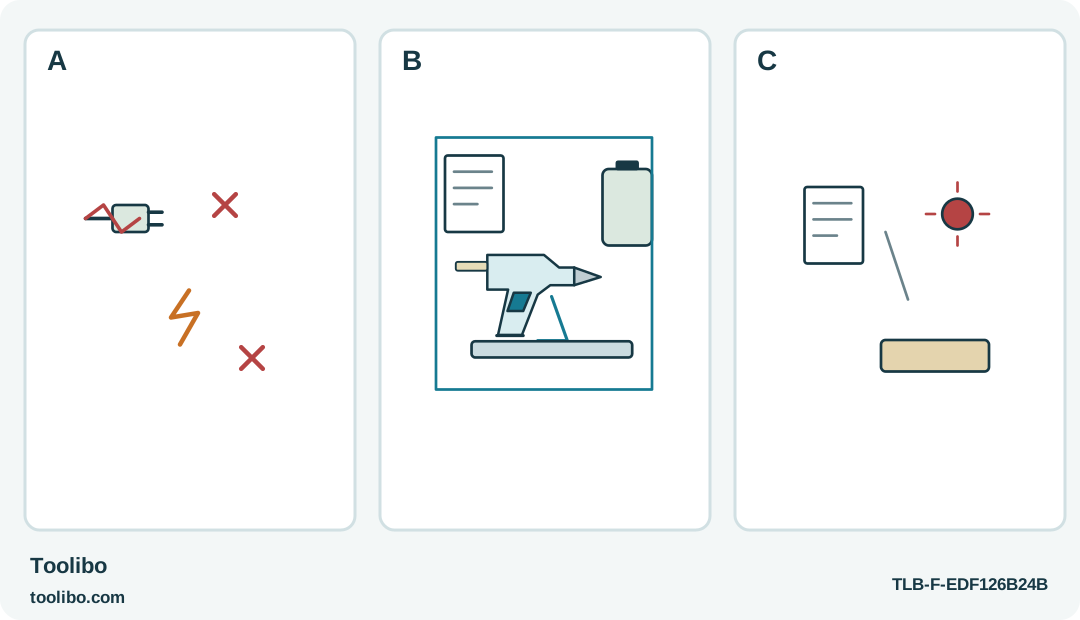
A
A damaged cord, smoke, sparks or abnormal heat ends the operating trial immediately; remove power only when safe and seek service.
B
For an undamaged tool, verify only the exact external power, stick, support and normal heating sequence without crossing the housing boundary.
C
Record the actual indicator and whether it occurred during charging, heating or feeding. Do not invent an internal heater or cell diagnosis.
An intact exterior permits a bounded setup check; damage or persistent malfunction calls for service observations instead.
Stop for damage before troubleshooting flow
A glue gun that will not heat is inconvenient; one with a damaged cord, smoke, sparks or abnormal heat is a stop-use situation. Do not keep squeezing the trigger to see whether it recovers. Put the tool in a safe resting position and remove power only if that can be done safely without touching a damaged or hot area. Keep people away while it cools, then arrange appropriate service.
This guide covers external checks for the Dremel 930, Einhell TC-CG 3.6/1 Li and Worx WX045L. It does not cover opening the housing, replacing a fuse or heater, repairing a cable, dismantling a battery or probing electrical contacts. An accessible screw is not evidence that the repair is intended for the user.
Before a normal restart, inspect the cold tool, cord or battery and the intended power equipment. If any part is visibly damaged, skip the operating trial. Do not treat an odor of overheating or visible sparking as ordinary behavior for a glue gun. Stop using the tool if either sign appears, even when the adhesive still flows.
Interpret the actual model’s power state
The Dremel 930 begins heating when plugged in. Its selector chooses low 105 °C or high 165 °C; it is not an off switch. Turning the selector to low does not isolate a suspected fault. Unplugging is the normal shutdown action. Check that the selected mode matches the original recommended adhesive, but do not use a temperature change to compensate for an unknown stick or an internal malfunction.
The Einhell TC-CG 3.6/1 Li uses an integrated lithium-ion battery and a different indication sequence. During normal startup, red indicates heating and green indicates readiness after the specified heating interval. During charging, red flashing indicates a temperature issue; the instructions call for keeping the tool at room temperature for a day before trying again. No charging LEDs indicates a battery fault in those instructions, and a defective battery must not be used.
The Worx WX045L uses its specified removable battery system. Check only ordinary correct installation, battery charge and the tool’s normal heating sequence. Do not substitute a different battery or bridge terminals to discover whether the heater works. Its recommended 11 mm stick system is not interchangeable with the 7 mm sticks used by the other two tools.
Use one orderly external check sequence
If there are no damage signs, work through the normal setup rather than changing several things at once:
- Confirm the exact model and its correct power equipment, without dismantling anything.
- Check that the recommended stick is present and its formula suits the tool’s processing temperature. Keep loading within the manual’s procedure.
- Place the tool in its proper resting position on a protected dry bench.
- Start it normally and allow the documented heating sequence. A cold trigger is not a test instrument.
- Make a small supported scrap application using ordinary pressure only after the normal readiness check.
For the 930, a few moments after plugging in is not the full heating interval. For the Einhell, do not keep pressing the switch after the protective circuit has shut the empty battery down; its instructions warn against that behavior. For the Worx, a stick that is too small or unsuitable can create a feed problem that more pressure will not solve.
If normal setup does not restore operation, stop. Repeated power cycling, pushing the stick with a metal object or increasing hand force adds risk without identifying the fault. A tool that works only when its cable, battery or housing is held at an angle also needs service rather than a new operating technique.
Give service observations, not an invented diagnosis
After safe shutdown and complete cooling, record the model identifier and what happened. Note whether there was an indicator, which pattern appeared, when it appeared and whether the fault occurred during charging, heating or dispensing. State the adhesive identity if known. Those observations are more useful than declaring that a heater or battery cell has failed based on a single symptom.
Follow the manufacturer’s service route for the tool and power equipment. A damaged Dremel cord requires qualified replacement, and an integrated Einhell battery is not a user-opening project. For the Worx, there are no user-serviceable internal parts. Keep a suspect tool separate from ready-to-use supplies so another person does not unknowingly restart it.
If the simple setup check succeeds, still make a fresh material trial before returning to the decoration. A paused joint may already have cooled and cannot be treated as a new bead. Finish by shutting down correctly and cooling fully before storage. The service boundary is reached when ordinary external setup fails or damage appears—not after you have tried every possible internal repair.
Models referenced