
Store three power systems by their own rules
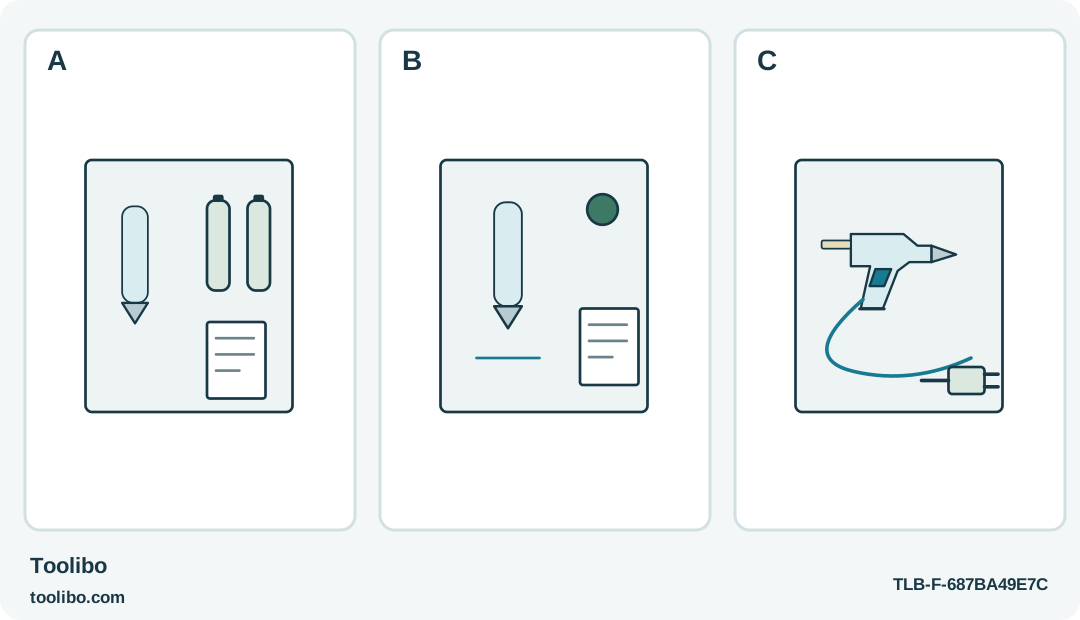
Separate storage compartments show a cooled pen beside its removable pair, a closed integrated-battery pen with a charge cue, and a corded gun with a relaxed unplugged lead.
A
For prolonged Gluey storage, remove the matched NiMH pair only after full cooling, protect the terminals and retain its chemistry identification.
B
Store MobileGlue 1007-S charged for prolonged storage as instructed, with the integrated battery housing unopened and charging equipment identified.
C
Unplug and cool the corded TC-GG 30, inspect the cable and avoid sharp folds. Keep every tool’s consumables and storage conditions separate.
A removable NiMH pair, a charged closed integrated-battery tool and an unplugged corded tool require different storage decisions.
Pack a tool, not the end of a hot session
Seasonal craft work often ends with a crowded table and a box waiting to be closed. Resist packing the glue tool with the decorations while it is still warm. Turn it off or disconnect it according to the exact model, leave it safely supported and allow complete cooling before cleaning or storage. A dark indicator does not prove that the nozzle or a hidden drip has cooled.
This guide compares three different storage situations: Bosch Gluey with its removable NiMH cells, STEINEL MobileGlue 1007-S with an integrated lithium-ion battery, and the mains-powered Einhell TC-GG 30. They should not receive one generic instruction to “remove the battery.” Only the Gluey’s user-removable cells belong in that step; opening an integrated-battery housing is not routine storage maintenance.
Clear a separate cooling space before collecting ribbon, paper and loose sticks. Keep the nozzle away from packaging and make sure nobody mistakes the tool for a cool item ready to put away. If there is damage, a persistent operating fault or an abnormal battery condition, set the tool aside for service rather than burying it in next season’s supplies.
Store Gluey with the correct cells identified
The identified Gluey uses two 1.2 V HR6 AA NiMH rechargeable batteries. Its instructions call for removing the batteries when the pen will not be used for a prolonged period because they can corrode during long storage. Perform that intended battery-compartment operation only with the pen off and completely cool.
Keep the pair together and identified so that next season’s user does not substitute AA-shaped lithium-ion cells. The Gluey instructions specifically prohibit lithium-ion batteries. Matching shape is not matching chemistry or voltage. When batteries need replacement, use the same manufacturer and capacity together as directed rather than mixing an old cell with a different spare.
Use the proper charging station and battery instructions when charging is needed; do not leave the pen or cells charging simply because the craft box will be unused for months. Store the cells so their terminals cannot be bridged by loose metal objects. Preserve the battery and charger information alongside the pen instead of relying on memory about which USB accessory belonged to it.
Keep integrated and mains-powered systems distinct
For the MobileGlue 1007-S, switch off and cool the tool, then follow its charging and storage instructions without opening the housing. Its lithium-ion battery is part of the tool. Do not try to remove it for seasonal storage or adapt the Gluey’s removable-cell procedure. For prolonged storage, put it away with its battery charged, as its instructions direct. Keep the specified charging equipment identified, and remember that the MobileGlue 1007 series cannot be used while charging.
The TC-GG 30 is corded. Unplug it, allow complete cooling and inspect the cord externally before packing. A damaged cable calls for the manufacturer’s service route, not tape or a household splice. Arrange the cooled cord without sharp folds or pressure from heavy decorations, and keep the nozzle from bearing against the cable in the box.
The TC-GG 30 instructions specify a dark, dry location above freezing, with an ideal storage range of 5–30 °C. Those are that tool’s storage directions, not a universal battery or adhesive specification. Avoid a damp shed, hot attic or sunny windowsill for the shared craft supplies; check each stored item’s own requirements rather than applying the broadest available range to everything.
Preserve the consumable identity and restart carefully
- Keep sticks in their original labeled packaging, separated by exact system and formula.
- Do not pull a partly used stick backward from a gun merely to make it fit a box; follow the particular tool’s instructions for any consumable handling.
- Store cold tools where the power control cannot be pressed accidentally and loose parts cannot damage the nozzle or contacts.
- Keep charging equipment, manuals and model identifiers together without allowing metal accessories to bridge battery terminals.
- Mark any unresolved fault clearly so the next session does not begin with an unexplained failed tool.
Gluey uses its short 7 × 20 mm low-temperature sticks, not ordinary long mini sticks cut by guesswork. Its manual specifies a maximum stick storage temperature of 25 °C. The TC-GG 30 and MobileGlue 1007-S use different systems, so a common bag of loose translucent sticks is a poor storage solution even when the pieces look similar.
When the next season arrives, inspect before powering on. Check for damage, contamination, battery abnormalities and readable adhesive labels. Charge only according to the correct instructions, establish normal operation on supported scrap and make a fresh material trial if the decorations or finishes have changed. Storage is successful when it preserves a recognizable, safe-to-assess system—not merely when everything fits inside the box.
Models referenced