
Small orbit and linear belt travel
The small circle is an enlarged conceptual center path, not to scale; the belt arrow shows linear travel, not an OPM equivalent.
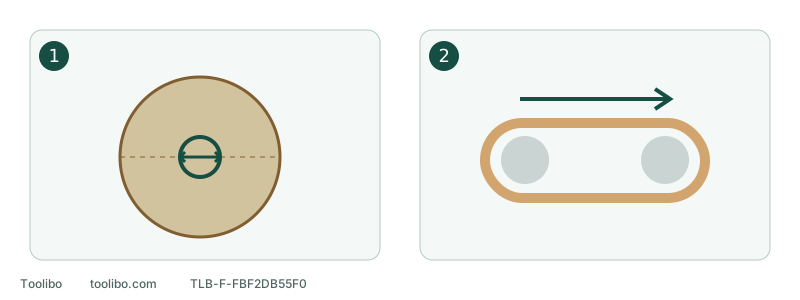
1. Two different diameters
Disc diameter buys the abrasive; orbit diameter describes its motion.
2. Travel along the belt
Feet per minute measures distance travelled, not complete circuits or orbits.
The small circle is an enlarged conceptual center path, not to scale; the belt arrow shows linear travel, not an OPM equivalent.
Attach each number to its quantity
Swipe or scroll horizontally to see all columns.
| Parameter | Meaning | Example | Does not mean |
|---|---|---|---|
| OPM | Orbits per minute | ROS20VSC: 7,500–12,000 OPM | Wood removed per minute |
| RPM | Revolutions per minute | A specified rotating component | Automatically the same number of orbits |
| ft/min | Linear feet travelled per minute | 9403: 1,640 ft/min | 1,640 complete belt circuits per minute |
| Orbit diameter | Diameter of the small orbital motion | ROS20VSC: 3/32 inch | Abrasive-disc diameter |
| Abrasive size | Size of the disc or belt to buy | BO5041: five-inch disc | Orbit size or speed |
Read the field name before the value. The large disc describes the consumable/contact area; the small orbit describes motion. Do not order a disc from the orbit dimension or treat disc diameter as eccentric travel.
Separate a range from a fixed value
US ROS20VSC lists 7,500–12,000 OPM; BO5041 lists 4,000–12,000. That establishes different published lower settings, not a universal fine-finishing advantage or equal removal at equal maxima.
GSS20-40 lists fixed 12,000 OPM without a variable-speed dial. Do not invent a second setting because a neighboring model has one. Range versus single value changes what the operator can adjust.
If buying for a low-speed process, also verify material, abrasive and tool suitability. A low setting is not permission to try every surface.
Orbit diameter is not radius or disc size
ROS20VSC lists 3/32-inch orbit diameter and BO5041 1/8 inch; both abrasives are five inches. These describe different objects. Radius is half diameter only when the original field actually specifies diameter.
Sketch a large disc and a small path for its center, labelled clearly rather than falsely to scale. The small orbit is not an instruction to move the whole tool in tiny circles; feed motion follows the tool and work requirements.
Retain original units and meanings. A larger nominal orbit alone does not prove rougher finish, faster removal or greater hand vibration.
Belt travel is linear speed
9403’s 1,640 ft/min describes movement along the belt. Its 4 × 24-inch specification describes width and complete circumference; 24 inches is not speed or flat contact length.
Converting feet to meters changes linear-speed units, not the quantity into OPM. Even calculated belt circuits would describe that belt, not a valid random-orbit performance comparison.
9403 has no variable-speed dial. Do not import another belt sander’s settings or use harder pressure as speed control.
Use the dial with a meaningful sample
Confirm known suitable material, correct abrasive, support and dust controls before selecting the instructed starting setting and using matching scrap. A faulty tool, loose pad or unknown material is not a sample-test case.
Change one controlled factor at a time, for example speed while retaining the same disc and handling. Changing grade, pressure and speed together obscures the cause. Inspect scratches, removal and abnormal heating, not sound alone.
“4” on one dial does not establish another tool’s speed. If ineffective, check abrasive and process rather than forcing pressure. Loosening, abnormal vibration or unexplained hot odour means stop and inspect, not find a setting that hides it.
Build a useful comparison
Record parameter, unit, fixed value/range and model separately. Compare only quantities with the same meaning; leave absent values blank rather than calculating removal from current, maximum OPM or orbit diameter.
Bring the numbers back to access, available abrasives, supported work and extraction. Their purpose is a better task choice, not a single ranking of unlike machines.
Models referenced