
Decide what “faster” actually means
It might mean more orbits per minute without load, more material removed in a minute, or less time to obtain a finish-ready surface. Each requires different evidence. OPM counts orbital motion, not wood mass, volume or thickness removed per minute, nor minutes to complete a task.
ROS20VSC lists 7,500–12,000 OPM, BO5041 lists 4,000–12,000 OPM and GSS20-40 lists 12,000 OPM. The first two have different adjustable ranges and the third has a different pad format. A shared 12,000 figure does not establish equal removal speed; a lower minimum setting does not establish poorer productivity either.
Unpack a typical advertising-style statement
This is a reading exercise, not a tested claim by a product: “A has a higher maximum no-load speed than B, so it finishes a tabletop 25% faster.”
Swipe or scroll horizontally to see all columns.
| Part of the statement | Missing information | What can presently be concluded |
|---|---|---|
| A has higher maximum no-load OPM | Exact models, markets and matching specification fields and units | Verified fields allow comparison of that no-load motion frequency only |
| A removes material faster | Matched starting material, abrasive condition, measured removal, time and operating conditions | OPM alone does not support a removal-rate claim |
| The tabletop finishes 25% faster | Common finish criteria, rework, abrasive/collection handling time and comparable repeated records | Without task-completion data, the percentage is unsupported |
This does not prove A is worse or that both are equal. Keep “known motion specification” separate from “unproven task advantage,” rather than replacing one guess with another.
A removal comparison needs to state its conditions
Start with the workpiece. “Wood board” is insufficient: species, grain, initial flatness, moisture condition and glue or coating can differ. One machine on rough pine and another on flatter hardwood do not become a fair removal comparison because both results are photographed.
Next examine the complete abrasive product, grading system and grit, mineral, backing, wear and loading. “Both used 120 grit” does not control one being fresh while the other is shiny and clogged. Record interface layers, pads, disc diameter and extraction holes too. Different accessory systems cannot be reduced to a motor-specification comparison.
Then examine operation and timing: speed setting, force, path, dwell, power state and extraction affect the result. A visibly harder push on one tool prevents simply attributing the difference to OPM. A serious removal-rate record needs a defined time interval, measured removal and repeat conditions sufficient to understand variation. A sped-up video or amount of dust on the floor is not enough.
Assess removal and an acceptable surface separately
One machine may quickly leave deep grooves while another removes less but reaches the required surface. Comparing completion of the same task requires a common endpoint, such as specified flatness, retained edges and next-process needs. Running each for one minute is not automatically a winner test.
Check for consistent lighting and inspection, and disclosure of further fine sanding, hollow repair, abrasive changes or rework time. Removal amount, surface defects and overall task time should be reported separately. Without surface assessment, “removed more” cannot become “worked better”; without whole-task timing, short-term removal cannot become total time saved.
Which of these two comparisons helps more?
The first lists maximum OPM and a photograph of sanded wood. It communicates motion specifications but not duration, abrasive or original surface condition.
The second identifies exact tools and accessories, matched starting material, abrasive identity and condition, timing, operation, measured removal and common surface acceptance. If repeated, it reports variation. It is easier to judge relevance to your work, but detail alone does not guarantee truthful numbers: methods and results must still support each other.
This is about interpreting information, not asking you to design high-load, forced-stall or dust-exposure tests at home. For your project, first filter by material, pad geometry, consumables and extraction, then choose comparisons with adequate task evidence.
Ask a more useful buying question
Rather than “Which runs faster?”, ask “For my material and required surface, with which abrasive and extraction setup, is there comparable completion-time or surface-result evidence?” If the seller supplies only a no-load specification, retain it as that field; do not add an invented time-saving percentage.
Also consider actual handling, cord or battery, existing accessories and complete cost. These are selection conditions, not substitutes for performance evidence. You can still choose a good match without a supported speed ranking, provided you describe it as matching the task rather than crowning an unproven winner.
Match the starting point and inspect the endpoint
Matched specimens and abrasives do not make removal and surface quality the same result; the sketch contains no measured winner.
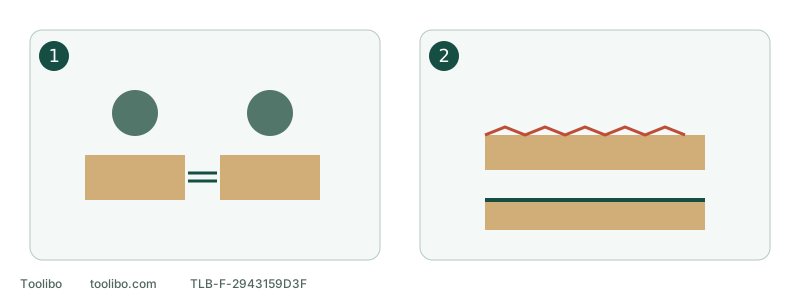
1. Comparable inputs
Identify material, abrasive condition, configuration and timing.
2. Separate surface acceptance
More removal with deeper grooves is not automatically faster task completion.
Matched specimens and abrasives do not make removal and surface quality the same result; the sketch contains no measured winner.
Models referenced