
Clamps need extra paper at the ends
The side views illustrate clamping allowance, not a cutting template or exact machine geometry.
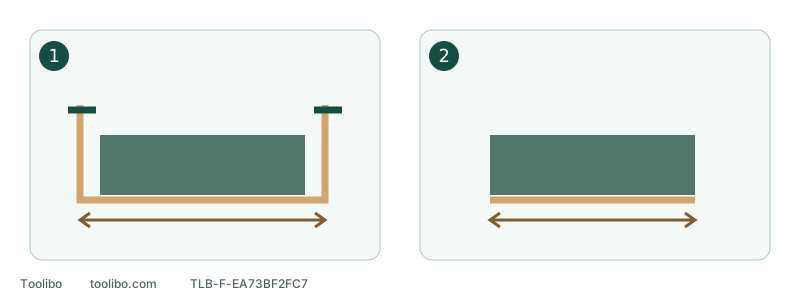
1. Clamped sheet
GSS20-40 ordinary paper is 4½ × 5½ inches, including gripping ends.
2. PSA sheet
The specified adhesive sheet is 4½ × 4½ inches; do not use it as the clamped-paper size.
The side views illustrate clamping allowance, not a cutting template or exact machine geometry.
Identify the fitted attachment
Switch off, wait for full stop, then unplug or remove the battery. Read the model and inspect the installed pad: round hook-and-loop disc, clamped paper, approved PSA sheet or continuous belt. Here “pad” means the support directly behind the abrasive, not the paper itself.
Used tools or replacement pads need an actual-system check, not the original box photograph. P120 describes grade, not whether a product fits the machine.
Write five items before buying
Swipe or scroll horizontally to see all columns.
| Item | Record | Common omission |
|---|---|---|
| Format | Round disc, rectangular/triangular sheet or belt | Just writing sandpaper |
| Attachment | Hook-and-loop, approved PSA or clamps | Looking only at face colour |
| Abrasive size | Required diameter, dimensions or width × loop length | Substituting measured pad size |
| Extraction | Hole count and position matching the actual pad | Assuming equal counts mean equal positions |
| Tool identity | Exact model, market and relevant version | Brand or family alone |
Only then select abrasive mineral and grade for the material and operation. A discounted size is not a reason to modify the tool.
A five-inch disc need not have a five-inch pad
The US BO5041 specification lists five-inch, eight-hole hook-and-loop abrasive and a 4⅞-inch pad. Buy the specified abrasive rather than rounding the pad field into another size.
A useful list reads: “US BO5041, five-inch eight-hole hook-and-loop discs, actual holes aligned to pad, grade chosen for this wood process.” ROS20VSC also uses a five-inch hook-and-loop system, but this does not approve every third-party five-inch disc.
Replacement main pads require mounting and version checks too. Matching disc diameter does not prove pad interchangeability. If BO5041’s actual pad differs, identify it first; generic peel-backing wording is not permission to convert it to PSA.
Clamped paper includes the gripping ends
GSS20-40 instructions specify ordinary clamped sheets at 4½ × 5½ inches and PSA sheets at 4½ × 4½ inches. The clamped sheet needs material at both ends; tracing the contact face omits that allowance.
Use the correct clamped-paper size and the tool’s threading, clamp-lock and punch-plate procedure. Do not substitute the shorter PSA dimension. Keep clamp levers latched even when an approved adhesive sheet is used.
Conflicting pad dimensions do not change the separately stated sheet sizes. Do not use the disputed pad field as a cutting template. If actual structure or model differs, stop and verify rather than force clamps or trim away needed allowance.
Belts use width and complete circumference
Makita 9403 takes a 4 × 24-inch belt: width and full closed-loop length, not the flat section between rollers. Equal width with a different length is not an acceptable near match.
Match size first, then material suitability, grade and seam condition. Do not copy a neighboring Makita model. Direction and tracking require their own checks; torn edges or a damaged seam are not candidates for a trial run.
Inspect delivery with power isolated
Compare packaging and shopping list, then inspect actual fit with the tool stopped and disconnected. Discs must lie centered and flat with the correct openings, no curls, bulges or extra layers. Clamp sheets by the procedure, not by stretching an incorrect size. Use the correct factory belt, not a cut-and-joined improvisation.
Poor retention, blocked holes, pad damage or uncertain dimensions means keep the tool out of use until corrected. Do not spin loose paper flat, add glue, drill or trim backing arbitrarily. Attachment, support and extraction all need to work together.
Models referenced