
Two holders, separate pad limits and power
Two panels show FEIN AMM 300 Plus 12 V clip-in, small-triangle 4–6 and larger-pad maximum 4; Metabo Q SL CAS 18 V quarter-turn spring pin and separate 150 mm maximum 8.
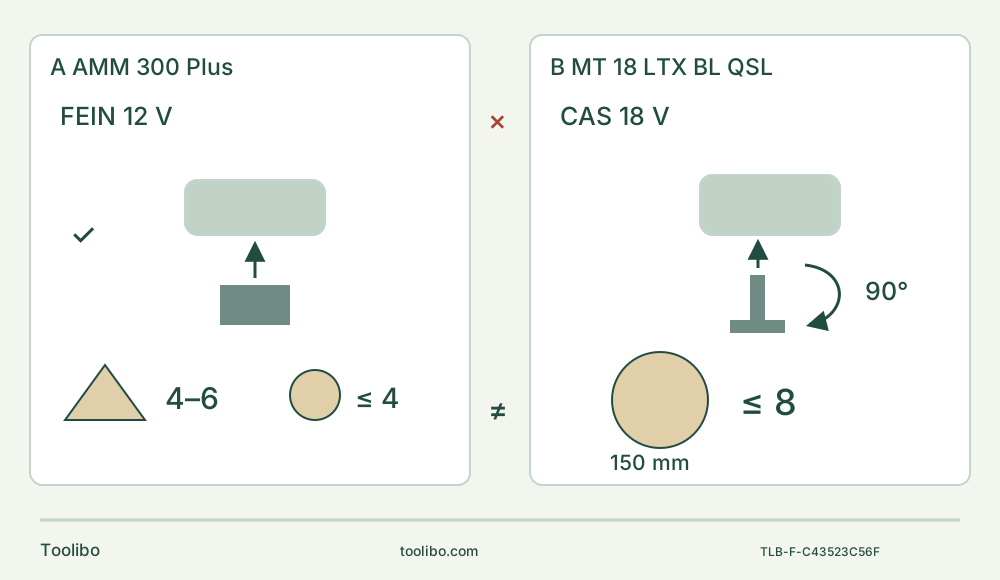
A · FEIN: reset, clip and select by pad
Use exact released FEIN accessories with the jaws in their closed starting state. Small triangles use 4–6; round and large triangles are limited to 4, with the separate named heavy-accessory exception preserved.
B · Metabo: finish the pin and dust system
Seat the approved accessory on the cams, insert the pin, turn it 90 degrees clockwise and close the lever against the housing. The 150 mm pad limit is 8; triangular-only extraction is not automatically a round-pad dust solution.
Original schematic. Both mounting actions require battery removal. The Metabo 90-degree arrow is the inserted spring pin’s clockwise turn, not a blade twist. FEIN’s circle represents the general round-pad limit; the specific heavy 115 mm exception still requires its narrower assessment. The values are model-specific dial limits, not equivalent frequencies or performance rankings.
A shared Plus tier does not make one sanding system
The useful comparison between FEIN AMM 300 Plus and Metabo MT 18 LTX BL Q SL is not simply whether both accept a StarlockPlus attachment. It is whether an owner can assemble, control and finish a particular sanding job with the exact holder, power system, pad and dust arrangement. This guide produces a complete choose-or-hold decision for a small clean-wood surface, then explains why a request for a larger round pad must be assessed separately.
The FEIN scope is US AMM 300 Plus Select 71293262090, the 12 V body with manual 3 41 01 329 21 0 dated 2023-03-28. It is not an AMM 500/700 AS or an 18 V AMPShare tool. The Metabo scope is the Austrian Q SL identity 613088840 / service type 13088000 with the matched 0323 instructions and general safety supplement. It is not the older non-QSL MT 18 LTX. Match each physical machine and its supplied documents; these sources do not establish current stock, kit contents, comparative runtime or measured finish quality.
Begin with the surface, not with the largest pad
Choose a loose, known, uncoated softwood sample with a small flat surface and visible edges. A small triangular pad must reach the intended area without striking clamps or hardware. Clamp the stock to a stable bench, support it against rocking and identify an accessible path for the pad, hands and extraction hose. Unknown paint, filler, treated wood or hidden contamination changes the dust assessment and puts this ordinary-wood comparison on hold.
For each proposed tool, write down the exact approved pad, matching paper, mounting parts, suitable dust control and already commissioned power system. A pad whose centre fits is not necessarily approved for the material, permitted size or operating setting. Do not choose a larger pad just because it appears to cover the sample faster; its pressure distribution, edge access and manufacturer limits are a separate decision. No removal-rate or time saving is claimed here.
FEIN: clip-in seating with a defined reset
The exact FEIN product identifies a StarlockPlus holder for FEIN Starlock and StarlockPlus accessories. Its manual limits use to original FEIN application tools specifically intended and released for the task. Do not infer StarlockMax or arbitrary cross-brand approval from the holder name.
Remove the battery before assembly. Clean the holder and accessory. The starting jaws should be together so the accessory can clip into place. If they are already open before insertion, move the clamping lever forward and back to reset them together; do not energize the mechanism to reset it. Align the attachment straight, clip it fully into the holder and check retention while isolated.
For repositioning or ejection, follow the full lever movement to the stop and return to the starting position shown in the manual, including the illustrated 180-degree movement. The attachment may be positioned in 30-degree increments. Control the released part above a safe surface and protect against sharp edges and heat. Do not reach into the jaws, operate the lever while running, start with the lever open or run with open jaws and no attachment. A failed reset or insecure seating is a service/identity problem, not an invitation to force the pad.
This route suits a documented small FEIN pad system when the owner can reliably distinguish the ready-to-clip starting state from the released state. It offers no basis for a claim that the mechanism is faster, stronger or immune to contamination compared with Metabo.
Metabo: the removable spring pin must be completed
The exact Q SL manual permits Starlock and StarlockPlus, not StarlockMax. With the battery removed, swing the clamping lever forward 180 degrees. Turn the spring pin slightly counterclockwise and remove it. Position the correct attachment so it engages the holder cams. Insert the spring pin, turn it 90 degrees clockwise, then close and engage the lever to its stop, in contact with the housing. Finally check firm retention.
This is not the FEIN clip-in sequence. The quarter turn and housing-contact check cannot be omitted because the attachment appears seated. Nor is the spring pin a generic threaded accessory bolt to be tightened with an invented torque. Keep fingers out of the lever’s spring-back path and wear protective gloves for sharp or hot accessories. Missing pins, damaged cams or a lever that will not close fully require a hold and qualified help.
For triangular sanding, Metabo describes its dust extraction attachment on the housing flange, fixed in the desired position with its screw. The suction adapter accepts the illustrated 28 mm connection; connect a suitable extraction device. Align the paper holes with the pad. The manual explicitly scopes this extraction fitting to the triangular sanding plate. Do not claim it captures dust with a saw blade or automatically transfers to a round pad.
Worked choice: a small bare-wood face
If the owner already has an approved FEIN small triangular pad, suitable paper, dust controls and commissioned B12A system, that is a complete candidate. The FEIN manual specifies electronic levels 4–6 for small triangular sanding plates. The overall tool range is 11,500–18,000 oscillations per minute, but it does not provide a frequency conversion for every intermediate setting. A lower restriction on the exact accessory still applies.
If instead the owner has a complete Q SL triangular assembly and its approved 18 V system, Metabo is a separate complete candidate. Its manual asks the user to establish the suitable sanding setting on a sample rather than borrowing FEIN’s numbered 4–6 prescription. The Q SL range is 8,000–20,000 oscillations per minute. Neither the highest number nor the shared Plus tier proves a better surface or greater usable removal rate.
Choose the system whose actual components and dust arrangements close the defined task. If FEIN has a qualified pad but no suitable dust solution, or Metabo lacks its spring pin, the otherwise compatible holder does not make that system ready. Obtain the missing parts or evidence first. Do not combine one brand’s holder, the other’s pin or an improvised extraction ring to complete the list.
Why a round-pad request is a new decision
FEIN limits its round and large triangular sanding plates to a moderate setting, maximum level 4. It additionally identifies heavy round plate 63806195210, diameter 115 mm, and tile-joint cleaning kit 63719011220 as possible overloads for the vibration-damping system. For the specific intense, unpleasant vibration described with those accessories, the manual specifies level 2 and says suitability remains limited. This is not a universal cure for unexplained vibration or a loose attachment. A damaged or insecure system must be stopped, not merely slowed down.
Metabo separately limits a 150 mm sanding plate to a maximum setting of 8. That number is not equivalent to FEIN level 4, does not authorize fitting the FEIN 115 mm plate, and does not show that Metabo removes material twice as fast. The 150 mm limit is also not proof that the triangular-only extraction attachment will work with that plate.
Suppose the requested job changes from a small corner to a broad face and the owner wants a round pad. The decision is to identify an approved model-specific round pad, its speed limit, dust solution and safe clearance before proceeding. If only the small-triangle system is complete, retain it for the small task or hold the larger task. Do not stretch its approval by changing the pad and preserving an old setting. Another sanding tool may ultimately suit the broad job, but these two manuals alone do not establish that broader comparison.
Keep the power and fault languages separate
FEIN’s matched system is B12A, 12 V, with the listed compatible ALG 30, ALG 50 or ALG 80 charger under the actual charger instructions. This guide assumes that exact owner system is already commissioned; it supplies no mains-input or charging tutorial. A green one-to-four-LED indication describes charge. Continuous red means almost empty; flashing red means not ready for operation, requiring the documented battery-temperature condition and qualified charging process. Read actual charge with the motor stopped. These are not Metabo’s tool-light signals.
Metabo uses its original approved 18 V Metabo/CAS system with the exact matching battery and charger instructions. For example, the already documented 625367000 pack and an approved listed charger remain an owner-document qualification, not a current kit promise. Do not put a FEIN 12 V pack into a CAS system or assume a different FEIN model’s AMPShare label changes this AMM 300.
On Q SL, one flashing pack LED can mean nearly empty, while the tool not running with its own LED flashing indicates restart protection. Insertion with the switch ON requires OFF then ON to release that inhibition; it never permits intentional ON insertion. Sustained overload can cause thermal cutoff. Let the tool or pack cool; the manual’s idling-cooling note applies only when normal operation is actually possible and must not override a protective shutdown. None of these events is a reason to repeatedly force a restart. Persistent faults or suspect packs go to qualified service.
Execute one supported sample and accept the result
Use the selected model’s complete safety instructions, proper eye/hearing and respiratory protection, suitable dust extraction and a controlled grip with vents clear. Keep the stock clamped, bystanders clear and hands away from the moving pad. Both bodies use a forward-running slide switch and a rearward OFF action; remove the battery for changes, inspection and cleaning, regardless of lamp or switch position.
For FEIN only, preserve the manual’s specific sheet-adhesion step after hand fitting: press the paper-equipped pad briefly and firmly against a flat secured surface and briefly switch on. This narrow step is not a powered test of an uncertain attachment or permission to run the machine unattended. For normal work, start the properly assembled tool before guiding it toward the sample. Use the whole sanding face, continuous movement and moderate pressure. Do not lean on a corner to hurry removal.
For the Metabo sample, use its correct isolated spring-pin assembly and triangular extraction setup, start before contacting the work and use moderate pressure with back-and-forth movement. Select the setting through a controlled sample trial, not a deliberate overload. If dust capture fails, the stock shifts, a pad catches or vibration becomes abnormal, stop and isolate before correcting the setup.
End the pass, switch OFF and wait for complete stop before laying down. Remove the battery before close inspection. Accept only an even intended surface without unwanted rounding, gouges, scorching or evidence of stock movement. Otherwise reject the pass and correct support, abrasive, setting or pressure before another sample; no invented flatness tolerance is supplied. Keep each complete system and its instructions together, clean vents and components by the matched procedure, and refer damaged holders or persistent faults to qualified service.
The final record should say which exact model and pad completed the small task, what remains on hold for a larger pad, and which mounting and power actions cannot transfer. That is a useful Plus-holder decision—not a claim that common accessory branding makes two different regional, voltage and clamping systems interchangeable.
Models referenced