
A bounded class map, not a universal-fit certificate
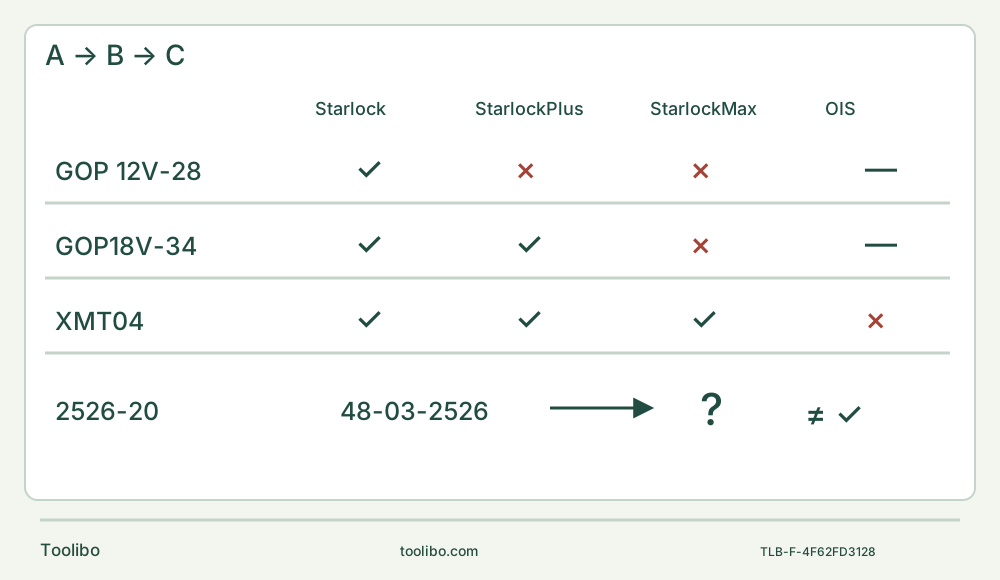
One matrix compares Starlock, StarlockPlus, StarlockMax and OIS across exact GOP 12V-28, GOP18V-34 and XMT04 examples; a separate 2526-20 adapter row ends with a question mark rather than approval.
Read the whole bounded matrix
GOP12 permits Starlock only; GOP18V-34 permits its OSL/OSP ranges, not OSM; US XMT04 permits the three Starlock classes but not OIS. Confirm accessory purpose/rating and the exact retaining parts separately. The 2526 adapter row remains unresolved unless the actual illustrated profile and recommended accessory match.
A → B → C refers to the article’s identity, purpose and required-parts gates, not three separate panels. Checks are conditional class permissions, crosses exclusions; Bosch OIS dashes are not approvals. XMT04 is US only. Adapter 48-03-2526 is limited to the two actual arbor profiles in its matched manual, not a universal conversion.
End with a complete purchase list, not a compatibility guess
This guide helps an existing oscillating-tool owner decide what to order for one known job. Its output is a documented accessory-and-required-parts list, or a decision to hold the purchase until compatibility is resolved. It does not test fit, rank shops or promise that a blade will work because it can be pressed onto a holder.
Start with a modest, visible task on known material, such as an edge-start cut in a clamped untreated softwood sample. Write down the cut’s approach, the clearance below the stock and how the waste will be supported. If the job is actually long straight cutting, unknown installed work or contaminated coating removal, resolve the tool and hazard choice first. A wider catalogue does not make every task a good oscillating-tool task.
The bounded map uses four exact bodies: UK Bosch GOP 12V-28 under E66 dated June 2026; US Bosch GOP18V-34 under its March 2023 manual; US Makita XMT04 under 885866-944; and US Milwaukee 2526-20 under its matched 58-14-2526d2 manual. They illustrate class limits and a narrowly documented adapter route. No other regional model or similarly named tool is silently included.
Gate A: identify the body and allowed interface
Record the actual model, regional label and manual revision before searching accessory listings. Keep the owner’s complete assembly instructions open alongside the catalogue. “Bosch,” “Makita,” “12 V” or “universal multitool blade” is not a sufficiently precise identifier.
The upper three rows of the figure answer only an interface-class question:
- GOP 12V-28 UK: Starlock is allowed. StarlockPlus and StarlockMax are not. This body uses a hex clamping bolt; do not order on the assumption that it is the GOP18V-34 snap-in mechanism.
- GOP18V-34 US: the manual’s OSL and OSP ranges are allowed; OSM is not. The matched Starlock/StarlockPlus accessory is installed by pressing the tool into it until the jaws snap in, not by adding a generic bolt.
- XMT04 US: Starlock, StarlockPlus and StarlockMax are allowed; OIS is prohibited. The tool uses a removable holder bolt that must be fully inserted before the lever returns. The row does not assert UK DTM52 equivalence.
The dashes in the Bosch OIS column are not approvals. This map makes no OIS purchasing recommendation for those rows; use only the explicitly documented approved route. A check mark also remains conditional on the specific manufacturer’s accessory recommendation, material purpose, rating and complete assembly. It is not a blanket endorsement of every third-party item bearing a class name.
Gate B: prove the accessory can do this particular job
Once the class passes, check the exact accessory identifier, its permitted materials, purpose and operating limits. A wood blade, a metal blade, a scraper and a sanding pad may share a holder while performing very different work. Photograph or save the product label and instructions, including any operating-speed limitation, before ordering. If a listing does not provide those facts, ask the manufacturer rather than inferring them from tooth colour or a reseller’s “fits all” badge.
For the known-softwood example, the current GOP12 E66 table explicitly lists AIZ 32 EPC for softwood. That is evidence for the stated material and accessory, not permission to cut concealed screws or unknown composite stock. The US GOP18V-34 manual separately names Bosch accessories and requires a rating of at least 21,000 OPM. Do not substitute the tool’s 20,000 no-load figure for that accessory requirement. Makita and Milwaukee likewise require accessories specifically designed or recommended for their exact tool; class acceptance alone is not the full selection.
Check geometry as well as the label. A narrow plunge-style blade can approach a short cut differently from a wider segment blade. Draw the entire moving envelope, not only the tooth tip at the marked line. Can the holder and body reach the intended position while your hands stay clear? Will the blade strike the bench or a clamp on breakthrough? Can the waste remain supported without closing the cut? Do not buy a longer blade to compensate for an unseen exit face or use sideways bending as a clearance solution. A catalogue dimension is not a guaranteed usable cutting depth in your assembly.
Keep speed rules with the chosen tool. Current GOP12 E66 recommends wood sawing up to setting 6 and limits sanding, RIFF, plastic and metal to 4, subject to lower accessory limits. Those dial numbers are not a cross-brand standard. The XMT04 cutting recommendation of 4–6 belongs to its own dial and instructions, while Milwaukee 2526-20 has a different scale. The purchase record should state the source-specific limit, not merge numbers into a universal recipe.
Gate C: include every required mounting part
A suitable blade alone may not complete the system. Inventory the exact original clamping bolt, flange, removable holder bolt, key or specified adapter required by the body. Determine whether the offered accessory includes those parts; do not assume the photograph shows everything in the package. A missing proprietary part is a separate sourcing question, not a reason to insert a household washer.
The Milwaukee exception is deliberately narrow. Its manual says blade adapter 48-03-2526 is required for the two arbor profiles actually illustrated on the assembly page. It also warns to use accessories specifically recommended for the tool. The adapter number therefore does not certify every closed centre, every star-shaped opening or every Starlock tier. Compare the actual accessory geometry with the original illustration and its own approval evidence; if the correspondence is uncertain, pause and ask Milwaukee. The question mark in the figure means “not established,” not “try it under power.”
For normal 2526-20 assembly, the pack is removed, the quick-release lever is pushed forward over its detent, the tool is turned over and the accessory bolt is unscrewed. Clean mating parts, fit the approved accessory and any specifically required adapter, hand-tighten the bolt securely and return the lever. That sequence cannot be transplanted to the XMT04’s insert-to-stop holder bolt or the GOP18V-34 snap-in jaws. Buying the right part includes knowing the right retention method.
Add dust control and power prerequisites without confusing them with fit
If the intended job is sanding, the list must include more than pad and abrasive. Match the pad, abrasive dimensions and extraction holes; then identify the exact compatible extraction attachment, hose/adapters and suitable extractor. Current GOP12 E66 requires extraction for every sanding operation and at least 230 mbar and 36 l/s at the tool connection. Its sanding attachment is not a saw-blade hood. These requirements cannot be silently replaced with another model’s lower figures or a vacuum’s advertised motor power.
The XMT04 optional extraction attachment is for sanding and must not be used when sanding metal because sparks and hot particles can cause ignition. A class-compatible sanding pad therefore does not prove a dust configuration is suitable for every material. If the extraction route or abrasive/material approval is incomplete, keep that project on hold instead of treating the missing equipment as an optional extra.
Power is another independent prerequisite. Confirm the existing genuine approved battery and charger under the actual owner documents. An accessory purchase does not establish a new battery/charger pairing, regional voltage compatibility or safe charging practice. Do not add an unidentified “compatible” charger merely to make a discounted accessory bundle appear complete.
Inspect the delivered system while isolated
Before handling the received accessory, switch OFF and remove the battery; allow any previously used parts to cool. Compare the delivered identifier and mounting shape with the saved order evidence. Reject damage, missing parts or unexplained substitutions. Use the full matched assembly instructions, not this overview alone, and protect hands from sharp edges.
Verify that the accessory seats correctly and that its specified retention mechanism reaches the required finished state. An isolated assembly check is necessary owner work, but it does not prove that an undocumented accessory is approved. Conversely, a documented compatible product can still be damaged or incorrectly assembled. Do not grind the opening, file holder cams, force a lever, stack washers or perform a powered wobble test to overcome either problem. A damaged holder requires qualified service; a disputed part should be resolved with the supplier or manufacturer before use.
Make one of three purchasing decisions
Order the complete documented set when body identity, exact accessory purpose and rating, allowed interface, required fastening parts, task clearance and relevant dust arrangements are all established. Keep an itemized record of the identifiers and source limits. This authorizes procurement, not immediate operation: follow the complete owner workflow and prove the first known-material sample acceptable before valuable work.
Hold and obtain evidence when a necessary fact is missing, such as an adapter-profile match, original fastener availability, installed extraction performance or a regional manual. State the precise unresolved question and seek manufacturer or qualified-service guidance. A vague seller assurance is not a completed gate.
Reject that accessory route or change the task/tool when the class is prohibited, the material is unapproved, the approach is unsafe or proper assembly would require improvisation. Buying fewer correct components is better than buying a large mixed box whose most important compatibility question remains unanswered.
Models referenced