
Four checks before calling a budget complete
A task document, inventory rows, a connected system evidence record and separate subtotal and hold boxes.
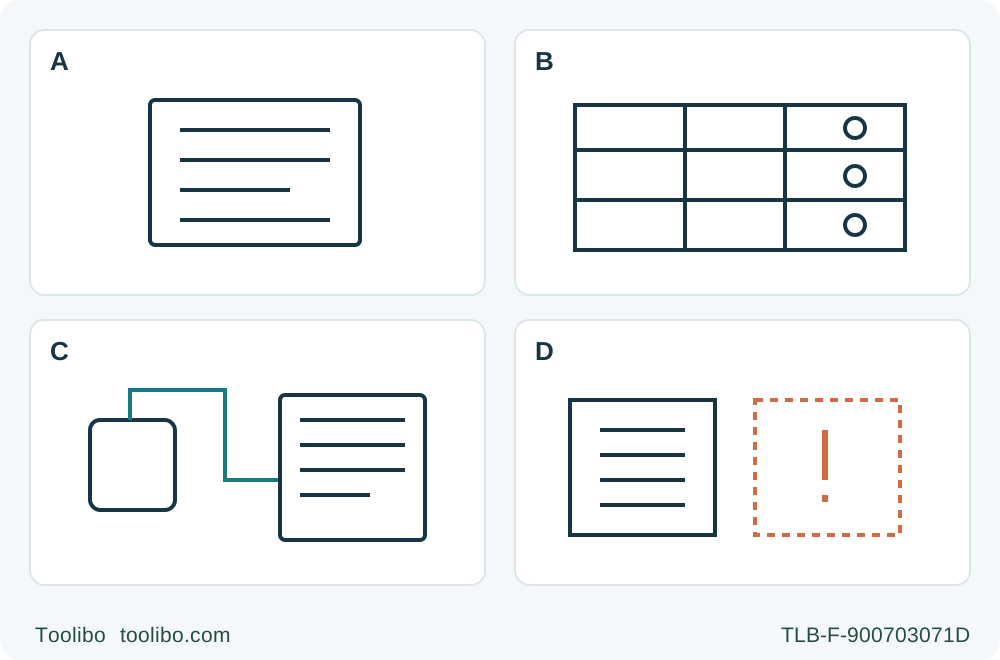
A · Define one exact task
Record material, cut, location, actual model and complete instructions before listing accessories.
B · Qualify the inventory
Distinguish verified reuse, required missing items and genuine optional convenience. Inspect only with the cord unplugged or battery removed.
C · Close system dependencies
For the GKS example, qualify the actual connected extraction arrangement at the tool; physical hose fit and a vacuum headline are not enough.
D · Keep money and holds separate
Sum dated qualified quotes and applicable charges; record unresolved prerequisites separately rather than treating them as free.
Conceptual planning symbols, not an accessory fitting diagram or a priced shopping list. The system row requires model-specific evidence; a hose symbol does not establish suction performance. Required unpriced items remain holds and are not included as zero-cost completion. The worksheet gives a plan, not permission to cut.
A saw’s advertised price is not the cost of a usable cutting arrangement. You may already own some of the required equipment, but “already owned” and “qualified for this task” are different entries. This worksheet separates verified reuse, missing prerequisites, optional convenience and unresolved compatibility before you add any prices.
The outcome is a priced readiness ledger for one known, loose-wood, square-cut task—not a recommended shopping basket. Two documented examples show why the details matter: the US Makita 5007MG under manual 884671-946, and the UK Bosch GKS 12V-26, product 06016A1001/type 3601FA1001, under D1R. They are separate systems, not interchangeable regional choices. This article contains no live cutting, battery charging, blade fitting or extractor commissioning procedure.
Define the job and the inventory boundary
Write the material, dimensions, required cut and intended location at the top of the ledger. Confirm that the material is known, free of hidden fasteners and within the actual saw and installed wood blade’s documented scope. Do not begin with “buy every accessory for this saw.” A one-off supported straight cut and a repeated rail-guided task have different prerequisites; adding a rail to this ledger does not establish a rail workflow.
Record the actual model, region, manual and present condition. This planning exercise assumes a correctly assembled original blade, washers, guard and controls. If those are uncertain, add a separate hold for documentation or qualified correction. Buying a new blade is not an automatic solution to an unexplained assembly problem, and a low price does not justify an improvised bore reducer or replacement washer.
Take stock with the 5007MG unplugged or the GKS battery removed. Do not energize either tool to identify accessories. List what is physically present, not what an old product photo shows. For a cordless offer, verify the actual carton or written configuration rather than assuming battery and charger inclusion. The Bosch manual explicitly notes that some tools are sold without a battery. This ledger makes no kit promise.
Give every row a requirement and a status
Use these columns: item or service; purpose for this task; exact compatibility evidence; quantity; already available; required new quantity; dated unit quote; delivery or other applicable quoted charges; status. Put the source of each quote in your private record so that you can check it again before buying. Prices, taxes and availability are not supplied here.
Assign one of four statuses. “Verified reuse” means an existing item is suitable, in acceptable condition and available when needed. “Required, missing” means the task cannot proceed without obtaining or otherwise qualifying it. “Optional” means the documented task remains complete without it. “Hold” means identity, condition or compatibility is unresolved. A hold is not a zero-price item and must not disappear when you calculate the subtotal.
A borrowed item can be reusable without being free of planning work. Confirm availability for the whole task, its complete instructions and its condition. Do not count one clamp twice because it appears in two rows, or assume the only extension lead can serve incompatible simultaneous needs. Quantities follow the actual supported arrangement; this guide invents no universal number of clamps or support load rating.
Fund the workholding and measurement, not just the blade
The 5007MG instructions require practical secure workholding, suitable support and a rip fence or straightedge for ripping. Its panel figures place supports near the cut and panel edges, with the saw on the larger retained portion. Translate those requirements into a layout before pricing a bench, clamps or guide. Secure the retained work; support both portions outside the blade path; allow waste to separate without closing the kerf. Do not clamp the two sides together across the intended cut.
Check whether existing supports provide a stable arrangement through separation and whether the planned guide and clamp bodies clear the whole tool path. A support that is adequate for a small sample is not automatically adequate for a long panel. If you cannot establish the arrangement, leave the operation held rather than assigning an invented load capacity to household furniture.
Measurement and marking also need rows: the actual means of checking thickness, length, square and guide position, plus suitable sample material for verifying the cut. These are workflow requirements, not endorsements of particular measuring products. A documented guide can be reusable; a guide-to-kerf offset must still be established for the actual assembly and contact side. Paying for a straighter-looking rail does not prove it fits an ordinary circular-saw base.
Keep power and dust-system costs model-specific
For the corded Makita, first qualify the actual nameplate supply and cord route. If a direct suitable supply is unavailable, treat an extension lead as a separate compatibility question under the complete manual table and actual length/current conditions. Do not price an arbitrary long lead and assume the requirement is closed. This article does not give a wiring or extension-sizing recipe.
For the Bosch example, the power row remains an already commissioned genuine battery/charger system with its complete matching instructions. An unqualified pack or missing charging documentation is a hold, not permission to buy anything marked 12 V. New charging setup lies outside this worksheet and the existing bounded owner workflow. Record the cost of obtaining qualified advice or an established system if that is what remains unresolved; do not invent a reciprocal approval from a connector that fits.
The Bosch’s extraction row is especially important. The selected D1R owner workflow uses connected external extraction. Its table requires at least 230 mbar vacuum pressure and 36 L/s flow at the power tool’s extraction connection, not merely at the vacuum or in a free-air headline. It recommends 35 mm nominal hose and dust-class M filtration. Separately, the adapter can accept a 19 mm hose. Physical fit, recommended hose size and installed performance are different checks.
Therefore the row must identify the extractor, hose, intended adapter and evidence for the actual installation. Do not close it by buying an unverified reducer stack or copying a vacuum’s maximum rating. The specific adapter requires connected external extraction and permits no dust bag. Obtain the complete system instructions and appropriate confirmation; this article gives no improvised measurement or commissioning method. If confirmation is unavailable, leave the Bosch operation held even if every component has a price.
Do not copy those Bosch numeric requirements onto the Makita as if they were universal. For each actual system, plan the documented dust measures, suitable ventilation and appropriate respiratory protection. Eye and hearing protection, safe footing and clearance for other people belong in the readiness plan as well. A blower that clears a sightline is not proof of dust capture, and protective equipment does not replace workholding or control of hazardous material.
Price only what has been qualified
For each purchasable row, multiply the required new quantity by the current quoted unit cost. Sum those line totals, then add applicable quoted delivery, tax or service charges once. Keep optional items in a separate subtotal. If an existing compatible item is reused, record zero new purchase quantity rather than pretending its identity and condition do not matter.
Check the arithmetic with units. Two required units at a quoted amount Q each produce 2 × Q, not Q. A pack price is not a per-item price unless the offer says so. If a bundle contains an already counted item, reconcile the quantities before adding it. Do not subtract a hoped-for resale value or an unconfirmed promotion from the amount required to complete the task.
Next count unresolved holds separately from money. “Known required subtotal, with one unpriced extraction hold” is honest; “complete setup total” is not. No contingency allowance can turn incompatible equipment into a qualified system. If the known subtotal exceeds what you want to spend, postpone the job or obtain a separately qualified alternative arrangement. Do not move a required guard, support, protective measure or power-system condition into the optional column to make the total look affordable.
Close the ledger before moving to the owner workflow
Review the ledger against the physical inventory and exact instructions. Every required row needs verified reuse or a qualified acquisition plan, not merely a number. Every optional row must truly be optional for this task. Record remaining holds, who will resolve them and what evidence will close them. Keep the quote date and the exact intended configuration together so that a later substitution triggers another check.
The worksheet is complete when it gives one of two clear outcomes: a fully identified, costed plan ready for the model-specific setup and sample checks, or a priced partial plan with explicit reasons not to proceed. Receipt of a parcel is not acceptance of the tool system. Before use, condition, original assembly, support, clearances and actual performance still require the complete owner workflow. The saving this ledger aims for is avoiding an unusable or incomplete purchase—not finding a cheaper way around a required condition.
Models referenced