
Identity, isolation, guarding and the decision boundary
A records a 5007MG identity example; B shows a physically disconnected connector; C depicts the lower guard and base as isolated inspection subjects; D combines inspection with a rejection mark for unresolved defects.
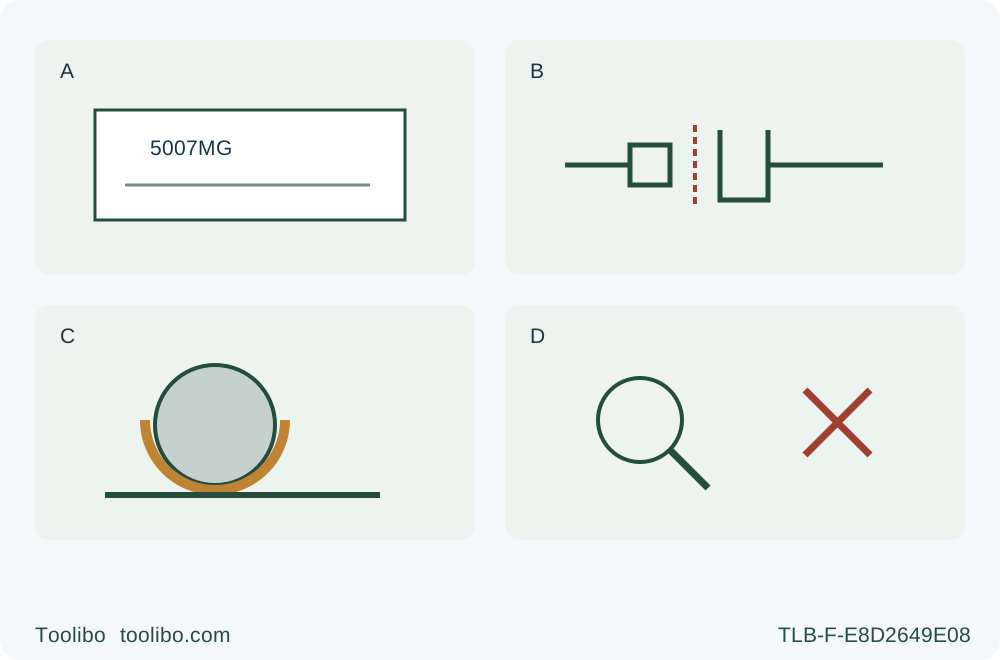
A · Match the complete identity
Record actual nameplate, full suffix and exact manual. An MGA-only brake claim cannot be transferred to an MG, and a shared 5903R manual still requires the correct model row.
B · Keep power disconnected
Keep the plug physically separated and under control for permitted external checks; a switch or dark lamp is not isolation. No powered fault test is included.
C · Inspect without defeating protection
Under the exact isolated instructions, check free guard closure and external controls; uncertain blade, flange or 5903R knife relationships remain a hold, not a driveway repair.
D · Write a bounded outcome
Record reject, hold with required evidence, or consider subject to separate commissioning. No outcome certifies hidden condition or establishes recall clearance.
The figure is a decision aid, not a test sequence that ends with permission to run. A is only an identity example, not a claim that all illustrated features belong to an MG. B requires visible physical disconnection. C does not instruct touching teeth or dismantling guards. D means an unresolved stop finding blocks acceptance; it is not a diagnosis or repair instruction.
A used circular saw can look complete while its identity, guard or blade assembly remains unresolved. This guide produces a pre-purchase decision sheet: reject the offered condition, hold for specific evidence or qualified correction, or consider the purchase subject to separate commissioning. It does not certify a saw safe, estimate its remaining life or turn a seller’s demonstration into an inspection.
The worked examples are the document-matched Makita 5007MG and 5007MGA under manual 884671-946, and the 5903R under 884364M224. They expose three different questions: whether the actual suffix matches a claimed feature, whether the lower guard still performs its job, and whether a riving-knife system has the correct original blade relationship. Their voltages, blade dimensions and service details are not interchangeable. For another saw, obtain its exact instructions rather than borrowing these numbers.
1. Define the purchase before meeting the seller
Write down the intended task and what you can actually support: ordinary known wood, an appropriate stable work surface, a suitable electrical supply, the necessary protective equipment and the ability to obtain qualified service. A low asking price is not useful if the tool cannot be identified or commissioned for that task. This is a condition-and-document decision, not a performance comparison between large and small saws.
Ask for clear photographs of the complete machine, both sides of the nameplate, the plug and full cord, the base, the guard and the visible blade markings. Request the complete manual, not just a specification screenshot. Ask what was replaced or repaired, who did the work, whether the tool was dropped, and whether the seller has noticed sticking, unexpected starting, abnormal vibration or slow stopping. Treat these answers as history to investigate, not verified measurements.
Record exactly what is included. A loose flange, a miscellaneous bolt, a spare blade with the same outer diameter or an accessory from a different model is not proof of compatibility. Ask for service paperwork where repair is claimed. Do not assume an old receipt establishes the present assembly, or that a new-looking blade erases damage to the saw.
If a model or serial range is subject to a current manufacturer safety notice, its applicability and remedy must be resolved before purchase for use. Check the actual identity against current manufacturer and relevant official recall information, or ask the manufacturer when identification is unclear. This article does not report a recall search or make a no-recall claim for any example. An absent label cannot be replaced by an assumption that no notice applies.
2. Build an identity row, not a visual guess
At the meeting, compare the photographed tool with the one offered. Transcribe the manufacturer, full model including suffix, identifying numbers, electrical nameplate information and manual code. Note differences rather than explaining them away. A replacement housing label, unreadable plate or mixed set of instructions is a hold until the manufacturer or qualified service source can establish applicability.
The 5007MG and 5007MGA share a manual, but its electric-brake section is expressly for the MGA. An MG is not a faulty MGA merely because it lacks that documented feature; equally, an MG listing does not acquire an electric brake because the seller has copied MGA advertising. If brake operation is important to the purchase, exact model identity is a prerequisite, not a detail to settle after paying.
The 5903R manual also covers other models. Read the 5903R row and its own diagrams. Its two bevel clamping screws must not be confused with the different arrangement described for 5143R. Match the actual voltage on the nameplate; a familiar model name or a plug that fits your outlet is not enough to establish electrical suitability. Do not fit an adapter or alter a plug during the inspection to make a mismatched tool run.
A useful identity row ends with a source for each claim: nameplate photograph, exact manual page, service record or unresolved seller statement. If the essential rows remain unresolved, stop before handling controls or discussing a trial cut.
3. Establish physical isolation and limit the inspection
Ask permission to inspect the external condition with the saw switched off and its plug physically disconnected. Keep the disconnected plug visible and under control so nobody reconnects it while you are checking the tool. A switch in OFF, a dark work lamp or a seller’s assurance that the socket is dead is not the required isolation. If safe isolation cannot be established, do not continue.
Use a stable clear surface and good light. Keep fingers away from the teeth and the blade’s path. Do not remove the blade, open the housing, dismantle the switch, loosen the riving knife or take off guards. This is an external, isolated condition screen, not electrical testing or a teardown. If a necessary identification or condition cannot be seen without disassembly, record the limitation and refer it rather than filling the gap by guesswork.
Look along the entire cord and at its entry to the tool and plug. Cuts, crushed insulation, exposed conductors, improvised joints, heat damage or a suspicious modification are stop findings. Do not tape a defect and then accept a powered demonstration. Look for cracked handles, missing fasteners, bent or fractured base sections and evidence that a guard or adjustment has been forced. Cosmetic scratches alone do not establish a dangerous fault, but paint or cleaning cannot establish structural soundness either.
4. Check the guard and external controls without powering up
Follow the exact manual’s isolated lower-guard check, using its retracting lever and keeping clear of the teeth. The guard must move freely and close immediately when released, without interference with the blade or housing. Inspect the spring action and the lever’s clearance. Check the applicable depth and angle settings only within the complete instructions and your competence; if the required range cannot be checked safely at the meeting, mark that portion unverified.
A tied-open guard, a removed return spring, a bent guard, incomplete closure or a lever that strikes the housing is not a bargaining point for immediate use. Both cited manuals require defective guarding to be corrected before operation. A seller who says that sawdust is the only cause has offered a possible explanation, not demonstrated a sound guard. Do not spray a lubricant into an unknown mechanism, grind a rubbing edge or hold the guard open to get through the viewing.
With the tool still unplugged, check that the trigger moves normally and returns to OFF as prescribed. On the 5903R, identify the documented lock-off button as well; do not invent the same control on the MG. A smooth mechanical return does not prove that internal contacts or insulation are sound. A known history of failure to switch off is a repair requirement even if the external trigger now feels normal.
Inspect the depth and bevel locks for missing parts, damage and the ability to secure the setting under the exact instructions. Do not force them or use improvised leverage. The 5903R has front and rear bevel clamps; the MG uses its own lever and stop arrangement. Mark looseness, uncertain locking or a distorted base for qualified assessment. Do not adjust a factory calibration screw to conceal an apparent fault before buying.
5. Treat blade and riving-knife uncertainty as an assembly boundary
Read the visible blade identification without dismantling the assembly. Check that its material purpose, diameter, mounting identity and speed suitability are supported by the actual model instructions. Missing markings or unexplained replacement history are reasons to hold the original-assembly qualification. A blade that looks round and sharp is not proof that the correct washers, bolt or inner flange are present.
For the documented 5903R example, the original 235 mm wood setup is paired with a 2.0 mm riving knife. Its blade body must be no thicker than 1.7 mm and its cutting width at least 2.1 mm. The knife must be straight and correctly positioned; the source diagram shows two separate 1–5 mm relationships, one at the toothed rim and another at the lower edge. Do not collapse them into one guessed gap. If markings, alignment or either clearance cannot be established safely, hold for complete verification by someone qualified to perform it.
A missing or bent knife is not excused by a functioning lower guard: those parts address different conditions. Nor does an MGA electric brake replace its lower guard. This inspection authorizes no knife removal, flange conversion, bolt tightening or protective-function test. The decision is whether the existing assembly can be substantiated, not whether a buyer can improvise a repair in a driveway.
6. Keep powered claims separate from the buying screen
Do not ask the seller to provoke a jam, defeat a guard, make a blind cut or repeatedly start a suspect saw to show that a fault has gone away. No powered test is included here. A video of an unloaded motor, a work lamp illuminating or a short cut through scrap cannot establish every guard, electrical, blade and structural condition.
For the MGA, ask specifically about stopping history and any related service. The manual calls for Makita service when it consistently fails to stop the blade quickly after trigger release; it does not give a universal number of seconds for this buying checklist. A seller’s unexplained brake complaint is not cleared by an isolated visual inspection. Conversely, the MG’s absence of the MGA-only brake should be recorded as model identity, not diagnosed as a broken feature.
Where functional or electrical condition matters but remains unknown, make qualified assessment a condition of proceeding, with any cost and arrangement agreed before purchase. This is a conservative buying boundary, not a claim that every owner task is manufacturer-restricted to a service centre. Do not buy an unverified tool on the assumption that a future repair is cheap, available or guaranteed.
7. Finish with a reasoned decision and a separate commissioning gate
Use one of three outcomes, with written reasons:
- Reject the offered condition for your intended use: defeated guarding, a dangerous modification, damaged cord, an unresolved known switch failure, refusal of safe isolation or identity that cannot credibly be established. A defect is not made acceptable by subtracting money from the price.
- Hold: the model is plausible but an essential document, assembly detail, repair record or qualified condition assessment is missing. State exactly what evidence or correction would reopen consideration; do not label the tool ready while waiting.
- Consider, not cleared to use: identity and the permitted isolated checks are satisfactory, no unresolved stop finding remains, and you can obtain the full instructions and any necessary commissioning or qualified assessment. This is not an electrical certificate or a warranty of hidden condition.
Keep the photographs and a dated sheet separating observed facts, seller statements and unverified items. If the purchase proceeds, transport and store the saw isolated, with the blade guarded and the cord protected. Before first use, complete the exact model’s pre-use checks and a properly supported owner setup; do not treat this purchasing screen as that operating lesson. The useful result is a defensible decision with no hidden assumptions, including the decision to walk away.
Models referenced