
Four gates to a blade purchasing decision
Four panels show machine identity documents, the KS 85 FS 235 × 30 mm and 4,500 RPM machine envelope, separate plate/knife/kerf widths, and reject/question/qualified-record branches.
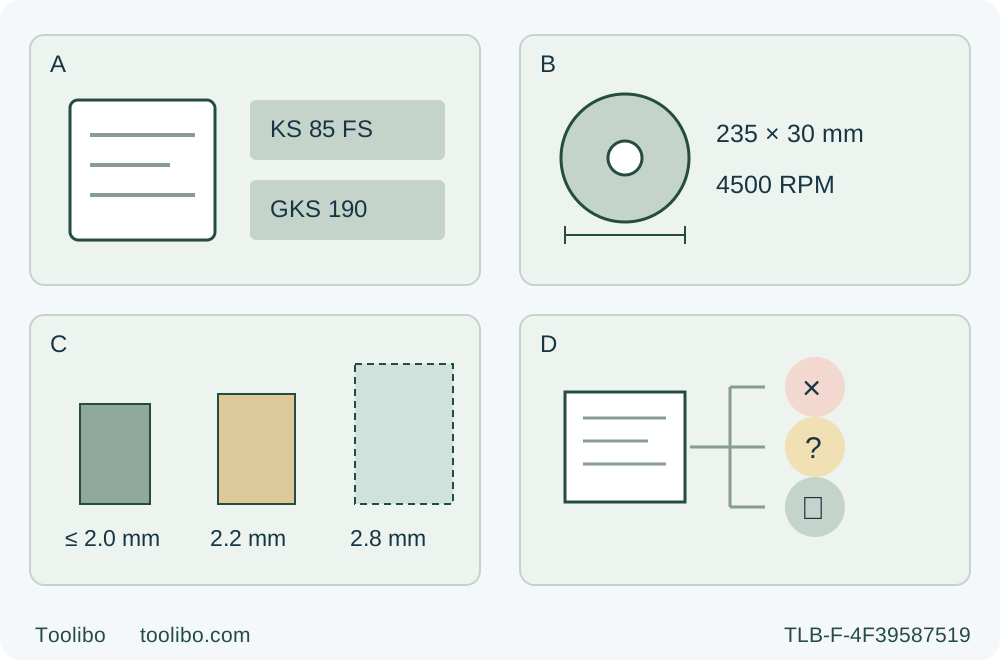
A · Match the actual machine
Record the exact region, nameplate, manual revision and original mounting system; uncertain identity stops selection.
B · Check every blade requirement
Match the required diameter, bore and shape, permitted material and construction, and the manual-specific speed threshold.
C · Keep plate, knife and kerf separate
For the documented KS 85 FS, preserve the maximum 2.0 mm plate, 2.2 mm knife and 2.8 mm kerf relationship; a bore match is not enough.
D · Reject, hold or qualify
Reject a failed gate, hold missing evidence, or qualify the documented purchase for the full matched procedure. D21 installation remains held for direction clarification.
B shows machine specifications, not a blade speed label. C is an unscaled comparison: maximum 2.0 mm plate, 2.2 mm knife and documented 2.8 mm kerf. D qualifies a purchasing record only; any unresolved installation question remains a stop.
Select a replacement, not just a diameter
A blade that enters the guard and slips over the spindle has not passed a compatibility check. Selection must join the exact regional saw, permitted work material, blade construction, diameter, mounting hole, speed rating and any riving-knife relationship. The result is a documented purchasing decision: reject a candidate, hold it for missing evidence, or qualify it for the matched manufacturer’s complete replacement procedure. This is not that procedure and does not authorize operating a newly fitted blade.
The worked machine envelopes are deliberately narrow: Metabo KS 85 FS product 601085000 / service 01085000 with its original 235 × 30 mm regional assembly and 0526 instructions; and UK Bosch GKS 190 order 0601623070 / type 3 601 F23 070, considered under D21 instructions dated 19 September 2025. Do not transfer either envelope to a similarly named regional model. The Bosch document also has an unresolved blade-bolt direction conflict, so even a dimensionally suitable purchase remains on an installation hold.
Build the machine side of the worksheet first
Record the actual nameplate identity, region, supply rating, manual identifier and existing original blade/flange system. Use the manufacturer’s product and service routes to find the matching documents. A shop’s title or the blade already in a used saw is not sufficient evidence: the previous owner may have fitted the wrong part. If the actual identity or original assembly cannot be established, stop and ask the manufacturer or qualified service before choosing a replacement.
Write separate cells for outside diameter, bore size and shape, maximum plate thickness, kerf requirement, riving-knife thickness if fitted, and the blade’s required speed rating. Keep the machine’s no-load speed separate from a blade’s maximum permitted speed. Also record the exact permitted material and blade-construction restrictions. An empty cell means “not yet resolved,” not “unrestricted.” Check the candidate’s manufacturer label and technical data against every cell; do not rely on a seller’s abbreviated size string.
For the documented KS 85 FS assembly, the relevant figures are 235 mm diameter, 30 mm bore, 4,500 rpm no-load speed, maximum 2.0 mm plate, 2.8 mm cutting width and a 2.2 mm riving knife. The manual’s regional table also prints 15.88 mm, but this guide does not turn that into permission to reverse a flange or convert the saw. Its wood blades must be genuine Metabo, suitable for the no-load speed, and conform to EN 847-1. HSS blades, cracked or distorted blades and blades outside the specified rating are excluded. KS 85 FS instructions, pages 3 and 10–14.
For the GKS 190 D21 column covering 3 601 F23 0.0, the table gives a 184–190 mm diameter range, 30 mm bore, maximum 2.0 mm plate and 5,500 rpm no-load speed. The separate 3 601 F23 0.1 column gives different regional dimensions; it is not a menu of alternatives. The UK product specifies the original 190 mm / 30 mm system. Retain that identified system here rather than treating the table range as an instruction to change its geometry. D21 requires the blade to match both manual and tool and to be tested and marked to EN 847-1:2017. HSS blades and abrasive wheels are not permitted; the stated intended cutting use is wood, not ferrous metal. D21, pages 14–16, exact UK product.
Apply the speed and thickness gates without swapping meanings
The saw’s no-load speed describes its spindle; the blade rating is a limit the machine must not exceed. A higher blade rating does not make the saw faster, and a low speed selected for a particular job does not waive the required rating. Use the exact manual’s threshold, not an invented universal margin.
D21 itself uses two formulations on page 16: one requires the blade’s permitted maximum to be higher than the tool’s no-load speed, while another says at least equal to the maximum speed marked on the tool. Preserve both. For the documented 5,500 rpm example, a rating strictly above 5,500 rpm satisfies the stricter wording; a label of exactly 5,500 rpm does not establish that. This is a conservative selection filter, not a correction of Bosch’s document. If the actual tool marking differs, or the requirement remains unclear, ask Bosch rather than choosing the convenient sentence.
Plate thickness is the metal body between the teeth; kerf is the width cut by the teeth. On the KS 85 FS, the plate must be thinner than the 2.2 mm knife and the kerf wider than it. The documented maximum plate of 2.0 mm and cutting width of 2.8 mm satisfy that relationship. Preserve the documented 2.8 mm configuration here; “anything wider than the knife” is not sufficient to establish every other requirement. A thin-kerf label without separate plate and kerf data leaves the worksheet incomplete.
Do not fix a bore mismatch by filing, loose washers or an improvised reducer. Bosch’s 2EP blade leaflet distinguishes prohibited loose-fitting reduction rings from a specified secure-fitting Bosch-ring arrangement, but that is not universal permission to adapt a blade to either saw. The machine’s exact instructions and qualified original mounting system still control. This guide offers no ring, flange or riving-knife conversion. Bosch 2EP blade safety, English pages 4–5.
Use a worked screening example, then finish the evidence
The following are hypothetical worksheet labels, not real products, available SKUs or manufacturer recommendations. They illustrate how an attractive-looking number can fail a different gate. Each is being screened only against the identified KS 85 FS 30 mm system.
Swipe or scroll horizontally to see all columns.
| Hypothetical candidate | Stated label data | Screening result |
|---|---|---|
| A | 235 × 30 mm; plate 2.0 mm; kerf 2.8 mm; maximum 6,000 rpm | Passes these numerical checks only; hold until genuine Metabo identity, EN 847-1 conformity, material suitability and all other evidence are established. |
| B | Same as A except bore 15.88 mm | Reject for this 30 mm system; the regional table is not conversion approval. |
| C | Same as A except maximum 4,000 rpm | Reject: below the saw’s 4,500 rpm no-load speed. |
| D | 235 × 30 mm and maximum 6,000 rpm, but no separate plate or kerf data | Hold: diameter, bore and speed do not close the knife relationship. |
For a real candidate, enter its exact manufacturer identifier, the manufacturer’s stated material and application, the relevant markings and the dated evidence for every cell. Prefer the intended cut description—wood species or panel construction, grain direction and required finish—over a generic “more teeth is better” rule. The Bosch wood-cutting guidance explicitly makes blade choice depend on wood type, quality and with-grain versus across-grain work. There is no universal tooth-count recommendation in this guide, and a wood/metal marketing label cannot expand the saw’s permitted use.
Reject damaged, cracked, distorted or otherwise unserviceable blades regardless of their printed ratings. If the original clamp parts, guard or riving knife are suspect, pause the entire replacement project for qualified assessment; buying a new blade cannot establish that the saw is fit to use. Any close inspection or handling must be at complete standstill with the plug removed, with care for sharp teeth and the manufacturer’s protective-glove instructions. Do not perform a powered trial to resolve uncertain fit.
Close the decision and keep installation separate
Reject when an established requirement is violated: wrong regional bore, unsuitable material or construction, insufficient speed rating, excessive plate thickness, incompatible kerf/knife relationship or visible damage. Do not let a low price or a matching diameter override a failed gate.
Hold when the identity, markings, plate/kerf data, manufacturer approval or original mounting system is unresolved. Write the exact missing question and send it with the tool and blade identifiers to manufacturer support or qualified service. For D21, separately ask for authoritative clarification of the blade-bolt direction: the English text uses direction ② for removal and tightening although Figure A shows opposed arrows. Do not infer a fitting direction from common practice. No current-product link has been established here as proof that D21 is the latest supplied tool manual.
Qualify for the next stage only when the real candidate has evidence for every requirement and no unresolved conflict affects its use. Keep the completed worksheet, actual label and matched documents together. The next stage is the manufacturer’s full replacement, adjustment and protective-system checks by a competent person, not a partial recipe assembled from this article. KS 85 FS knife alignment and both specified clearances, guard return and correct original clamping all remain necessary; GKS 190 stays on installation hold until its direction question is resolved. A successful purchasing decision is not a safety certificate, a performance ranking or permission to start a cut.
Models referenced