
Compare no-load endpoints in the same gear
Four proportional bars compare the low and high gear endpoints of 3403-20 and 3601-20 on one rpm scale.
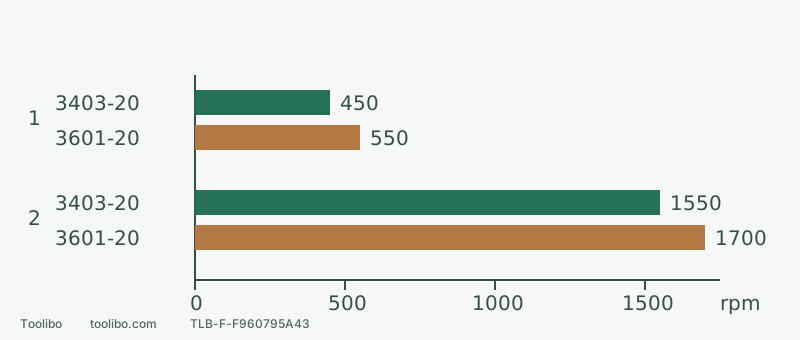
1 · Low gear
450 versus 550 rpm: the endpoint difference is 100 rpm, not seconds saved.
2 · High gear
1550 versus 1700 rpm: compare matched task conditions before discussing work-time differences.
Published US manual no-load ranges start at zero. Bar length is not drilling time, power or loaded speed.
Restore the missing gear information
These are published no-load speeds for exact US Milwaukee models, not our drilling tests. 3403-20 uses manual 58-14-3400d2; 3601-20 uses 58-14-9845d2.
Swipe or scroll horizontally to see all columns.
| Model | Low-gear no-load range | High-gear no-load range |
|---|---|---|
| 3403-20 | 0–450 rpm | 0–1550 rpm |
| 3601-20 | 0–550 rpm | 0–1700 rpm |
The defensible comparison is a 100 rpm higher published low-gear endpoint and a 150 rpm higher high-gear endpoint for 3601-20. It does not predict seconds saved per hole. Comparing 1700 with 450 does not even align gears.
A range starting at zero reflects trigger control, not a promise of holding any chosen speed under every load. Material, bit, feed, battery condition and protection behavior affect cutting.
Keep three units separate
rpm counts rotations, BPM counts blows, and seconds per hole measures completion of a particular task. They can appear for the same tool but are not interchangeable.
The shared 3403-20/3404-20 manual contains a BPM-label conflict: the specifications call the 3404-20 figures no-load BPM, while the symbol table defines BPM under load. The listed ranges are 0–6750 low and 0–22500 high. This guide does not silently decide which label is correct.
Use those figures to locate the published specification, not as verified matched-load rankings or thousands of completed holes per minute. They do not apply to the non-hammer 3403-20.
Distinguish useful comparisons from missing conditions
Swipe or scroll horizontally to see all columns.
| Comparison | What it establishes | What it does not establish |
|---|---|---|
| Matching low-gear no-load endpoints and units | Difference in published ranges | Hole-time difference in a material |
| Low gear versus high gear | The data are not aligned | A fair speed ranking |
| Same diameter, thin sheet versus thick wood | Hole diameter matches | Equal work quantity |
| Same material, diameter/depth and comparable bits, with battery and operation recorded | Results for those explicit task conditions can be assessed | Every material, battery or tool’s lifespan |
The last row specifies requirements; it is not an existing test result. Equal hole counts still fail to align work if depth or completion rules differ.
Fill in a review-reading record
Record material and thickness____; hole diameter/depth____; bit type and condition____; exact battery and initial state____; gear and mode____; feed and operator arrangement____; timing start/end____; abnormalities and unfinished attempts____.
If a video gives A a new bit and thin wood but B a worn bit and thicker material, an 8 mm label on both cannot attribute the timing difference to the drill. Only aligned, clearly repeated conditions justify discussing that task result. Include failures and abnormalities rather than selecting the fastest attempt.
A home buyer need not run a performance competition. Recognizing missing conditions prevents treating weak comparisons as promises. Any small permitted personal trial still needs secure work, sound accessories and protection; never deliberately stall, overload or repeatedly trigger protection to pursue a number.
Use speed information for the right decision
A speed table helps identify available ranges and control options. It does not replace accessory speed limits or turn maximum rpm into an allowed hole diameter. Large accessories, long bits and different materials have separate restrictions.
For these tools, stop fully before shifting gear or direction and isolate power as instructed before accessory changes or adjustments. Do not check a maximum no-load speed with a long bit spinning unsupported away from the work.
First screen for material, accessory, space and compatibility needs. Then compare the ranges as control information. Without matched task data, stop at this gear has a higher published endpoint, not this drill must finish sooner.