
Same torque level, different tightening angles
Two conceptual rising curves share a starting contact point and a final torque level; the steeper curve reaches it sooner.
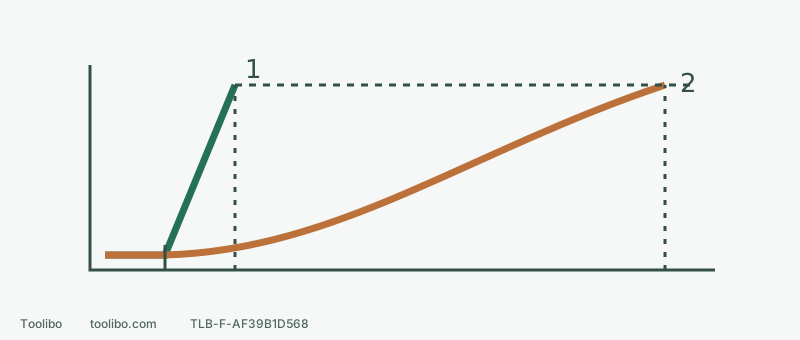
1 · Harder joint response
Torque rises rapidly after contact; a small additional angle can reach the shown level.
2 · Softer joint response
Compressible components allow more turning before the same level is reached; material name alone does not classify the joint.
Horizontal: additional tightening angle. Vertical: torque. Shapes are conceptual, not drill test data or installation settings.
Identify what the number measures
Do not rank 35, 300 and 500 until you have copied the whole label: unit, soft or hard joint, any maximum designation, exact model and market. N·m and lbf·in can describe torque. W and UWO concern power, not another spelling of torque.
Maximum drill output is not the required installation torque of a screw, nor a calibrated value for each clutch setting. Positions 1, 2 and 3 are tool settings, not automatically 1, 2 and 3 N·m. When a fastener or assembly requires a specified installation torque, use its prescribed tools and procedure; a powerful drill is not a substitute for control.
Make a complete conversion to one unit
The conversion is approximately 1 lbf·in = 0.1129848 N·m. These are arithmetic examples, not measurements of particular drills.
Swipe or scroll horizontally to see all columns.
| Original label | Calculation | Recordable result |
|---|---|---|
| 100 lbf·in | 100 × 0.1129848 | About 11.30 N·m |
| 300 lbf·in | 300 × 0.1129848 | About 33.90 N·m |
| 35 N·m | No conversion needed | 35 N·m |
Although 300 lbf·in and 35 N·m are numerically close, they do not establish equal performance if one is unspecified and the other is a hard-joint result. Conversion aligns units; it neither supplies missing test methods nor increases the precision of the original claim.
Watch for lbf·ft: it differs from lbf·in by a factor of 12. Do not discard the length unit because both contain lb. A sales description saying only lb is insufficient for a reliable conversion.
Soft and hard describe how resistance builds
Separate tightening into the period before contact and the period after the parts become snug. A hard joint can develop torque rapidly over a small additional angle. A softer joint with compressible components generally needs a larger angle to reach the same target. The same tool can therefore produce different measured results on the two joint types.
For intuition, consider a short bolt clamping plain metal parts compared with a joint containing a compressible gasket. The latter continues compressing as it turns. This explains the response of the joint system; it does not classify every metal job as hard and every wood job as soft, or prescribe an installation torque.
The UK Bosch GSR 12V-35 product table lists 20/35/– N·m in soft/hard/max order. Read that as 20 for soft, 35 for hard and no numerical maximum in that field. The dash is not zero. Nor does 35 become a continuously available torque in every condition. This example teaches label reading; it does not transfer automatically to similarly named US models.
Put competing specifications through four checks
Swipe or scroll horizontally to see all columns.
| Check | Grounds to continue | Conclusion you cannot draw |
|---|---|---|
| Quantity | Both measure torque | A larger UWO number beats an N·m number |
| Unit | Both converted to N·m | Omitting in or ft still permits an accurate conversion |
| Test basis | Matching joint definitions, methods and configurations stated | One hard-joint value equals an unspecified maximum |
| Actual work | Separately verify material capacity, accessories, low-speed control and reaction management | More torque automatically permits a larger hole safely |
Matching labels without adequate methods are limited specification information, not a controlled head-to-head test. For furniture, manageable low speed and straight bit access may matter more than a small peak difference. For large accessories, check explicit permission and side-handle requirements rather than deriving permitted diameter from torque.
Why UWO cannot directly become torque
DEWALT’s UWO describes drill-system output power at the chuck, involving the transmission, clutch and chuck as well as the motor. Power concerns work rate; torque concerns turning action. Even when speed relates them, the output and loaded speed must come from the same operating point. Do not combine maximum no-load speed with a maximum power measured under a different condition.
Keep the original labels: torque and its conditions in one column, power information in another, and the required job capacities separately. Write down missing information instead of forcing everything into one score. That comparison may sound less dramatic, but it helps avoid buying the wrong tool or treating a promotional output figure as a fastening instruction.