
Gear range and ring alignment are separate
A top selector and side ring show displayed numbers and the fixed alignment arrow.
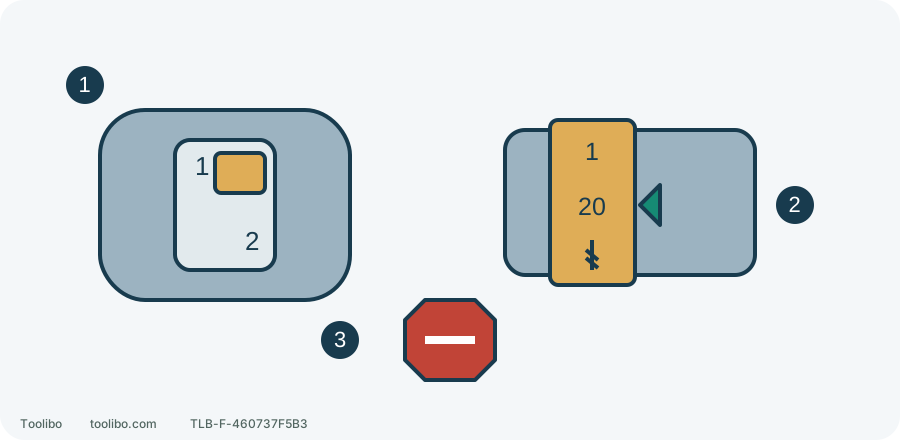
1. Displayed gear
Fully select 1 or 2 while stopped.
2. Fixed arrow
Align one ring setting with the housing arrow, not between marks.
3. No powered changes
Wait for complete stop before changing either setting.
Control relationships only, not exact housing geometry. Stop and remove the battery for setup.
Separate this model’s three controls
GSR18V-400 is a drill/driver. Do not look for the GSB18V-400 hammer-mode ring on it simply because the family looks similar. Identify the housing model first.
Swipe or scroll horizontally to see all columns.
| Control | GSR18V-400 function | Avoid this assumption |
|---|---|---|
| Top mechanical selector | Low no-load range 0–500 rpm; high 0–1,900 rpm | A light trigger in high is not low gearing |
| Numbered collar behind chuck | Settings 1–20 progressively increase the screwdriving limit | Numbers are not torque units or screw sizes |
| Handle trigger | Start, vary speed within the range and stop | It cannot make shifting while rotating safe |
The drill symbol locks the clutch for suitable drilling. It is not a finer screwdriving setting above 20; do not select it while expecting a low numbered clutch to limit penetration.
Prepare representative scrap
Clamp the same material in similar thickness and use the intended screw and a sound, correctly fitting driver bit. Match pilot holes, countersinks and fittings too. A short screw in soft scrap does not establish a setting for a long screw in hardwood.
Define the finish first: a countersunk head should meet its prepared seat rather than crushing a recess into wood. A non-countersunk fastener holding hardware seats according to the fitting, not by disappearing into the timber. This trial is for ordinary non-load-bearing assembly, not a specified-torque connection.
Move from isolated setup to a controlled start
- Release, wait for the chuck to stop and remove the battery. Fit the matching bit securely and straight, with no loose tools left nearby.
- For this ordinary wood-screw trial, choose the low mechanical range and engage the slider fully, never between positions or while rotating.
- Align a low numbered clutch setting with the housing mark, not the drill symbol. Check forward selection, clamped work and hands clear of the exit and slip paths.
- With setup checked and your finger off the trigger, reinstall a compatible battery normally and confirm retention. Seat the bit fully in the recess, aligned with the screw.
- Start with a gentle squeeze, increasing speed only as needed and easing off as the head approaches its seat. Release when the clutch operates or the head seats; do not keep it chattering.
- Wait for a complete stop to inspect. Remove the battery before setup changes, then recheck and reconnect before another trial. Change one factor at a time, not gear, bit and pressure together.
If the motor has run without chuck movement, do not keep squeezing. Stop and disconnect, then check full gear engagement. If normal selection still cannot restore transmission, stop for inspection.
Let the outcome choose the next step
Swipe or scroll horizontally to see all columns.
| Trial outcome | Next step |
|---|---|
| Head proud, clutch releases early, sound recess and timber, no abnormal resistance | Stop and disconnect, increase a little and retry matching conditions; do not jump to maximum |
| Head overdriven, crushed or split wood | Stop and review pilot, countersink and setup; reducing the number cannot repair existing damage |
| Bit jumps out or spins in the head | Stop and check profile, size, wear and alignment; higher clutch does not cure poor fit |
| Repeated shutdown, severe speed loss, twisting or abnormal heat | Release, assess load, capacity and holding, and allow normal cooling; resolve the cause before retrying and seek service for recurring faults |
A good result reaches the intended seat without crushing material or losing bit engagement. Confirm once on equivalently prepared scrap before using it as a starting point for matching work. Repeat the trial when the screw, material or connection changes.
Models referenced