
Different references, common complete-system qualification
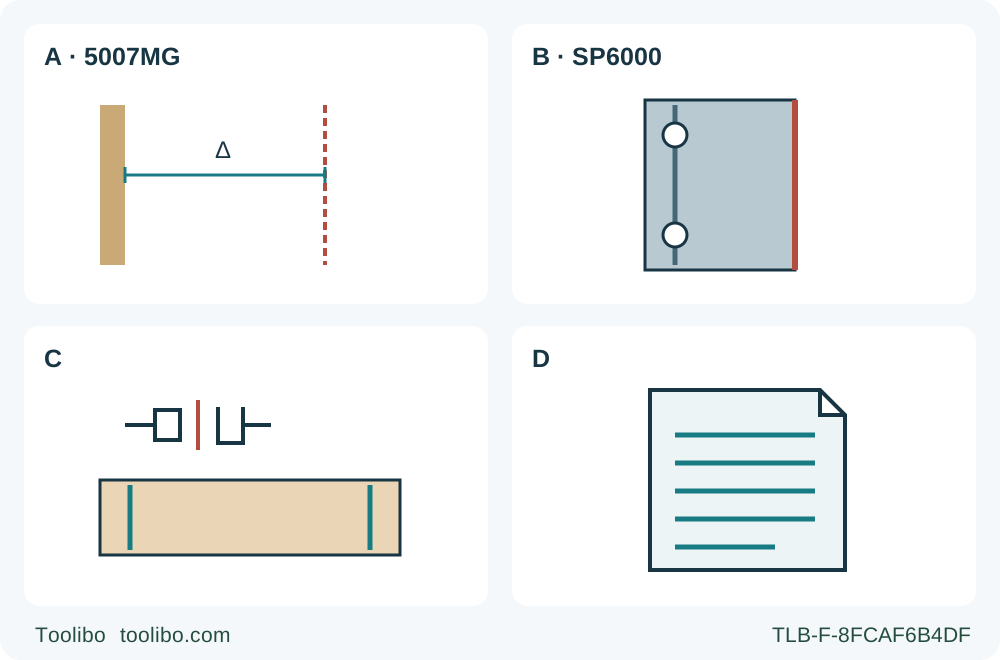
A shows a measured contact-edge offset; B shows a rail strip reference with two fit checkpoints; C combines physical disconnection with layout inspection; D records the complete system decision.
A · Qualify the actual straightedge reference
Record the correct base-contact side and verified blade-to-guide offset. A straightedge edge is not automatically the finished cut line.
B · Qualify the matched rail reference
Match the exact SP6000 rail and clamps, complete instructions, paired sliding fit and commissioned splinterguard; verify on a separate supported sample.
C · Compare complete isolated layouts
Unplug and check retained-side support, waste behavior, guide seat, clamps, blade corridor, grips, cord and any hose throughout the actual travel.
D · Choose or hold on evidence
Record the system whose prerequisites and sample result are established. Unknown offset or unqualified rail fit/strip is a hold, not a reason for a finished-work test.
The drawing is a conceptual comparison, not a running saw layout or accessory assembly diagram. A requires the actual measured base-contact offset for the chosen 5007MG setup. B represents the SP6000’s paired fit checks and qualified trimmed strip, not interchangeability with A or any other rail. C keeps layout inspection isolated, while the body requires complete support and clamp clearance. D means evidence is recorded, not that a guide alone certifies safety or accuracy. The original rail-specific instructions remain prerequisites.
A clamped straightedge and a matched guide rail can both guide a straight cut, but they establish the cut reference in different ways. Choosing between them is a system decision: what touches the saw, what locates the kerf, what must be qualified, and what the actual workpiece can support. Neither word is a universal accuracy or safety rating.
This comparison uses two exact documented examples: a US Makita 5007MG following a qualified straightedge under instructions 884671-946, and a US SP6000 with a listed genuine rail under 884683E949. Both retain their correctly installed original approved wood assemblies. The SP6000 example also requires the actual rail and clamp instructions. This article does not approve adapters, other-brand rails or placing a 5007MG on an SP6000 rail.
The completed outcome is a choice between two qualified workflows—or a hold because neither can be supported in the available space. It is not a duplicate rail-commissioning or offset-calibration tutorial. Those full procedures must already be available for the selected system before an ordinary square edge-start sample.
Define the job before choosing the guide
Record the actual known wood or approved panel, thickness, cut length, wanted edge, retained side and finish requirement. Identify the working space and what happens to both pieces at separation. Do not start with “a rail is more accurate” and assume the rest follows.
A long cut in a loose panel may favor a system whose reference can be positioned reliably over the full length, but length alone does not establish that either arrangement is safe. A narrow or irregular piece may lack a stable seat for a particular rail or enough bearing surface for a conventional base and straightedge. If neither system can be supported and clamped without interference, the decision is to change the work plan, not to remove the clamps.
Keep the scope ordinary, square and edge-start. The SP6000 is a plunge saw, but this comparison does not authorize an internal cut, a stopped plunge, a joined rail or a bevel workflow. Those are separate tasks with their own complete controls and support requirements.
Understand the straightedge reference
For the 5007MG arrangement, the selected side of the base follows a straight, secured guide. The blade cuts at a measured distance from that contact edge. The guide’s visible edge is not automatically the finished cut line.
Before relying on it, the actual contact-side offset must be established on supported scrap with the installed blade and intended setting, then checked after complete standstill and unplugging. A change of saw, blade, angle or contact side requires reassessment. A remembered distance from another model is not a calibration.
The guide must be straight and sufficiently supported, and its clamps must clear the base, motor, guard and complete travel. The wider base stays on supported retained material. The owner’s manual requires a fence or straightedge for ripping, but that instruction does not approve every improvised guide shape or attachment. An arrangement that rocks the base or requires sideways force is not ready for a cut.
The ownership commitment is therefore to maintain a sound guide, qualify the real offset, place it consistently, and verify the result. This can be a complete solution for an already qualified conventional saw. It is not a reason to claim the same saw has become a rail saw.
Understand the matched-rail reference
For the SP6000 example, the base engages the intended rail interface. The current US product identifies genuine rails 194368-5 and 194367-7 and clamp set 194385-5. Those identifiers establish a bounded selection, not a promise about carton contents or a universal cross-brand fit. Use one actual qualified rail and its complete accessory instructions here.
The manual requires adjustment of both base fit screws so travel is smooth without clatter. A tool that happens to sit on a rail is not qualified merely because it can slide a short distance. Binding, rocking, changing resistance or a damaged rail is a hold, not a reason to push harder.
The splinterguard is another distinct prerequisite. The manual’s commissioning process trims it over the full rail length after fit is established. Only then can the edge serve as the intended cutting reference, and the complete owner workflow verifies that reference on a separate supported sample. An untrimmed, damaged or detached strip is not a finished-size ruler.
Depth must also be established with the actual rail in the setup. The SP6000 scale is a rough guide; the manual requires actual projection measurement for accuracy. Do not add a guessed rail thickness or borrow the 5007MG’s depth setting. This comparison does not teach the quick-stop scoring button or convert a marketing fraction into a universal scoring depth.
The rail’s bevel anti-tip control is not a substitute for its fit screws, clamps or stable support. This square-cut selection does not transfer that bevel feature into a general guarantee against kickback or tool movement.
Compare the entire arrangement, not just the line
Sketch the selected system on the actual work: the retained piece, waste, base or rail bearing area, clamps, blade corridor, start and exit positions, and the route of cord and any extractor hose. Neither guide carries an unsupported offcut or prevents a panel from sagging into the kerf.
Both manuals require stable workholding and describe panel support near the cut and edges to reduce pinching. Keep supports and clamps out of the full blade path below the material. Keep the broad supporting area on the retained piece and plan for the moment the pieces separate. Do not assume an arbitrary foam sheet or unsupported overhang is approved by the presence of a rail.
With power physically disconnected, rehearse the entire travel. The actual front grip and rear handle must remain usable without reaching across the cutting line. Cord and hose must not drag the saw sideways or catch a guide end. Clamps must hold the work and selected guide without distorting them. If the setup cannot be rehearsed safely, it is not ready to compare by cutting.
Dust control belongs to the actual tool-and-material arrangement, not to the guide name. For the SP6000 example, the accepted owner workflow uses a properly connected extractor with a fitting hose and appropriate protection. This does not invent an equivalent port or adapter for the 5007MG. A claim that a rail gives a cleaner line is not evidence that airborne dust has been adequately controlled.
Choose by qualification evidence
Make a two-column sheet. For the straightedge, record exact saw and original assembly, guide condition, measured contact-side offset, clamp clearance and supported sample acceptance. For the rail, record exact saw, rail and clamps, complete accessory instructions, smooth paired fit, usable commissioned strip, actual depth and separate sample acceptance.
Then add the common conditions: sound guarding and controls, correct supply, eye and hearing protection, appropriate dust measures, stable two-piece support, safe reach and a clear complete path. A longer checklist does not mean a worse system; it makes the prerequisites visible.
For an owner whose 5007MG and straightedge are already qualified, with adequate support and a verified offset, that workflow may meet an ordinary square-cut task without purchasing an unverified rail conversion. For an owner with the complete SP6000 genuine-rail system and its commissioning evidence, the trimmed reference may suit the same task. These are conditional choices, not measured accuracy comparisons or price recommendations.
If the straightedge’s offset is unknown or the rail’s strip and fit are unqualified, select neither for a finished cut. Resolve the specific missing prerequisite using the full procedure. Do not declare a winner by comparing an unprepared example of one system with a commissioned example of the other.
Keep the acceptance standard common
After the chosen system’s complete preparation, its ordinary supported sample must show a stable guide, controlled travel, the intended dimensions and an acceptable square edge and surface. Release the trigger at normal completion, wait for full stop and blade enclosure or guard coverage, and unplug before measuring. If binding occurs, release and hold motionless until the blade stops; never pull a moving blade backward.
A sample that looks straight but involved guide movement, forced steering, a trapped offcut or unsafe reach fails the process. An intact strip or a carefully measured offset also cannot excuse a damaged guard. Record the selected exact configuration and result rather than saying “rails are always better” or “any straight board is enough.” The useful choice is the one whose complete system you can qualify and support for this particular cut.
Models referenced