
Square capacity, bevel controls, lighting and actual stop
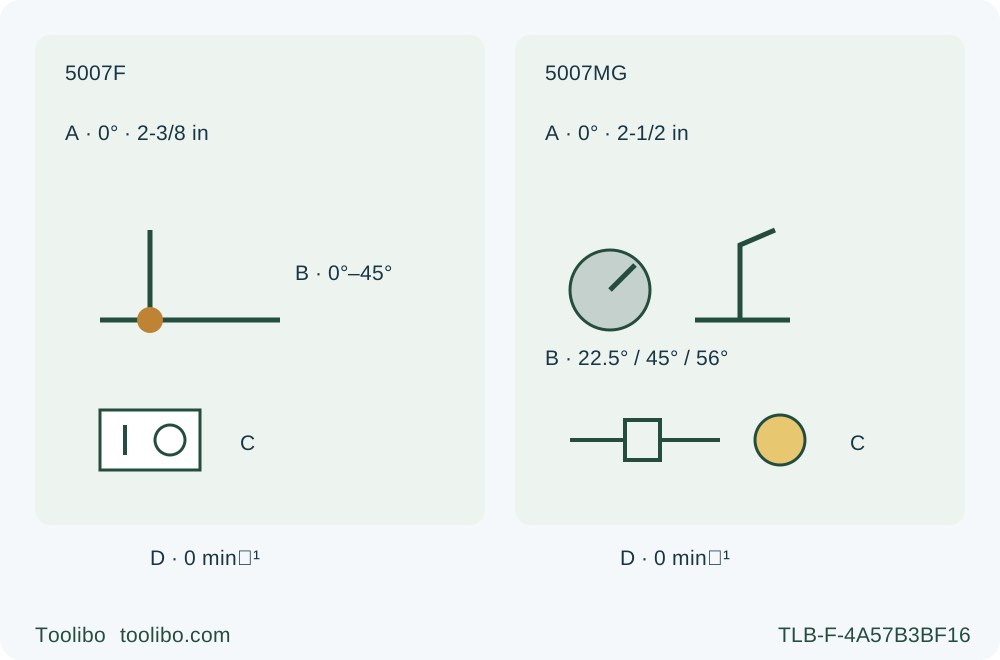
Two model columns compare A square capacities, B front screw versus lever and positive selector, C separate lamp switch versus connection-linked lamp, and D actual zero blade speed.
A · Screen the actual square task
The documents list F 60 mm/2-3/8 in and MG 63.5 mm/2-1/2 in. Measure the real stock and qualify the complete arrangement; do not convert the capacity difference into a power ranking.
B · Identify the actual bevel locks
While unplugged, distinguish the F front clamping screw from the MG lever and separate positive-stop selector. A selector position is not a locked base.
C · Keep lighting and isolation separate
F has its own lamp ON/OFF control; MG illuminates while connected. Physically unplug before adjustments regardless of lamp state.
D · Retain the common stop boundary
Release the trigger, wait for complete standstill and guard coverage, then unplug for work on the tool. FA/MGA brake text does not apply to the selected F/MG bodies.
A records each manual’s square maximum, not a cutting-depth setting or material guarantee. B identifies the F’s front clamping screw and MG’s separate lever/positive-stop mechanism; the numbers do not teach a bevel cut or transfer a range. C contrasts the F lamp switch with the MG lamp that follows connection. Neither lamp state proves isolation. D requires actual standstill plus guard coverage before setdown; neither exact non-A model borrows its sibling’s electric brake. All adjustments require unplugging.
The 5007F and 5007MG can both make an ordinary supported square cut, but they do not teach the operator the same control habits. The most useful comparison is not a contest between two similar-looking 7-1/4-inch saws. It is a decision about the exact controls, documented capacity and preparation you need to understand before choosing or switching between them.
This is a documentation-based comparison of the US 5007F under shared instructions 884404A949 and the US 5007MG under 884671-946. It makes no claim of hands-on cutting speed, measured balance, vibration, durability or a price advantage. Each saw must match its actual nameplate and complete instructions, with its original correctly installed approved wood-cutting assembly. A shared brand and blade diameter do not establish interchangeability of parts or accessories.
The outcome is a model-specific choice and a short “do not transfer” checklist. It is not another cutting lesson. Use the complete owner guide for the selected model before a supported sample; do not operate one by remembering the other.
Start with the letters that change the instructions
Write the full model on the decision sheet. The F manual also includes 5007FA, 5008F and 5008FA. The MG manual includes 5007MGA. Those extra rows and conditional sections are not optional features that can be assumed present on 5007F or 5007MG.
Both selected models use the documented 185 mm / 7-1/4-inch blade category and 5800 rpm no-load identity, with the current US product records specifying a 5/8-inch arbor. That is only an identity check. The actual installed blade still needs the correct application, markings, condition and matched fastening assembly. Do not treat one saw’s loose blade or flange as an approved spare for the other merely because these headline dimensions agree.
Neither selected model receives the shared manual’s brake-equipped sibling provisions. The F manual reserves the electric-brake section for FA models; the MG manual reserves it for MGA. If an electric brake is a required feature in your purchasing brief, neither of these exact non-A selections satisfies that brief by borrowing text from its sibling. A different exact model would need its own qualification.
Compare the light controls as an operating habit
The 5007F has a separate lamp switch with ON and OFF positions. Its instructions tell the owner not to look directly into the source and to switch the lamp off when the tool is not in use. This is a distinct control to recognize rather than a side effect of pulling the motor trigger.
The 5007MG’s lamp illuminates when the tool is plugged in and remains lit until it is unplugged. A person used to the F’s independent switch should not search for an equivalent lamp-off control on the MG or assume that a dark lamp means the cord has been disconnected.
For both, physical unplugging is the requirement before adjustment, inspection or other work on the saw. Lamp state, trigger position and blade standstill are different facts. A lamp can help reveal a line; it cannot certify that the tool is isolated, that the blade has stopped or that the lower guard is functioning.
On the sheet, record the actual habit: “F—recognize and turn off the separate lamp switch when finished,” or “MG—lamp follows connection; physically unplug for work.” Keep the common isolation rule beside either entry. This is a useful distinction for a shared workspace where users change between bodies, not a claim that one lighting arrangement is inherently safer.
Compare bevel mechanisms without turning the comparison into a bevel tutorial
The F’s documented bevel control is a clamping screw on the front bevel scale plate, with a 0–45-degree setting range. The MG has a lever and a separate positive-stop selector marked 22.5, 45 and 56 degrees. A stop selection and the final clamping action are separate functions; the selector is not a substitute for tightening the lever.
Those physical differences matter even if the planned work is square. When returning to zero, identify the selected saw’s actual control and confirm the base setting while unplugged. Do not search for an MG-style selector on the F, or assume that moving the MG selector by itself has locked an angle. Do not force a control to imitate the other model’s range.
The MG instructions give an ordered method for changing the stop position and setting the desired angle. This comparison identifies that extra mechanism but does not abbreviate it into a high-angle cutting recipe. A later bevel task needs its own complete setup, depth and support plan under the exact manual. The number 56 on a selector is not permission to tilt the F beyond its documented range, nor evidence that every high-angle application is appropriate.
Both manuals describe a rear depth lever and require secure depth and bevel settings before cutting. Their clean-cut depth advice is no more than one blade tooth below the work. Do not use maximum depth merely because the saw can reach it. Set the selected tool to the actual stock, verify clearance and secure its controls under its own instructions.
Use capacity only to screen the actual task
For square cuts, the F manual lists 60 mm, printed as 2-3/8 inches, and the MG manual lists 63.5 mm, printed as 2-1/2 inches. Treat those as each document’s stated maximum, not a guarantee that any material of that nominal thickness can be processed with your blade, support and required finish. Measure the real workpiece and consider the whole cutting arrangement.
The small difference may matter when a specified task approaches one limit, but it does not establish a universal “more powerful” winner. It also does not justify cutting an oversized piece from both faces without a separate supported method. If the stock exceeds the selected tool’s qualified scope, choose a properly supported alternative rather than inventing an extra pass from this comparison.
The manuals and current product pages contain differing weight figures and shared-table conventions. This guide deliberately does not resolve those into a weight or handling ranking. If actual mass or grip fit matters, verify the exact offered unit and its configuration through appropriate product information and isolated assessment; do not represent a published figure as a personal handling test.
Keep sighting, guidance and stopping model-specific
Both selected manuals identify A for square sighting and B for 45-degree sighting. The matching letters do not prove that the distance from a guide-contact edge to the actual kerf is identical. Measure and verify the selected saw’s real offset at the intended setting before committing a finished dimension. Moving a straightedge to the old saw’s remembered offset can make an otherwise well-supported cut the wrong size.
For ripping, use the required fence or straightedge guide. Match the accessory to the actual tool and complete instructions; do not infer direct guide-rail compatibility from a flat base or a familiar Makita name. Original assembly and a correctly qualified guide are separate prerequisites. This comparison grants no shared rail, nozzle or replacement-part approval.
Neither model choice removes the need for a free-moving, instantly closing lower guard, two-hand control, stable supported work and a clear cord route. Place the wider base on the supported retained portion and plan the offcut through separation. Eye and hearing protection and appropriate dust precautions remain necessary for the actual material.
Release the trigger at normal completion, then wait for actual complete standstill and guard coverage before setdown. If binding occurs, release and hold the saw motionless until the blade stops; do not withdraw a moving blade. Those shared obligations do not become optional because the chosen model has a different lamp or bevel control.
Finish with a choice and a transfer checklist
Consider a hypothetical owner who needs ordinary square cuts in stock comfortably within both documented capacities and wants to keep a separately operated light. The F’s lamp arrangement may match that preference, provided its exact assembly and controls are qualified. Another owner may need the MG’s documented stop-selection system for a separately planned angle workflow and be prepared to learn its full sequence. Neither example is a performance test or a recommendation to buy a tool with unresolved condition.
Before deciding, write four answers: does the real stock fit the documented task; do the actual controls and supplied instructions agree; are the original assembly and any guide already qualified; and which control habits must change from the previous saw? If a brake is mandatory, record that neither exact selection meets that feature requirement. If condition or identity is uncertain, hold the choice for evidence rather than letting a specification advantage settle it.
The transfer checklist should name the lamp control, bevel locking mechanism, stop-selector presence or absence, actual guide offset and non-A braking boundary. After selection, complete that model’s isolated preparation and supported sample. The successful comparison ends with a justified exact-model decision and no borrowed operating assumptions, not merely a longer list of specifications.
Models referenced