
Different stopping feature, shared final checks
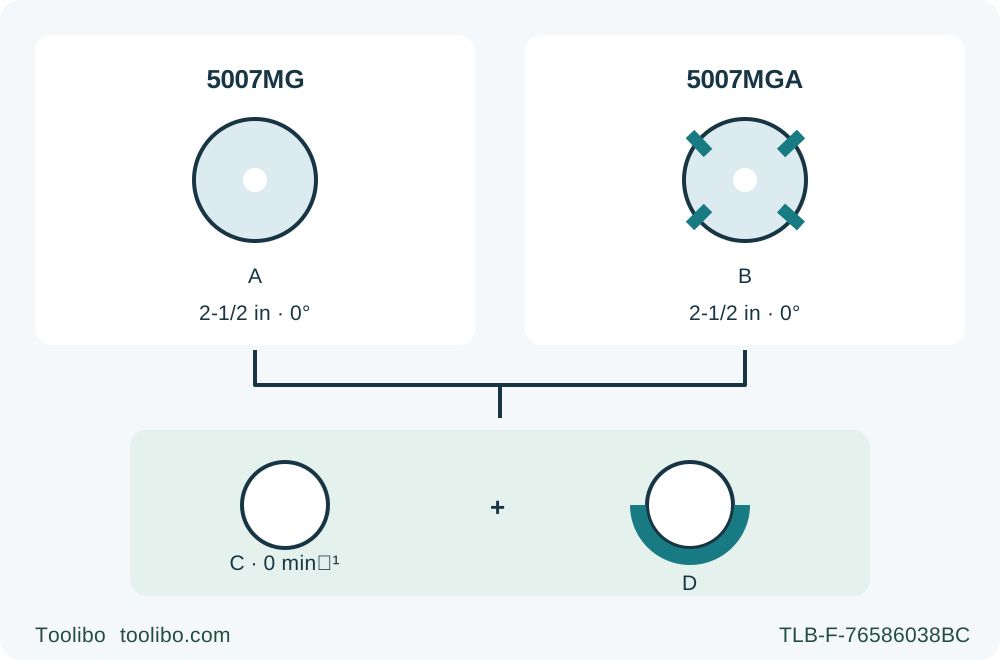
5007MG and 5007MGA appear side by side with their shared 2-1/2 in square capacity; brake marks distinguish MGA, and both lead to standstill and lower-guard symbols.
A · 5007MG
Do not inherit the brake from the shared booklet; allow coast-down and confirm actual standstill.
B · 5007MGA
The manual assigns electric braking to MGA only; no universal stopping seconds are given here.
C · Standstill
Wait for the blade to stop completely before placement or handling the offcut.
D · Guard coverage
A functioning lower guard remains mandatory on both models; braking is not a substitute.
A conceptual comparison, not an internal brake diagram or stopwatch result. A identifies MG without the MGA brake claim; B identifies the documented MGA electric brake. The shared 2-1/2 in value is square-cut capacity, not a high-angle claim. C and D apply to both: complete standstill and lower-guard coverage before placement. Neither condition replaces unplugging before adjustment.
Compare the stopping system, not just the final letter
The useful question is not whether one letter makes a saw universally safer. It is whether the documented electric brake on the US Makita 5007MGA addresses a requirement in your work, while the actual tool still passes the same guard, blade, support and electrical checks required of the 5007MG. The outcome of this comparison is a written selection or inspection decision with unresolved claims kept visible—not a timed performance ranking.
The evidence is Makita’s current US product pages for the two exact models and the manufacturer-hosted shared instruction manual 884671-946. The manual expressly assigns its electric-brake section to 5007MGA only. We have not conducted hands-on stopping tests, measured production speed or established that the available manual is the latest booklet supplied with every example. An owner’s actual nameplate, controls and supplied instructions must agree before using either saw.
Start with what is genuinely shared
Both product pages describe corded 7-1/4 in saws with a 5/8 in arbor, 15 A motor and 5,800 rpm no-load speed. The shared manual gives a 185 mm blade and 63.5 mm / 2-1/2 in square-cut capacity. That common square capacity is a useful first screening fact when the work is ordinary edge-start wood cutting. It does not establish suitability for every stock, blade or support arrangement, and no-load speed is not a measured feed rate.
The shared operating instructions require a functioning automatic lower guard, a correctly fitted suitable blade and mounting parts, both front and rear grips, a flat base and stable work support. Keep the broad base on the supported retained portion rather than on the piece that will separate. Remove nails despite marketing language about nail-resistant blade tips. Neither model’s blower is proof of captured dust, and the manual does not supply a universal improvised extraction connection.
The controls also share distinctions worth checking in person. A depth lever secures the chosen depth, with no more than one tooth projecting below the work. A separate bevel lever locks the angle; the 22.5°, 45° and 56° positive-stop selector limits the available range rather than replacing that lock. The front A reference is for straight cuts and B for 45°. The trigger is pulled to run and released to stop. The lamp stays illuminated while plugged in, not only while the trigger is held. None of those features is a substitute for unplugging before adjustment.
The documented difference: electric braking on MGA
For 5007MGA, the manual describes an electric blade brake. Its practical purpose in this comparison is to help stop the blade after trigger release. Do not transfer that claim to 5007MG merely because the two models share a booklet or similar housings. The MG owner must allow for coast-down and wait for actual standstill.
The evidence does not provide a universal number of stopping seconds for the MGA in this manual. Do not import a time from a different Makita model, a seller’s demonstration or another manufacturer’s brake. A claim such as “always stopped before your hand arrives” would go well beyond the source and encourage the wrong behaviour. Keep hands away from the blade and offcut until the blade has stopped, whichever label is on the saw.
Makita also gives a service boundary: if the MGA consistently fails to stop the blade quickly after trigger release, have it serviced at a Makita service centre. That is not permission to keep working indefinitely with a failed brake, to modify the switch, or to adjust internal components from a buying article. Nor is this comparison a live diagnostic test protocol. A prospective buyer who cannot establish the condition should treat the uncertainty as unresolved and arrange an appropriate inspection.
Brake, lower guard and isolation answer different questions
A brake concerns residual blade motion. The lower guard concerns coverage of the blade. Unplugging prevents the connected tool from being started during setup or inspection. These are separate conditions, not interchangeable indicators.
The manual specifically says the brake is not a substitute for a functioning lower guard. Before use, the guard must move freely and close immediately; its lever must not collide with the housing. After a cut, both standstill and guard coverage are required before putting the saw on a bench or floor. A covered but still-moving blade is not an invitation to reach underneath, and a stopped blade with a faulty guard does not qualify the saw for another cut.
Releasing the trigger is likewise not physical isolation. Both models remain connected, and their lamps stay lit, until unplugged. A brake does not make it acceptable to touch the blade, adjust depth, clear a jam or change a guide while the plug remains connected. The buying decision should preserve these habits rather than treating the extra feature as a reason to reduce them.
Keep conflicting specifications out of the verdict
Two discrepancies prevent an honest comparison from becoming a tidy but unsupported scorecard. The shared manual lists 4.6 kg / 10.1 lb, while the current US product pages list 10.6 lb. This article therefore does not declare one model lighter, assign a measured carrying advantage or average the figures. If actual carried weight determines suitability, verify the exact configuration and obtain a trustworthy measurement for that configuration.
High-angle capacity also needs restraint. The shared manual places the 1-3/8 in capacity at 56°, while the current MGA technical table labels that capacity at 50°. The MG page uses 56°. We do not silently choose the more attractive number or assume a typographical correction. The clear common square-cut capacity is enough for this bounded comparison. If a particular deep bevel is the purchase requirement, obtain model- and revision-specific confirmation before choosing either tool for that requirement.
Current listings may describe supplied blades, fences or cases, but a product photograph is not proof of the contents of a particular used or regional offer. Check the seller’s actual item and written contents separately. A missing correctly matched blade or mounting part is not fixed by the presence of an electric brake. This guide makes no current stock or price claim.
Turn the evidence into a short acceptance sheet
Write down these entries before deciding:
- Identity: exact 5007MG or 5007MGA, market, actual nameplate supply and matching instructions. A blurred label or generic “5007” listing is insufficient.
- Work requirement: supported square wood cutting within the qualified blade and capacity, or a different requirement that still needs verification.
- Blade and guard condition: correct approved assembly, undamaged blade, free immediate guard closure and no improvised guard restraint.
- Controls and structure: reliable trigger return, secure depth and bevel locks, sound handles, base, cord and plug.
- Stopping requirement: whether the documented MGA brake is a feature you specifically want, without inventing a stopping-time guarantee.
- Evidence gaps: unresolved weight, deep-bevel capacity, service condition or actual offer contents, with a named way to resolve each rather than a guessed answer.
This sheet changes the question from “Which badge wins?” to “Which exact example meets the work and condition requirements I can verify?” If both qualify and electric braking is an explicit requirement, the documented feature points to MGA. If the existing MG qualifies and the work does not require that feature, the shared capacity alone does not establish a need to replace it. Neither conclusion is a claim that one model prevents all kickback or makes poor support acceptable.
Use a stopping plan regardless of the choice
Before an ordinary cut, arrange supported retained wood, clear blade travel, both-hand control and a cord route that cannot snag. Start with the blade clear of the wood and allow full speed before entry. Feed smoothly and do not force a wandering blade sideways. If binding or interruption occurs, release the trigger and hold the saw motionless until the blade stops; do not drag a moving blade backward through the kerf. Unplug before investigating the cause.
At the normal finish, maintain support until the blade clears the work, release the trigger, then confirm complete standstill and lower-guard coverage before placement. This sequence applies to both models. The comparison illustration uses brake marks only to distinguish the documented MGA feature; it is not a picture of the internal mechanism or a promise about elapsed time. Its shared endpoint is deliberate: neither model earns a shortcut around the final two checks.
Models referenced