
Two complete systems, one evidence sheet
A contrasts disconnected cord and detached battery; B contrasts fixed trigger recognition and a prior-mode document; C separates brake obligations from shared standstill and guard coverage; D records a choice worksheet.
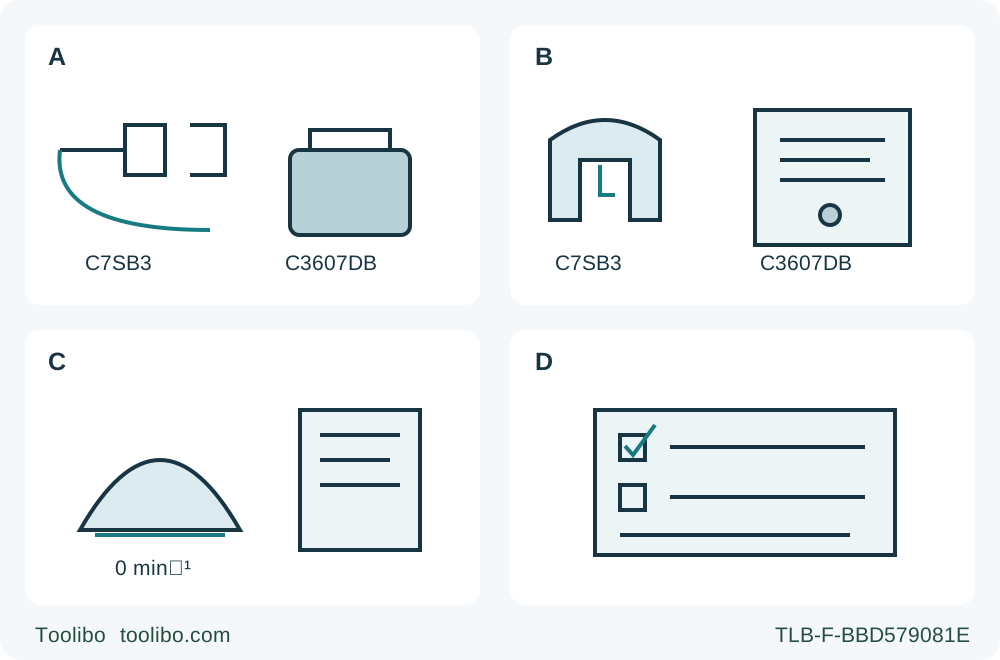
A · Qualify actual power
Check the C7SB3 direct supply and full cord route, or the C3607DB exact already commissioned battery system.
B · Know the controls
Do not transfer the cordless lock-off or persistent mode to C7SB3, and do not program an unknown mode from this comparison.
C · Preserve stopping conditions
C7SB3 has no documented electric brake; C3607DB requires proper brake operation. Both still need actual standstill and guard coverage.
D · Choose or hold
Close identity, power, controls, support and dust rows before choosing the complete route; record exact missing evidence if any row fails.
These symbols compare prerequisites, not operating sequences or safety scores. A shows physical isolation, not interchangeable power. B does not instruct mode activation. C uses the same standstill and covered-blade conditions for both tools; the document symbol denotes the additional C3607DB brake obligation, not a timed stopping guarantee.
Choosing between the Metabo HPT C7SB3 and C3607DB is not just choosing a cable or a battery. The useful result is a complete operating-system decision for a particular supported wood cut: which actual tool, assembly, power arrangement, controls and dust plan can you qualify today? Neither a shared brand nor a 7-1/4 in label makes their manuals, accessories or stopping behavior interchangeable.
This comparison uses the admitted US C7SB3 under the currently linked Hitachi C99722362 F instructions and the US C3607DB under the North American C99749561G / 306 July 2023 instructions. Both routes retain an already correctly qualified original wood-cutting assembly. The cordless route additionally requires its actual commissioned BSL36B18 and UC18YSL3 system and a known previously qualified operating mode. This is a choice worksheet, not a charging, blade-fitting or mode-programming tutorial.
Start with one job that both candidates could reasonably serve
Use one clearly defined ordinary edge-entry cut in known, dry, untreated loose wood. Write down the retained dimension, square-cut requirement, allowed finish defects and how you will measure acceptance. Check the entire path for nails and other foreign material. Choose stock that can be clamped to a stable platform with the retained base supported throughout and the waste free to separate without pinching the blade.
A job lacking safe support is not made acceptable by choosing cordless power. A narrow opening is not proof either circular saw can pass with its guard functioning and base supported. An installed wall, blind underside, structural joint design or internal plunge is outside both routes here. Reject those assumptions before comparing ownership convenience.
The same job definition prevents a misleading comparison in which the corded tool is judged in a cramped corner and the cordless tool on a clear bench. Compare the actual proposed arrangements, not a staged performance race. We have not measured cutting speed, torque, runtime, fatigue or edge quality against one another.
Route A: qualify the C7SB3 supply and moving cable
The bounded C7SB3 route requires the actual nameplate-matched 120 V AC, 60 Hz supply and a sound direct outlet. Although the dated manual’s table also mentions DC, that is not permission to improvise a DC system here. The current US product’s 15 A rating is not evidence that any available receptacle and wiring are adequate.
Inspect the cord and plug. A loose outlet, damaged cable or unsafe route is a hold requiring proper correction, not something the saw’s double insulation excuses. The cord holder can draw the cable sideways; it cannot ensure that the remaining loop avoids every clamp, offcut and blade position. Plan the complete start-to-exit cable path while disconnected, with no need for either operating hand to manage the cable.
If the only possible arrangement needs an extension lead, that is a missing qualification under this direct-outlet comparison route. Obtain the complete applicable supply/extension assessment rather than importing another saw’s cable table or plugging together convenient leads. This does not declare extensions universally forbidden; it makes the boundary of the already reviewed owner route explicit.
C7SB3 has separate rear depth and front inclination levers, both called lever (A) in the manual. The spindle lock is a different function. Its trigger starts and releases to stop; do not invent the C3607DB’s lock-off button or mode selector on this body. The fixed documented no-load speed is 6,000 rpm. There is no mode-programming dependency to resolve, but the tool still needs all original-assembly, guard and workholding checks.
Route B: qualify the C3607DB battery and known mode
A cordless body removes the saw’s mains cable from the cut route, but not the need for a verified power system. For this comparison the actual genuine BSL36B18 battery and UC18YSL3 charger must already be commissioned under their complete instructions. Broad MultiVolt wording does not approve an unidentified old pack, an adapter or a substitute charger. Charging, USB and the optional ET36A AC adapter remain outside this choice.
Record the known mode rather than assuming battery removal resets it. The C3607DB retains its selection through switch cycles and battery removal. In Auto Switch it automatically changes under load and returns when the load decreases; deliberately selected High Torque stays selected. The manual says mode changes are available only after battery insertion and a trigger operation. This comparison does not authorize trigger priming to discover or change an unknown setting.
That distinction affects the choice before any cutting. If the battery system is sound but mode commissioning is unknown, the cordless candidate is not yet ready. Resolve the complete instructions or obtain qualified help. A mode lamp is not an assembly inspection, and a claim about torque cannot replace either step.
The manual lists 4,500 rpm in High Torque while the current product table lists 4,300 rpm. Preserve that disagreement rather than choosing whichever number seems more favorable. Both sources identify 6,000 rpm for the ordinary maximum no-load context, but equal maximum figures do not prove equal cutting performance. Use the documented known-mode owner route, not a comparison-derived feed rate.
Keep original assemblies and dust provisions separate
The C7SB3 manual describes 184 mm / 15.9 mm and lists standard blade 115429; its current product page lists 372102. The C3607DB manual describes 185 mm / 15.9 mm and lists 115750M, while its current product page lists 115757M. These are source-specific identities and unresolved accessory histories, not a cross-model replacement table. A common fractional diameter or bore does not authorize exchanging blades, washers or bolts.
For C3607DB wood blades, retain its genuine-blade, speed-suitability and EN 847-1 requirements. For both candidates, uncertain installation or damage is a hold before operating. Do not perform a trial to decide whether an unidentified assembly is acceptable.
Dust arrangements also differ. The C7SB3’s blower helps expose the line but does not collect dust; the reviewed source does not establish a retrofit vacuum nozzle. The C3607DB owner route uses an already correctly fitted approved 380086 collector with M4 screw and a suitable connected, operating vacuum under its instructions. No shared connector or airflow threshold is inferred.
For either route, record ventilation and actual eye, hearing and respiratory protection under its manual and task. C7SB3 requires hearing protection; C3607DB expressly requires it for extended use and always requires a mask or respirator during operation. Neither a blower nor a hose removes the need for the other applicable protective measures. If the workspace needs dust control that the candidate cannot provide, mark that route unsuitable rather than treating a clear cutting line as evidence of clean air.
Stopping obligations change, but the final conditions do not
The current C7SB3 product lists no electric brake. The C3607DB manual requires proper electric-brake operation before use and directs failure to an authorized service center. Its owner route includes only the prescribed normal check on an otherwise sound tool, blade clear, guard closed and tool controlled—not a powered investigation of a suspected fault or a countdown guarantee.
For both tools, the blade must actually stop and the lower guard must cover it before setdown. A brake is not permission to touch the blade early, use the spindle lock to stop it or bypass the guard. After switching off and waiting for standstill, unplug the C7SB3 or remove the C3607DB battery before inspection or adjustment. Cordless OFF is not the same as a detached battery.
The C3607DB’s mode indication, work-light protection flashes and battery gauge are separate signals. Record any abnormal event under the exact owner instructions; do not borrow a C7SB3 symptom interpretation or treat a protection stop as automatic clearance to restart. Both routes exclude recovery-in-the-kerf recipes here.
Finish a decision that can be acted on
Make two columns with five rows: actual identity and original assembly; qualified power; known controls; support and guide route; dust and stopping obligations. Mark each row established, missing or failed, with the evidence beside it. Use the complete owner guides for operating instructions rather than assembling a hybrid procedure from whichever feature looks convenient.
At a stable bench with a qualified direct outlet and clear cable route, an already sound C7SB3 may satisfy the job without taking on battery or mode commissioning. At a location where the saw’s cable route cannot be made workable, an already commissioned and known-mode C3607DB may fit better, but only if its complete battery, extraction, support and brake conditions also pass. Neither example is a universal recommendation or a claim that cordless operation is safer.
Choose one exact qualified system, or record a hold and the missing item. If both qualify, practical factors such as your established equipment and workable site layout may decide; this evidence does not rank their performance. After choosing, verify a supported sample’s dimensions, square edge, finish and process under that model’s guide. Reopen the decision when the stock, location, blade assembly or power arrangement changes. The finished worksheet explains why one complete route is usable, not just why one tool sounds attractive.
Models referenced