
Makita DF333DZ versus HP333DZ UAE: the extra mode is not extra wood capacity decision map
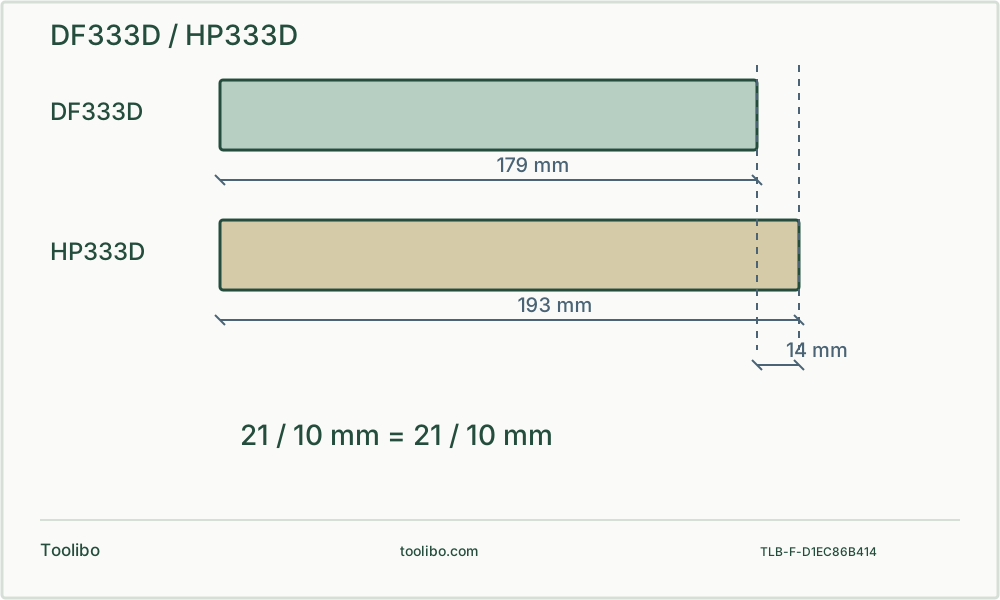
Shared-scale bars show DF333D at 179 mm and HP333D at 193 mm, with the calculated 14 mm difference and equal 21 / 10 mm wood and steel capacities.
DF333DZ
- DF333DZ tool-only regional listing; matching tool family DF333D, not DF033D.
- 20 numbered clutch positions plus drilling; 0–450 / 0–1700 rpm; no hammer mode.
HP333DZ
- HP333DZ tool-only regional listing; matching HP333D manual, not DF333D.
- Three action modes and 20 torque positions; 0–450 / 0–1700 rpm no-load ranges.
Length
Compare the listed body lengths, then add installed accessories.
Shared limit
Both list 21 mm wood and 10 mm steel.
Mode
Masonry needs its own assessment even when hammer mode is present.
Two original body-length bars on a shared scale show 179 and 193 mm with a 14 mm difference; equal wood and steel capacity bars make clear that the additional mode is not extra wood capacity.
Keep the comparison within one regional family
These are the UAE DF333DZ and HP333DZ listings, matched to the DF333D and HP333D English manuals. Both are sold as CXT tool-only models without a battery or charger in the selected descriptions. The comparison does not establish stock, price or a recommendation for every Middle Eastern country. A local product page does not verify the contents of an unrelated imported kit.
DF333D is a rotary driver drill. HP333D adds a hammer-drilling action mode and a separate torque ring. The DF manual also includes DF033D, but that hex-holder tool is not part of this comparison. Keep the exact letters and digits on your shopping list; a similar-looking photograph cannot settle the identity.
Put the differences beside the shared limits
Swipe or scroll horizontally to see all columns.
| Documented field | DF333D | HP333D |
|---|---|---|
| Main action choices | Clutch screwdriving and rotary drilling | Clutch screwdriving, rotary drilling and hammer drilling |
| Overall length | 179 mm | 193 mm |
| Wood / steel capacity | 21 / 10 mm | 21 / 10 mm |
| Masonry capacity | Not listed | 8 mm |
| No-load gears | 0–450 / 0–1700 rpm | 0–450 / 0–1700 rpm |
| Battery-included weight range | 1.1–1.2 kg | 1.1–1.3 kg |
The length difference is 14 mm, calculated from the listed figures. It is not a complete installed clearance measurement. Add the bit, battery, screw and hand space before deciding a tool fits a cabinet. Weight ranges include different battery combinations; do not present the lightest figure for one and the heaviest for the other as a measured head-to-head test.
Choose for the job you can actually prepare
For removable furniture parts, the DF’s simpler control arrangement may be enough. Its lack of hammering does not reduce the listed wood or steel capacity relative to HP333D. You still need a correctly sized sharp bit, a restrained workpiece and a pilot and screw matched to the material. A lower price, if available, would not justify omitting a suitable battery or charger.
HP333D may be relevant when a separately assessed small masonry job calls for its hammer mode. First establish the substrate, hidden-service risk, fixing specification and dust controls. An 8 mm number alone does not approve structural anchoring or an unknown wall. If the work cannot be safely assessed, the extra mode is not a solution.
Check a common furniture example
Suppose you need small pilot holes for ordinary cabinet screws in removable, known wood. Both tools can be candidates if the bit, hole size and workholding meet the actual instructions. On matching scrap, test the hole location and depth, then use a low clutch setting to drive a trial screw. Inspect the face for crushing and the edge for splitting before repeating the setup.
If the project changes to a 35 mm concealed-hinge cup, neither tool’s listed 21 mm wood capacity covers the job. A reduced-shank cutter fitting the chuck does not change that. Select a drill specifically suitable for the cutter and fixture. This is a useful rejection test because the larger advertised feature count of HP333D might otherwise suggest that it is automatically the stronger choice for every woodworking task.
Avoid two common comparison traps
First, do not call a ring position a calibrated fastening torque. DF333D has numbered clutch positions plus a drilling position; HP333D separates action mode from its 20-position torque ring. A small number on HP333D does not provide screwdriving clutch behaviour when the action ring is set elsewhere. Learn the controls on the actual machine rather than copying a photograph of the other one.
Second, the UAE HP333DZ marketing summary says brushless, but the matched operator manual does not substantiate that statement. It is excluded here. Product dimensions and broad marketing labels can conflict across pages. Prefer the matched manual’s field and scope, and leave uncertain claims out of the buying decision instead of filling the gap with assumptions.
Budget for a safe complete system
Verify the specific approved battery and charger against the supplied manual and actual local charger input rating. CXT is not LXT or XGT, and similar voltage labels do not create cross-brand compatibility. Include suitable bits, protective equipment and workholding in the setup, not just the body and a battery chosen by appearance.
Before first use, check the trigger, chuck, battery latch and selectors with power safely isolated. Stop for binding, unusual noise, insecure retention or repeated protection events. Both manuals call for a 15 minute tool rest after continuous work exhausts a pack before continuing with a fresh one; that is not permission to continue an overheating task until the pack empties. Choose the simpler suitable configuration and a verified task boundary, not an unsupported claim that one is universally better.
Models referenced