
Check a corded jigsaw externally when it will not start · Diagram
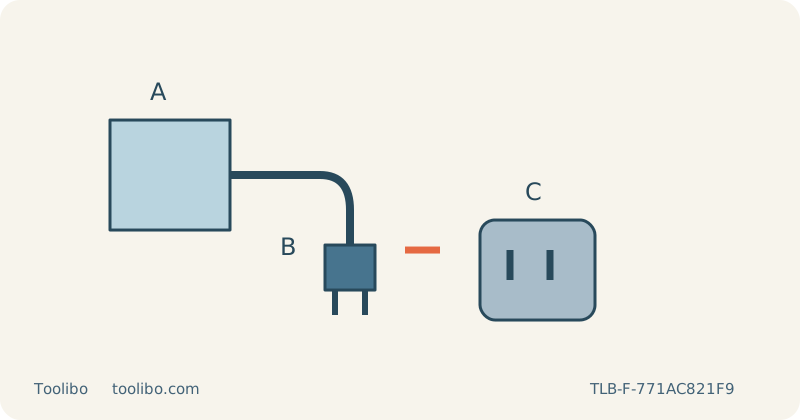
A tool cable ends in a disconnected plug with a visible gap before a separate socket.
A
Confirm controls are off
B
Inspect the disconnected cable
C
Do not bypass supply protection
Inspect the disconnected power path and controls without opening the saw or bypassing protection.
Make the first action a disconnection
If a corded jigsaw does not start, release its control and unplug it before examining anything. A tool can begin running unexpectedly if power returns while a lock-on control remains engaged. Confirm that the trigger and any lock-on function are in the normal stopped condition using the model’s instructions. Do not leave an unresponsive tool plugged in on the bench while investigating the outlet elsewhere.
This guide concerns external checks for the US SKIL JS313101 and JS314901. Their identified electrical supply is 120 V, 60 Hz. It is not a guide to adapting a US tool to another country’s supply, replacing internal switches or testing live wiring. If the local supply is different or uncertain, stop and obtain appropriate equipment or qualified advice instead of using a casual plug adapter as a voltage solution.
Inspect the visible power path
With the saw unplugged, inspect its plug, cable and strain-relief area for cuts, crushed insulation, scorching, loose parts or signs of overheating. Do not flex a damaged cord while reconnecting it to see whether the motor starts. Tape is not an acceptable repair for a compromised power cable. If damage is present, remove the tool from service and follow the manufacturer’s repair instructions.
If an extension lead was used, inspect it separately while disconnected. Check that it is suitable for the tool’s requirements and intended setting. Do not assume that a cable which powers a small light is adequate for a motor load. Avoid chained adapters and improvised connections. A hot plug or connection is a reason to stop, not a reason to hold it more tightly in place during another attempt.
Keep outlet checks separate from tool repair
Look for an obvious external cause such as a switched outlet being off or the extension lead being disconnected. Confirm the outlet’s normal operation using a safe, intact device appropriate to that supply only if you can do so without handling damaged equipment or exposed wiring. Do not insert test objects into an outlet or open a wall plate as part of this procedure.
A tripped protective device can indicate a fault. Do not repeatedly reset it to force the saw to run, bypass it or move to an unprotected supply to avoid the interruption. If its instructions permit a normal reset, first disconnect the suspect tool and investigate the cause safely. Repeated tripping, uncertain wiring or any burning smell requires an electrician or qualified service rather than continued trial and error.
Decide whether one controlled restart is justified
Only consider reconnecting when the cable and plug are intact, the supply is correct, the controls are confirmed off and no unresolved electrical warning remains. Check the mechanical setup while still unplugged: the blade should be appropriate, fully seated and securely retained, with its back in the guide roller where required. The base and guard must be secure, and the blade must not be trapped in material.
Prepare a stable supported position where the blade cannot contact the bench, a cable or anyone nearby. Use the model’s normal starting action without engaging lock-on merely for diagnosis. If it still does not start, or starts intermittently, stop and unplug it. Do not continue squeezing the trigger in different positions, striking the housing or opening the tool to reach a switch or brushes. Record the observed behaviour for service.
Re-establish the complete cutting setup
If an ordinary external interruption was clearly resolved and the saw now starts normally, do not immediately return to the middle of a jammed cut. First prepare a short sample of known, uncoated wood. Clamp the retained piece and support the waste independently on a stable bench, with the full blade stroke clear below. Route the cord behind the saw so it cannot enter the cut or catch a clamp.
Wear eye and hearing protection and suitable respiratory protection, and arrange compatible extraction and ventilation. Support the base, start with the blade clear of the material, establish speed and advance steadily. Stop on abnormal sound, heat, interruption or loss of control. Wait for a full blade stop before withdrawing or setting down, then unplug before adjustments. A tool that repeatedly fails after an apparently successful restart belongs in service, not in a routine of repeated resets.
Models referenced