
A fault record branches by source, not by guessed component
Original decision diagram has an unsafe-condition stop branch, a separate battery charging check and two isolated source observations leading to service notes.
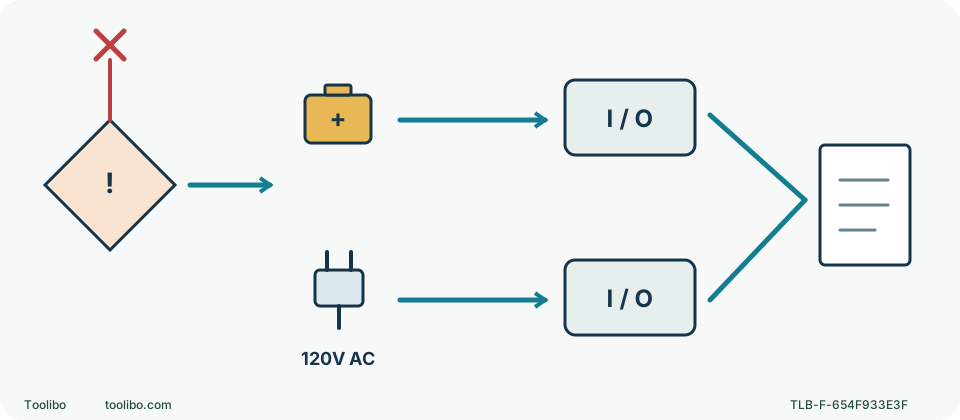
Stop
Damage, moisture, heat or protective trips end the check.
Separate
Observe only a sound permitted supply arrangement.
Record
Report motor behavior and the exact source used.
Only safe external observations belong in this flow; no internal testing or live probing is shown.
First decide whether a check is appropriate
A vacuum that runs on the battery but not the cord, or the reverse, presents a useful observation rather than a completed diagnosis. Before trying anything, look for damage, moisture, a burning smell, abnormal heat or a recent drop into liquid. Any of these ends the owner check. Disconnect only if it is safe to do so and obtain qualified service; do not keep changing power sources to find one that still works.
A tripped protective device is also not an invitation to repeated resetting. Record what happened and stop if the cause is not already understood and safely corrected. This guide does not direct you to open a plug, probe a live socket, bridge battery terminals or bypass a protective feature. The useful work is preserving a clear symptom without creating another fault.
Rule out the normal non-charging behavior
The selected DCV581H accepts a compatible 20V MAX* battery or the specified 120V AC supply. Its mains input powers the vacuum but does not charge an installed pack. Therefore, “it was plugged in all afternoon, but will not run on the battery” can result from an unchanged low battery rather than failed charging inside the vacuum. There is no in-vacuum charging function to repair.
Remove and charge the compatible pack using its designated charger and instructions. Interpret the charger’s own indication instead of inventing a universal LED meaning. If charging is refused or the battery is damaged, unusually hot or wet, stop there. Do not cool it with water, force charging or substitute an unverified adapter.
Make the setup identical before comparing observations
Switch off, unplug and remove the battery before checking accessible parts. Confirm the correct filter is fitted, the tank is properly latched, and hose/nozzle are unobstructed. An empty collection tank and the same sound configuration prevent a full tank or blocked nozzle from confusing the record. Do not run without the filter to make a weak machine sound stronger.
If equipment and location are sound, a normal brief operating check may establish what happens on each permitted source, one at a time. Switch off before changing the arrangement. Keep the unused source physically disconnected so the record is unambiguous. Do not intentionally cut a running machine’s mains power as a changeover stress test.
Swipe or scroll horizontally to see all columns.
| Observation | What to write down | What not to conclude |
|---|---|---|
| Mains works, battery does not | Pack identity, charge indication and seating | The vacuum should have charged the pack |
| Battery works, mains does not | US input rating, safe supply arrangement and visible lead condition | The cord or internal circuit is safe because battery mode runs |
| Both fail | Switch position and external collection/power checks | A particular internal component must be replaced |
| Both run, pickup is weak | Tank level, filter and hose condition | It must be a supply fault |
Keep mains checks external and regional
Compare the machine’s rating plate with the actual supply. This US model’s 120V specification must not be treated as universal voltage. A travel-plug adapter does not perform a voltage conversion or establish safe compatibility. If the supply is unfamiliar, damaged or wet, do not connect the machine to it for diagnosis.
With the lead disconnected, a visual inspection can identify a cut, crushed area or damaged plug. Finding no visible damage does not certify the lead or internal circuit. If a known suitable, safe supply and intact arrangement still produce a one-source failure, stop and provide that observation to service. Do not dismantle the head to follow the cord inside.
Hand over a reproducible, limited report
Record the complete model, Type 2 marking, battery model, whether the lead was connected, switch state and what was heard or seen. Say whether the motor failed to start or ran with poor pickup: those are different symptoms. Include any protection trip, damage or recent liquid incident without trying to reproduce an unsafe event.
Then leave both sources disconnected and label the machine so another person does not assume the working mode makes it safe. A report such as “battery mode starts; mains mode does not on the checked suitable supply; no internal tests performed” is useful. A guessed diagnosis such as “changeover board definitely failed” is not supported by these owner checks.
Models referenced