
One machine, two sources to disconnect
Original diagram shows a battery branch and a mains branch meeting at one vacuum, with both branches interrupted before the tank is opened.
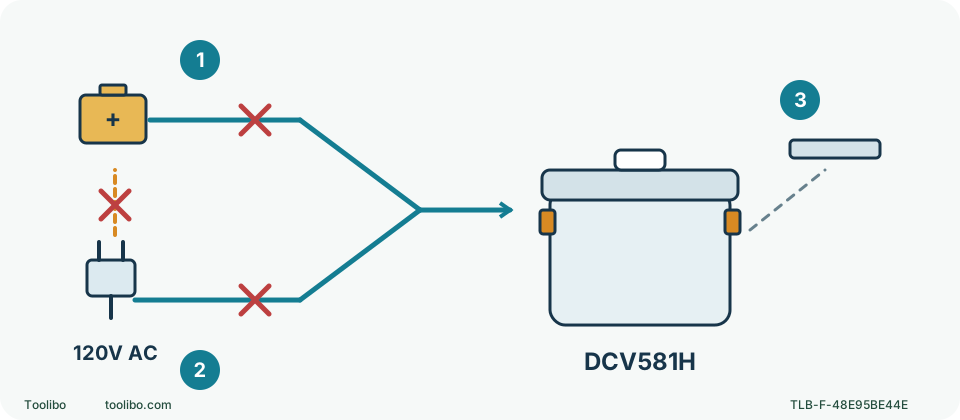
Mains
Unplug the 120V supply.
Battery
Remove the fitted pack.
Handle
Only then open or adjust the machine.
Both sources must be isolated; the crossed charging arrow indicates that AC operation does not recharge the installed pack.
What the extra power option actually changes
The DCV581H Type 2 can operate from a compatible 20V MAX* lithium-ion battery or a 120V AC supply. Its automatic changeover is useful when a cleaning route moves between a suitable outlet and a place where a cord is inconvenient. It is not a battery charger: connecting the lead does not replenish an installed pack. Plan charging with the separate approved charger.
That distinction changes how you finish a job. Unplugging only the lead does not establish that a battery-powered machine is isolated. Before opening the tank, changing attachments or cleaning, use a deliberate sequence: switch off, disconnect the mains supply, remove the battery, and then handle the collection components. Keep the removed pack away from loose metal and the wet work area.
Check the regional identity and the route
Match DCV581H and Type 2 on the actual unit to the applicable documentation. Do not apply an older Type 1 statement about additional battery families to this version. Equally, an American 120V input is not permission to connect to a 220–240V outlet through a travel-plug adapter. The visible plug shape is not the electrical rating. Resolve an imported machine’s suitability before use rather than improvising a conversion.
For a household room, identify a safe dry position for the body and a lead route that will not be trapped by a door or pulled over an edge. Keep both battery access and the plug reachable. If either would require leaning across a spill to disconnect it, rearrange the task before starting. Battery operation does not make an unsafe wet location acceptable.
Assemble the collection path before choosing power
With both energy sources disconnected, inspect the tank latches, hose and filter. The listed package has a 5 ft hose, crevice and wide nozzles, and the DCV5801H wet/dry filter. The matched instructions keep that filter in position for dry and wet collection; no filter-removal shortcut should be borrowed from a different compact vacuum.
Choose a nozzle while the machine is isolated. Check its fit without forcing the connector, close the head securely and leave enough hose slack to reach the intended area. Only then fit the approved battery or connect the suitable supply. A large amount of hose tension is a placement problem, not evidence that the machine needs a heavier battery to stay in place.
Swipe or scroll horizontally to see all columns.
| Situation | Correct interpretation | Action before continuing |
|---|---|---|
| Lead unplugged, battery fitted | Another energy source remains | Remove battery for handling/maintenance |
| Plugged in, battery still low | Vacuum is not a charger | Charge separately as instructed |
| Same body, different type label | Compatibility may differ | Match the exact documentation |
| Mains voltage does not match | Plug adapter cannot fix voltage | Do not connect |
Use the tank as a collection space, not a pump
The 2-gallon capacity label describes the tank. It does not establish a continuous-pumping capability or a guaranteed volume you should collect in one lift. Before a permitted clean-water pickup, empty dry debris so it does not become a difficult mixture. Keep the unit upright and the motor head, battery interface and supply connections dry.
If suction drops and the motor tone changes, stop and isolate both sources. Check collection level and the documented causes with the machine stopped. If a tip activated the suction cutoff, return it upright only after switching off and waiting for the motor to stop. Do not keep cycling it to clear a recurring symptom. Water escape, damaged electrical parts or unexplained repeated malfunction require qualified service.
Finish with an unambiguous handover
Before storage, empty and clean the tank and permitted accessories, inspect the filter, and allow cleaned parts to dry appropriately. Check the lead for visible damage while it is disconnected; do not splice it, open the power head or probe the battery contacts. Arrange the hose and lead so the next person can distinguish the suction path from the electrical route without tugging either.
A useful note for shared equipment reads: exact type, collection material, filter condition, battery removed, lead unplugged, and any unresolved symptom. This is more useful than “works on mains.” The dual-power feature offers flexibility for already suitable tasks; it does not expand material permission, weather resistance or the range of owner repairs.
Models referenced