
Four clues after a stall
Diagrams show an angled bit, a closing kerf, rounded cutting edge and speed selector.
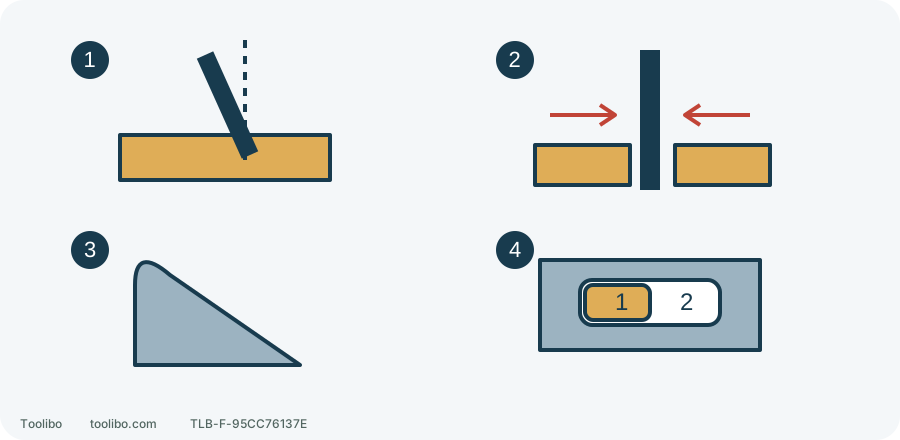
1. Alignment
Check whether the drill was pushed sideways.
2. Work restraint
Inspect shifting or pinching before freeing the cutter.
3. Cutting condition
A worn edge is not corrected by more pressure.
4. Gear suitability
Choose for the task after a full stop; gear 1 is not an automatic cure.
These are inspection clues, not instructions to recreate a stall. Release the trigger first and isolate only after stopping when safe.
Release instead of pulsing
Release immediately when the accessory stops, the drill struggles severely or the housing twists. Stop feeding while maintaining safe grips. DEWALT explicitly rejects repeated trigger cycling to start a stalled drill. Another short pulse does not establish safety or remove resistance.
A smoking, leaking or rapidly heating battery calls for keeping people away, not routine removal. With stable equipment safe to approach, wait for standstill then remove the battery as instructed. This is external task review, not housing removal, switch bridging or protection bypass.
If the bit is trapped, stabilize tool and work against sudden falling. Do not lever the housing or grab potentially rotating work. Release the accessory only by a safe procedure suited to tool, accessory and circumstances; if that cannot be done safely, stop for assistance rather than powered attempts.
Distinguish clutch release from a stall
During screwdriving, a running motor with repeated numbered-clutch release may indicate the setting or abnormal joint resistance. That differs from a bound bit, stopped motor or sudden reaction. Review screw seating, recess fit and matching-scrap clutch setting instead of forcing drilling mode.
Use previous observations. Do not restrain a bit again to listen, and do not treat a lit worklight as proof of motor, switch or battery health. Light status is one observation, not a complete functional test.
Inspect four classes of external clues
Keep isolated and wait for safe accessory handling. Several causes can coexist.
Swipe or scroll horizontally to see all columns.
| Existing clue | Isolated check | Appropriate response |
|---|---|---|
| New material causes difficulty, edge visibly worn or chipped | Accessory type, diameter, edges and tool capacity | Use a sound permitted cutter; shank fit alone is insufficient |
| Off-centre hole, moving work or side load | Restraint, axis, support and exit space | Re-secure and align; no sideways steering inside the hole |
| Speed steadily drops under feed before stopping | Excess pressure or chip blockage | Clear safely accessible blockage isolated; plan steady feed, not harder pushing |
| Heavy work in high range or incomplete gear engagement | This model’s range and mode requirements | Select suitable range fully while stopped; no powered shifting or forcing through a bind in low gear |
Unknown hard material in wood or unexpected wall resistance is not automatically a dull bit. Identify the target instead of exploratory drilling for hidden services.
Explain the cause before resuming
State the correction specifically: damaged cutter replaced with a sound suitable equivalent, moving work re-secured and checked, or visible chips safely cleared while isolated. “Changed the battery” or “light went out” does not explain mechanical resistance.
Only sound tool/accessory, reliable restraint, normal controls, suitable temperature/supply and a permitted task justify full preparation. Finger off trigger before installing and securing the compatible pack. Start normally, not by resetting power into a trapped accessory.
DEWALT recommends easing pressure near breakthrough during normal cutting. This is not permission to pull a trapped bit out under power. Stop again and isolate appropriately for accessory fitting or clearing; gear changes require standstill.
Repeated abnormality ends the trial
Rapid recurrence, unreliable retention or controls, unusual noise or an unexplained cause means stop and arrange inspection. One remaining hole does not justify more pulses. Do not buy an internal motor, bearing or switch on the strength of one symptom.
Report complete model/type, material, hole size and cutter, gear/mode, gradual slowdown versus sudden binding and completed corrections. Record facts without reenacting the hazard; these are more useful than “drill failed.”
Models referenced