
Separate equipment identities and three report fields
A tool and detached battery carry separate label areas beside a record with observation, completed-check and unknown rows.
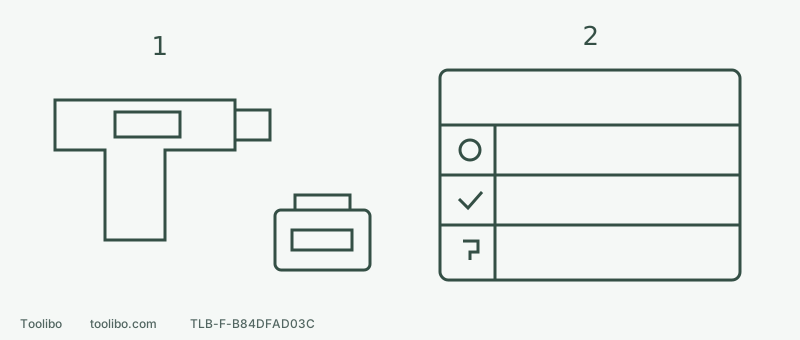
1 · Separate device labels
Record actual tool, battery and charger models; a kit name does not replace them. Keep serials private.
2 · Observation / checked / unknown
Describe existing evidence without recreating the fault; an unknown cause is not a confirmed failed motor.
Conceptual record layout, not a battery-removal procedure. Do not approach smoke, leaks or rapid heating to collect identifiers.
Active danger comes before photographs or battery removal
If the tool or battery is smoking, hissing, leaking or heating rapidly, do not approach to read a label, remove the pack, film it or prepare a parcel. Move away, keep others clear and follow local emergency arrangements. The report can wait; this is not routine inspection.
Only when such active hazards are absent and safe approach is possible should normal stopping and isolation follow the tool instructions. Mark the equipment out of use and separate it from usable tools so someone else does not try it. This guide does not cover battery dismantling, internal electrical testing or protection bypasses.
Collect exact identities once
Without opening the housing, record full tool model, Type/service identifier and serial number. Battery and charger have separate models; original kit is not enough. Add the package code if useful, but do not substitute it for the actual tool.
Keep purchase date, receipt/order and the manual number/revision used. Provide full serials and purchase evidence privately only when a verified service channel needs them. Avoid public photographs containing addresses, payment information or unrelated labels.
If a label is unreadable, record that rather than opening the housing to search. Existing purchase photographs may help, but do not prove a replacement battery still matches the original package.
Report symptoms without inventing a diagnosis
Stopped turning during a hole and the light flashed is an observation; failed controller is an unconfirmed diagnosis. Record the material, accessory, hole size/task, mode, gear and circumstances before the first occurrence.
Write only what was observed. Unknown flash count stays unknown; do not invent a temperature. Do not recreate a stall, restart repeatedly or charge a suspect pack to obtain a better video. Missing evidence is not a reason to recreate a fault.
Copy and fill in this report
Swipe or scroll horizontally to see all columns.
| Field | Entry |
|---|---|
| Tool identity | Brand____; full model____; Type/service code____; serial kept privately |
| Associated equipment | Battery____; charger____; adapters used____ |
| Purchase/documents | Purchase date____; receipt available____; manual number/revision____ |
| Last normal task | Material____; accessory____; hole/task____; mode/gear____ |
| Observations | When____; observed rotation, holding, light, sound or smell____ |
| Completed checks | What was done, under which safe conditions____; result____ |
| Unknown/not done | Unconfirmed identities or conditions____; no restart/no dismantling etc____ |
| Present state | Out of use____; hazard signs____; handling questions awaiting confirmation____ |
For example: stopped while drilling clamped wood; flash count not recorded; taken out of use, not restarted or opened; please confirm required photographs and whether the battery should accompany it. This helps diagnosis more than motor broken, replace motor, without selecting the repair in advance.
Verify the service route
Start from the manufacturer’s official site for the correct region and its Support/Service section. Do not send serials, receipts or payment merely because an advertisement or chat account says authorized.
For US RYOBI, the Service and Repair page provides an authorized-center search by product line and ZIP code. It warns that not every center repairs every RYOBI product. Before visiting, confirm the exact model is accepted, whether an appointment is needed and what accessories/documents to bring. Other brands and regions have their own routes and conditions.
Confirm three things before sending equipment
Ask whether the tool alone or battery/charger is needed; whether a battery with damage or abnormal history can be accepted and how it must lawfully be handled; and how charges, warranty checks and repair authorization will be discussed. A normal shipping label does not authorize packing a damaged battery yourself.
This record ends with providing useful information to verified service. Qualified personnel must determine repairs, parts and when the equipment is fit to return to use.