
Three controls and two diagnostic branches
Three controls and two diagnostic branches — numbered controls and physical routes explained by the legend.
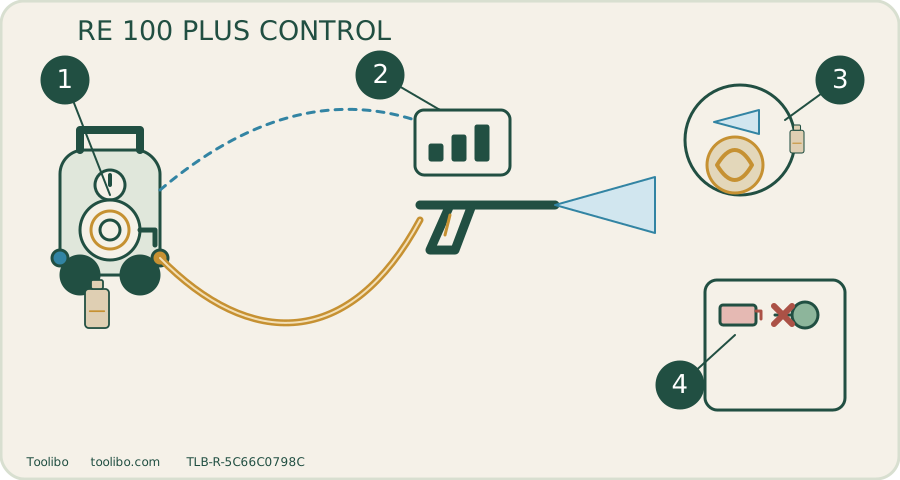
Machine
Mains on/off is electrical state
Gun
Three power levels and activation
Nozzle
Release trigger before mode change
Indicators
Red: batteries; flashing green activation: link
Original explanatory diagram; not a dimensioned service drawing.
Three kinds of control—not one “power” button
The UK RE 100 PLUS CONTROL is product RE020114531, matched to RE 100.0 PLUS CONTROL manual 0458-004-9821-B. It combines a 7 m hose reel, integrated detergent bottle, 3-in-1 nozzle and battery-powered control panel at the gun. The washer itself remains mains-powered. Changing the control batteries is not charging the machine.
First distinguish the machine on/off switch, the gun’s three power levels, and the nozzle’s fan/rotary/detergent positions. They solve different problems. A rotary pattern on a lower power level is still not automatically appropriate for a sensitive surface.
Prepare water and controls independently
- With the washer off and unplugged, check hose, gun and couplings and fully unwind the 7 m hose. Fit the control panel’s AAA LR03 batteries with the indicated polarity and close the cover securely; do not use a panel whose battery cover will not close.
- Connect a suitable clean-water supply with the required backflow protection. Purge through the gun without the lance until the stream is even, then release/lock the trigger and attach lance and nozzle.
- Check the actual supply plate and protected dry electrical connection. With the switch off, connect the plug; then switch the washer on and activate the gun control.
- Confirm the green indications. The level-selection button cycles through three levels, returning to the first after the third. Select a cautious starting combination and test an inconspicuous area before increasing the setting.
If water is absent, stop and resolve the supply rather than pressing the level button repeatedly. If water is normal but the panel indicates a fault, use the electrical-control branch below; that distinction prevents unnecessary nozzle or pump work.
Rotate the nozzle only with the trigger released
The 3-in-1 nozzle provides fan spray, rotary cleaning and detergent application. Release the trigger before changing its position. Use the fan for controlled broad cleaning; reserve rotary action for appropriate insensitive material. Observe the test surface and choose distance so it is not damaged.
For detergent, the matched manual specifies the detergent nozzle position and the highest power level. This is not the same as a generic instruction to put every washer into its lowest motor setting for soap. The nozzle configuration controls the detergent application; never infer that a high-pressure rotary setting is a soap mode.
Before removing, filling or refitting the integrated bottle, switch off and unplug the washer, stop the water supply, release retained pressure and lock the trigger. Fill the bottle using the detergent’s dosing instructions, replace its cap and seat it in the holder. If the bottle stays full and cleaning agent is absent, first verify nozzle position, selected level and correct bottle installation. Do not add more concentrate to compensate for an incorrect setting. Rinse the machine after using detergent before the final shutdown.
Read red and green faults differently
A red flashing BATTERY INDICATION means the control-panel batteries are empty: replace them with the specified type and correct polarity. A green flashing activation key means the connection to the washer is lost. Switch the washer off, reduce the gun-to-machine distance, and restart the washer and panel.
Those indications do not diagnose all causes of a weak jet. If the link returns but flow remains poor, stop and check the water route, inlet screen and nozzle separately. Persistent faults or damaged components require a STIHL servicing dealer, not attempts to bridge contacts or bypass the control.
Numbers that keep the setup honest
For the 220–230 V/50 Hz version, input is 2.1 kW, working pressure 110 bar and maximum permissible pressure 150 bar. Maximum throughput is 450 L/h; minimum throughput 350 L/h is an output label, not minimum inlet supply. Pressure-fed inlet water is limited to 40 °C and 10 bar. Optional tank suction uses the appropriate STIHL set, maximum 0.5 m lift and 20 °C water—not an arbitrary bucket hose.
Releasing the trigger stops pumping but leaves the washer switched on. To finish, rinse after detergent, switch off and unplug, stop supply, release pressure and lock the trigger before disconnecting or cleaning. Wind the hose evenly only after this sequence and store protected from frost. Choose this model when the reel, integrated bottle and on-gun selection genuinely simplify the routine; the extra controls also mean learning which indicator belongs to which system.
Models referenced