
Trace steady weak output from setting to supply
Original water-path diagram links accessory setting, inlet hose and filters, nozzle condition and a closed pump silhouette without internal adjustment points.
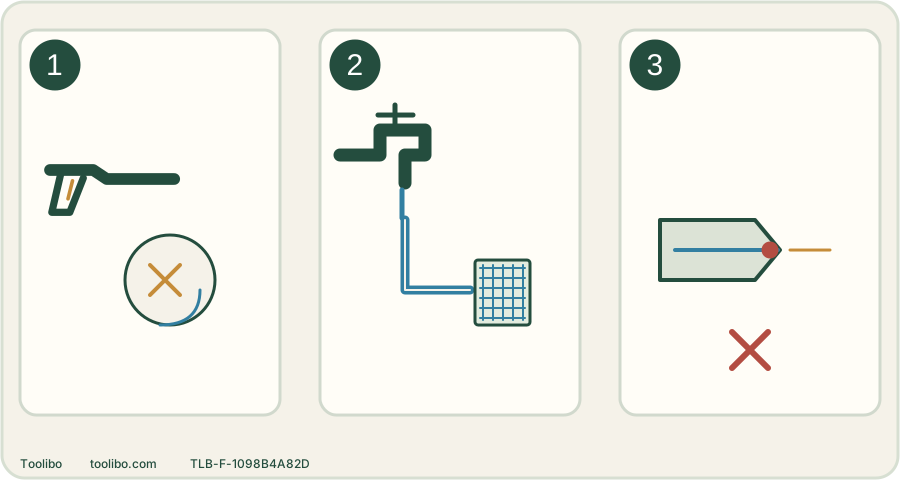
Correct setting
Detergent mode and some accessories normally deliver lower pressure.
Adequate inlet
Check the hose route, water source and both filters.
Correct nozzle
Clean debris or replace wear; do not open the pump to compensate.
Use the correct cleaning setting, restore an adequate inlet and compare an approved nozzle before arranging service. Conceptual schematic, not a product image or scale drawing.
Define the symptom before changing parts
Use one familiar, approved nozzle and an appropriate cleaning surface. Compare its current behaviour with its previous performance at the same setting; moving farther away or using a wider fan changes cleaning intensity without proving a machine fault. A detergent setting or a low-pressure attachment is not a valid test of maximum cleaning output.
Record whether the stream stays weak continuously, surges in a rhythm, or stops completely. This article follows steady weakness. For repeated pulses, check trapped air and supply stability separately. Do not measure pressure by spraying your hand or by forcing the jet into a container.
Check the operating setup
On a machine with an adjustable lance, verify that it is in the intended cleaning setting rather than detergent mode. Confirm the nozzle and any extension are approved for the model. A connector that fits says nothing about the orifice size or required flow. If the problem started after adding an accessory, return to the original approved arrangement after shutting down and depressurizing.
Check that the water tap is fully open and the supply hose is not pinched, flattened under a wheel or wound around a tight corner. Verify the water source meets the model’s inlet requirements. Do not solve a weak source by trying to run the pump harder. A tank-fed setup also needs the model’s permitted suction height, suitable hose and an airtight connection.
Restore an unrestricted inlet
Shut down, unplug, disconnect the supply and release pressure before opening the inlet. Inspect and rinse the removable filters, then refit them and their seals. Bosch UniversalAquatak 135 uses both an internal and external filter; checking only one leaves a possible restriction in place.
Reconnect and clear air using the matched startup procedure. Run one short comparison with the original nozzle. If pressure returns, note whether correcting the supply or cleaning the filter made the difference. Changing several components at once may restore operation but hides the cause and makes a recurring problem harder to trace.
Distinguish a blocked nozzle from a worn one
Debris can reduce or distort the spray; a calibrated opening enlarged by wear may give steady low pressure. Inspect a detached nozzle under good light. Clean a blockage only with the specified tool and method. Do not drill, file or grind the opening, because changing its dimensions changes the nozzle’s operating characteristics.
A correctly rated, known-good replacement nozzle can test the accessory branch. Isolate and depressurize before fitting it. If this restores normal performance, replace the worn accessory. If both approved nozzles behave the same, stop buying more heads and return to the shared supply or machine fault.
When external checks are enough
The Bosch troubleshooting table also lists a worn start/stop valve under steady low pressure. That entry is not permission to open the valve or adjust a spring. If the correct accessory, adequate water supply and clean filters do not restore performance, arrange service and provide the model, nozzle used, water source and observations.
Stop sooner for a damaged hose, internal leakage, burning smell, abnormal vibration or repeated electrical protection trips. A machine that still sprays water is not automatically safe to continue using. The useful outcome of this checklist is either a corrected external cause or a clear service report, not a guessed pump diagnosis.
Keep a short before-and-after note for each single change: accessory used, water source and whether output stayed steady. If an apparent improvement disappears when the same setup is repeated, report that uncertainty instead of assuming the last part touched was the cause.