
Choose a suitable water jet
Numbered schematic explaining Choose a suitable water jet.
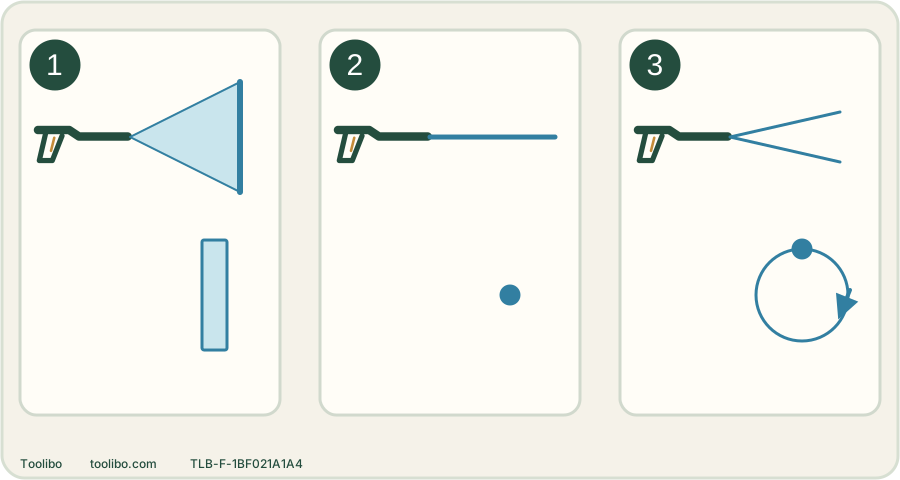
Fan footprint
A broad strip spreads the jet; compatibility and a test patch still matter.
Concentrated point
A small contact patch concentrates action and is unsuitable for sensitive vehicle surfaces.
Rotating point
A point jet sweeps a circle; circular coverage does not turn it into a gentle fan.
Use a suitable fan jet for sensitive surfaces; reserve rotary jets for sound surfaces explicitly permitted by the maker. Conceptual schematic, not a product image or scale drawing.
What changes when the jet changes
A fan spreads water across a strip. A narrow concentrated jet applies water to a smaller target. A rotary nozzle moves a concentrated jet in a circular pattern: it covers an area, but it has not become a gentle fan. This distinction matters when the target has paint, soft fibres, a coating or joints that can be washed out.
The colour of a replaceable nozzle is not sufficient to identify its compatibility. Check the connector, permitted pressure, flow/orifice specification and the washer’s accessory list. Do not transfer one brand’s colour code or bayonet connection to another. A fitting that latches can still be hydraulically unsuitable.
Make the surface decision first
For vehicles, the Bosch UniversalAquatak instructions specifically prohibit rotary and pencil jets. For wood, Kärcher’s decking guidance uses a flat jet and warns against point jets or dirt blasters. Strong paving may permit an aggressive attachment, but its joints, coating and surrounding soft stone still need separate assessment.
Swipe or scroll horizontally to see all columns.
| Surface or task | Sensible starting choice | Reason to stop |
|---|---|---|
| Sound painted surface approved for washing | Suitable fan at permitted distance | Paint lifting, edge damage or water entering seams |
| Approved timber deck | Low-aggression flat jet along grain | Raised fibres, furrows or coating removal |
| Sound compatible paving | Fan or matched surface cleaner | Sand loss, loose jointing or exposed aggregate |
| Unknown coating or fragile substrate | Hand cleaning first | No reliable material instructions |
Change an attachment without retained pressure
Complete the exact washer’s shutdown and pressure-release procedure, and isolate power before disconnecting a nozzle or lance. Engage the trigger lock after depressurizing. Check the seal and locking mechanism, attach the correct nozzle and confirm it is secure before restarting. Never look into an attached nozzle or place a hand in front of it to inspect the spray.
Run a controlled trial
Choose an inconspicuous representative patch, not an already damaged edge. Start at the gentlest permitted setting and the maker’s stated distance, keeping the lance moving. Inspect the patch with the trigger released. Change one variable at a time: detergent and brushing may solve a stain without increasing jet aggressiveness. Moving closer is not a harmless substitute for choosing the right tool.
When cleaning becomes damage
Stripes, a newly rough texture or colour change can be material removal rather than remaining dirt. Do not chase the stripe with a closer jet. Stop and let the area dry enough to inspect. Likewise, a rotary nozzle that stops rotating must not be treated as a usable fixed-point jet. Isolate the machine and follow the accessory’s cleaning or replacement instructions; do not dismantle a running nozzle.