
Hook and external bottle versus reel and on-gun control
Hook and external bottle versus reel and on-gun control — numbered controls and physical routes explained by the legend.
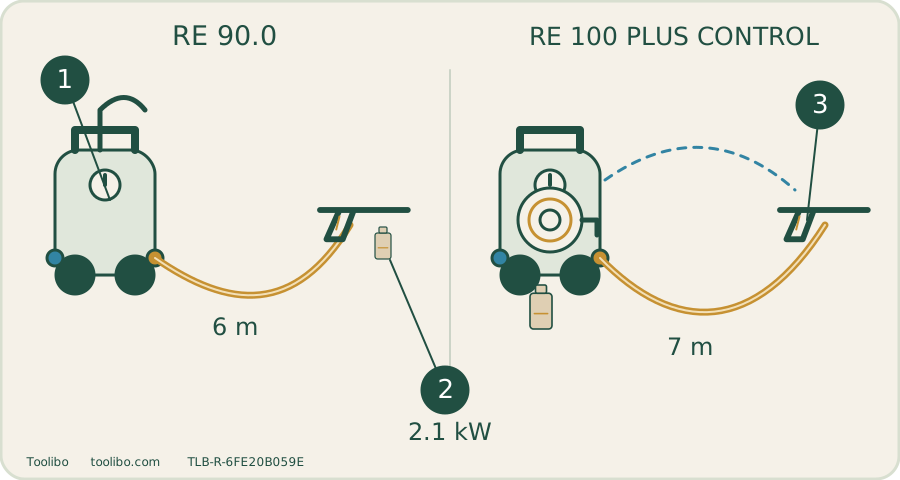
RE 90.0
- Working 100 bar; maximum permissible 130 bar.
- 6 m hose on hook, not reel; separate fan/rotary nozzles and external detergent spray set ≤ 500 ml.
RE 100 PLUS CONTROL
- Working 110 bar; maximum permissible 150 bar.
- 7 m reel; three power levels, 3-in-1 nozzle and integrated bottle. Detergent position requires HIGHEST level. AAA LR03 control batteries; red battery and green link indications differ.
Storage
RE 90 hook / RE 100 reel
Detergent
Lance spraying set / machine bottle
Control
Separate nozzle / 3-in-1 plus radio levels
Original explanatory diagram; not a dimensioned service drawing.
Match the two current UK identities
Compare RE 90 product RE020114541, with the current RE 90.0 manual, against RE 100 PLUS CONTROL product RE020114531 and its RE 100.0 PLUS CONTROL manual. Older RE 90 families and US voltage versions are not interchangeable evidence. Both selected UK versions use 2.1 kW input in their matched technical sections; the larger model number does not mean a higher input rating here.
The main differences are hose storage, detergent application and pressure selection. RE 90 has a 6 m hose on a hook, separate fan/rotary nozzles and an external spraying set. RE 100 PLUS CONTROL has a 7 m hose reel, a 3-in-1 nozzle, integrated detergent bottle and gun-mounted three-level radio control.
Keep performance labels consistent
Swipe or scroll horizontally to see all columns.
| Matched specification | RE 90.0 | RE 100.0 PLUS CONTROL |
|---|---|---|
| Working pressure | 100 bar | 110 bar |
| Maximum permissible pressure | 130 bar | 150 bar |
| Maximum water throughput | 440 L/h | 450 L/h |
| Minimum water throughput | 350 L/h | 350 L/h |
| Hose | 6 m | 7 m |
| Storage | Hook | Reel |
Minimum throughput is an output label, not the minimum tap supply. Do not substitute 350 L/h into a water-supply checklist. The maximum-flow difference is small in this table, and neither figure provides a tested cleaning-time advantage on your paving. Choose the workflow first.
Scenario one: infrequent, straightforward work
For a few objects near the tap, RE 90 may be the simpler choice if 6 m covers the route. You select the appropriate separate nozzle and use the external spraying set when needed. There is no gun-control battery or radio-link indication to understand.
That simplicity still requires deliberate attachment changes and safe isolation. If your routine is mostly plain-water rinsing with one suitable nozzle, those changes may be infrequent. Compare how you actually clean rather than assuming every extra feature will be used each time.
Scenario two: several surfaces and frequent packing away
RE 100 PLUS CONTROL is more compelling when switching the working level at the gun and winding the hose onto a reel genuinely reduces inconvenience. Its 7 m hose offers only 1 m more than RE 90, so measure the real route before counting reach as the reason to upgrade. The entire hose must still be unreeled during use.
The 3-in-1 nozzle selects spray function separately from the power level. This is useful control, but not automatic surface recognition. A sensitive finish still needs a test and an appropriate pattern. Low power cannot make rotary cleaning suitable for every material.
Scenario three: detergent is part of every job
RE 90’s detergent bottle attaches at the lance in place of the normal nozzle. RE 100 stores its bottle on the machine and uses the detergent position of its 3-in-1 nozzle; its matched instructions require the highest power level for that detergent setup. Do not transfer a different brand’s “lowest setting for soap” rule without checking which control is meant.
The integrated arrangement may be convenient when you repeatedly alternate stages. The external set may suit occasional use and simpler visual checking of the fluid path. Neither is a reason to mix chemicals or let cleaner dry against its product directions. Complete cost includes the detergent and any genuinely needed compatible accessories, not just the washer.
What the extra electronics ask of you
On RE 100, a red flashing battery indication directs you to the control batteries; a green flashing activation key means a lost connection. These are not pump-pressure readings. If you prefer fewer diagnostic branches, that is a legitimate reason to prefer RE 90 rather than a missing feature to apologize for.
Choose neither until water, safe electrical positioning, surface tolerance and runoff are resolved. Both require proper model-specific setup and frost protection. A useful choice is “RE 90 covers my simple 6 m routine” or “RE 100’s reel, integrated detergent and on-gun level selection solve repeated handling.” It is not “150 bar must clean everything better than 130 bar.”
Models referenced