
Four fields keep a service request factual
The eye records observations, the components record configuration, the check marks only work actually done and the question mark records what service must confirm.
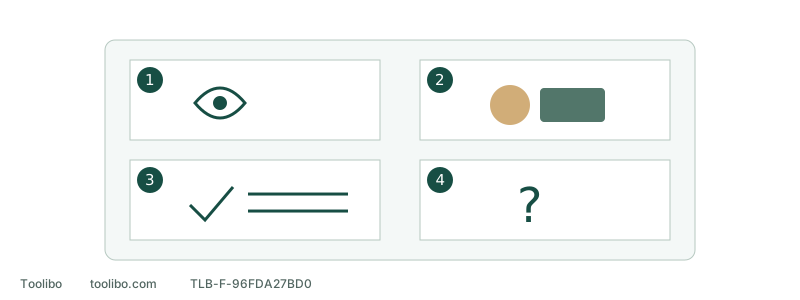
1. Observed facts
Separate what happened from a guessed internal cause.
2. Configuration
Identify actual abrasive, pad, extraction and power setup.
3. Completed checks
Leave unperformed checks and unmeasured values explicit.
4. Requested next step
Ask for applicable external action, service or transport guidance.
The eye records observations, the components record configuration, the check marks only work actually done and the question mark records what service must confirm.
Decide whether approaching is safe before collecting details
For ongoing smoke, fire, abnormal heating, leakage or a damaged-battery risk, do not approach, touch or remove things to read labels or photograph them. Move away and seek appropriate emergency or professional assistance. Information can wait; a missing photo is preferable to added injury.
For stable equipment safe to handle, stop according to the applicable instructions, wait for all motion to cease and safely isolate power before reading external labels. Mark it out of use so somebody else does not test it because it looks normal. This guide organizes a request; it does not require new powered tests.
Put identity before the four fields
Record brand, complete body model or catalog number, full serial number and any visible Type or suffix. List the sales kit separately rather than replacing body identity with its package name. Preserve additional model letters when identifying RYOBI PCL401 or PCL406 for service; do not shorten them away.
For battery tools, list the actual battery and charger models used, or unknown where necessary. Do not handle a hazardous battery to fill this gap. Prepare purchase date, receipt and repair history if available, without inventing a date or warranty status.
Send complete serial and purchase information to the selected manufacturer or service provider. For public discussion photographs, obscure names, addresses, order details and identifiers that do not need public disclosure.
Copy these four fields and enter existing facts
Swipe or scroll horizontally to see all columns.
| Field | Information to fill in |
|---|---|
| Observations | Symptom: ____; when or during which task first noticed: ____; location: ____; intermittent or consistent: ____; existing observations of smoke, smell, heat, vibration or battery trouble: ____; not observed or uncertain: ____ |
| Configuration | Known material and coating: ____; abrasive brand, series, grade and size: ____; actual pad or intermediate layer: ____; box, extractor, hose and adapters: ____; battery or power information: ____; recently changed components: ____ |
| Completed checks | External checks and cleaning actually performed: ____; exact manual and steps used: ____; whether power was isolated: ____; observations: ____; checks not performed: ____ |
| Questions | Replacement accessory, permitted external action or service assessment wanted: ____; please confirm version and next step: ____; if transport is needed, provide separate tool, dust and battery acceptance/packing requirements: ____ |
Not every box needs a definite answer. If you did not measure temperature, airflow or vibration, say “not measured.” Do not convert “hot” into a temperature or a sound change into an instrument-measured speed drop.
An example that does not pretend to diagnose
This is hypothetical wording, not a real inspection report: “2648-20, actual serial supplied separately. After changing a dust connection, I noticed visible dust escaping at the box joint during normal sanding. The tool is now out of use and power isolated. I inspected the external connection and saved photographs, without opening the housing or restarting to verify. Please confirm accessory suitability and permitted external action, or advise service arrangements.”
It does not declare the fan broken or pretend every cause has been excluded. Include smoke or abnormal heat if actually present rather than omitting it to fit the example. Only say power was isolated if that genuinely happened.
Supply only documents and photographs obtainable safely
When referring to 2648-20 parts lists, specify 54-38-2600/J49A or 54-38-2601/J49B and whether applicability to the actual serial is confirmed. If not, say pending. A common catalog number does not guarantee identical service parts. Do not diagnose an internal component or order it merely from a drawing label.
Prefer safely isolated external views, visible labels, abrasive packaging and existing affected-area images. Do not open the housing or restart to demonstrate sparks, smoke, severe vibration or abnormal pad motion. For PCL406 stopping concerns, distinguish a change noticed during normal work from a routine check genuinely performed earlier using the exact procedure. A casual estimate is not the formal six-second brake check; do not reproduce abnormal behavior to complete the form.
Wait for a next step applicable to this tool
A useful reply matches actual model, version and symptoms, and distinguishes permitted owner external work from service assessment. Finding a parts diagram does not change Milwaukee’s repair boundary. Advice about a dust box does not authorize opening the motor housing. Clarify replies for another model or omitting smoke and heat before acting.
Do not pack and ship a suspect, damaged, leaking or abnormally hot battery as an ordinary parcel. Obtain professional handling and carrier requirements appropriate to its condition first. A normal tool return label is not hazardous-battery transport approval, nor a reason to remove a dangerous battery to satisfy it.
Keep the request, photographs and reply, and keep the tool out of use until an applicable resolution. The goal is not a technician-like fault name: it is removing guesswork about identity, configuration, observations and safety state.
Models referenced