
Trace the item into its matching list
Simplified document and dust-box shapes show the reading path, not a disassembly sequence. Dashes are missing independent numbers in these rows, not permanent unavailability.
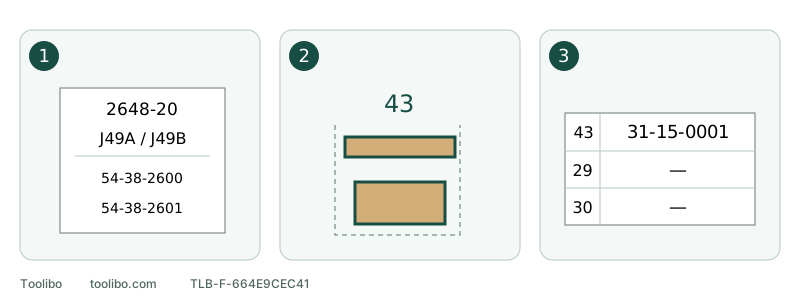
1. Identity and document
Match actual serial group to the correct list.
2. Illustrated item
43 identifies the dust-box assembly in the drawing.
3. Ordering reference
Read across to 31-15-0001 and confirm current applicability with service.
Simplified document and dust-box shapes show the reading path, not a disassembly sequence. Dashes are missing independent numbers in these rows, not permanent unavailability.
Choose the document for the question
For fitting abrasives, connecting extraction, cleaning the dust box or normal starting and stopping, use the exact applicable operator’s manual. Use a parts list to describe a missing component to service or establish a replacement assembly’s identity. A product page can locate documents, but does not replace operating instructions.
A damaged dust-box lid may require both: the drawing identifies lid, gasket and body relationships; the operator’s manual establishes permitted external removal and cleaning. Keeping these purposes separate prevents treating an internal exploded view as your own dismantling plan.
First: match the tool identity to the document header
Read labels only on stable equipment that is safe to approach. For smoke, continuing abnormal heat or suspected battery leakage, do not approach, touch or remove anything to obtain photographs; seek appropriate help first. For ordinary label inspection, switch off, wait for all motion to stop and safely isolate power.
Record the actual catalog number and complete serial number without opening the housing. The relevant 2648-20 lists are 54-38-2600 for starting serial group J49A and 54-38-2601 for J49B. Both are dated June 2023, so date alone does not select the right one.
J49A or J49B identifies an applicability group, not the complete serial number of your individual tool. If the label is unclear, prefix differs or applicability remains uncertain, send existing label details and document numbers to support rather than selecting by appearance.
Second: trace the drawing number into the same table
The dust-box example explains identification, not internal repair. Find the item in the drawing, locate its number in the FIG. column, then read across PART NO. and description. Do not splice numbers from different rows or documents.
Swipe or scroll horizontally to see all columns.
| Marking | Meaning | Useful next action |
|---|---|---|
| 43 in the illustration | Dust-box assembly item number | Look up assembly description and ordering number |
| 31-15-0001 beside item 43 | Dust-box assembly part number | Ask support about current supply and exact-version suitability |
| 29, 30, 31 and 32 | Component items such as lid, filter, screws and body | Describe the affected area, not shopping model numbers |
| Dashes in a PART NO. cell | No independent ordering number given in that row | Do not invent a number or infer that replacements can never be available |
Both lists agree on this dust-box example. They are not interchangeable throughout the tool: motor assemblies and other entries differ. One common external accessory does not make J49A and J49B universally interchangeable.
Third: separate assembly contents from purchasing options
The large number and associated small numbers show what the assembly includes, not that every component is sold separately. A lid problem might lead support to recommend an assembly or another applicable accessory route. The drawing itself guarantees neither stock nor price nor the current superseding number.
A useful request is: “My tool is 2648-20, complete serial number … . I am using document … . The damaged area appears to be the dust-box lid, item 29. This drawing lists dust-box assembly item 43 as 31-15-0001. Please confirm the current applicable replacement and permitted external installation procedure.”
This is clearer than asking to buy number 29, without presuming a whole box must be purchased. Share the complete serial number with the selected manufacturer or service provider, not in a public comment.
A part number does not extend the repair boundary
A service document may also contain internal assembly, wiring and fastening information. Its presence does not authorize the owner to open the tool, battery or charger. The 2648-20 operator’s maintenance instructions direct repairs through Milwaukee service. This example stops at identification and enquiry, not motor, electrical or brake repair.
A used tool may have replacement external components. Record visible differences from the drawing instead of dismantling the tool to restore its pictured appearance. Even permitted external accessory replacement follows the exact operator procedure, not guessed order, torque or testing derived from a picture.
Check three things in the reply
Does the reply match the complete tool identity rather than only its brand? Does it confirm a part number, assembly contents or a service appointment? Do not expand one answer into another. Finally, is the next step explicitly suitable for the owner, with the necessary exact instructions?
If a shopping link leaves serial applicability unanswered, ask before ordering. Identifying a part is not diagnosing a fault. The useful result is a clear description of the actual area, matching document and remaining question.
Models referenced