
Turn an observed fault into a clear handover
Isolated washer and hose, clock and numbered observation sheet.
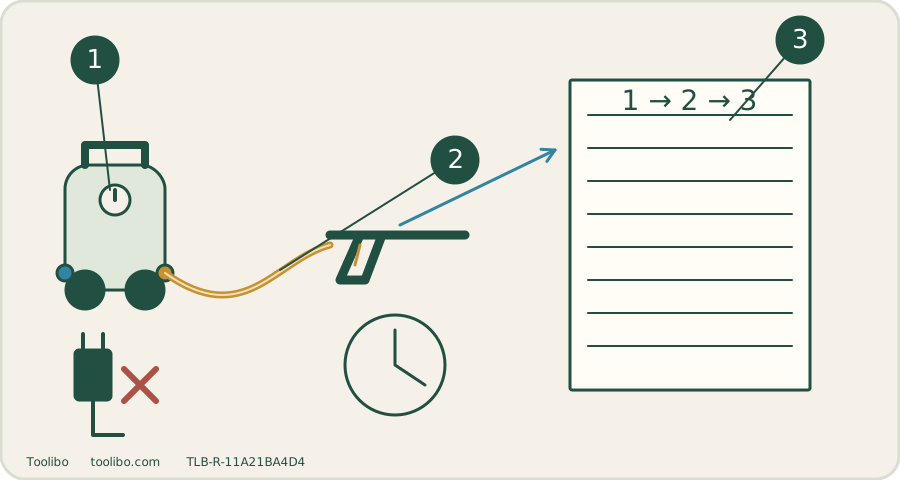
Stop
Use safe model-specific shutdown where possible.
Observe
Record timing and visible location.
Handover
List actual checks and the current isolated state.
Photographs must not require restarting a leaking or electrically unsafe machine.
Decide when the record replaces troubleshooting
Stop using the machine if there is a damaged power cable, a damaged pressure hose, leakage from the housing, protective-device tripping or abnormal behaviour that the permitted external checks do not resolve. A current STIHL RE 90.0 manual sends repeated pump cycling with the trigger released to dealer inspection; it is not an invitation to adjust a pressure switch.
Use the model’s safe shutdown and pressure-release sequence where it is safe to do so. If an electrical fault makes touching the plug or machine unsafe, keep clear and obtain qualified help. Do not open the case, measure live voltage or feel for a high-pressure leak.
Capture identity and configuration
Record exact model/type, market, serial number, approximate purchase date and whether the machine is borrowed or rented. Keep the serial and purchase documents in a private service record. A public forum does not need your address or a full receipt photograph.
List the fitted gun, nozzle, hose and adapters; note whether they are original or documented approved replacements. Record supply method, such as mains tap or a manufacturer-approved suction setup. Describe any extension arrangement only as actually used; do not quietly omit it because it may be relevant.
Describe timing rather than guessing the failed part
Swipe or scroll horizontally to see all columns.
| Record field | Useful observation | Avoid replacing it with |
|---|---|---|
| When it occurs | Starts normally, then pressure fluctuates while trigger is held | “Pump is broken” |
| Trigger released | Motor stops once, or repeatedly restarts | “Autostop problem” without timing |
| Visible water | Water observed at inlet coupling before shutdown | “Internal seal leak” without evidence |
| Protection | Device tripped once; machine not restarted | A claim that a larger fuse is needed |
These examples show how to describe an observation, not instructions to provoke each symptom. Include whether it began after storage, an accessory change or a different water supply, but label an association as an association, not a proven cause.
List checks already completed
Write each permitted external check and its result: supply hose unkinked, accessible filter inspected intact, approved nozzle identified, or water-flow check performed with the washer disconnected. If you measured supply volume and time, record both raw values and the calculated flow. Do not simply write “water is fine.” Leave unperformed checks blank.
For photographs, use the safely isolated machine. A wide shot of the connection layout and close-up of an already visible defect can be useful. Do not reconnect a leaking hose or re-energize wet equipment for a recording. Mark the location on a sketch if the fault is not safely photographable.
Make the handover actionable
End the record with the current state: disconnected, pressure released where safely possible, water drained as permitted, and not returned to use. Ask the service provider how to transport the particular machine and which accessories they need. Avoid sending a fuelled petrol machine under electric-machine transport assumptions.
Keep the completed repair report with the original symptom record. Before returning to work, confirm that the repairer has cleared the fault and that any replaced hose or gun is the correct assembly. A fault that disappears after repeated resets has not thereby been diagnosed.