
Accept evidence, not a dry-running demonstration
Disconnected washer, identity sheet and sound versus bulged pressure hose beside a water tap.
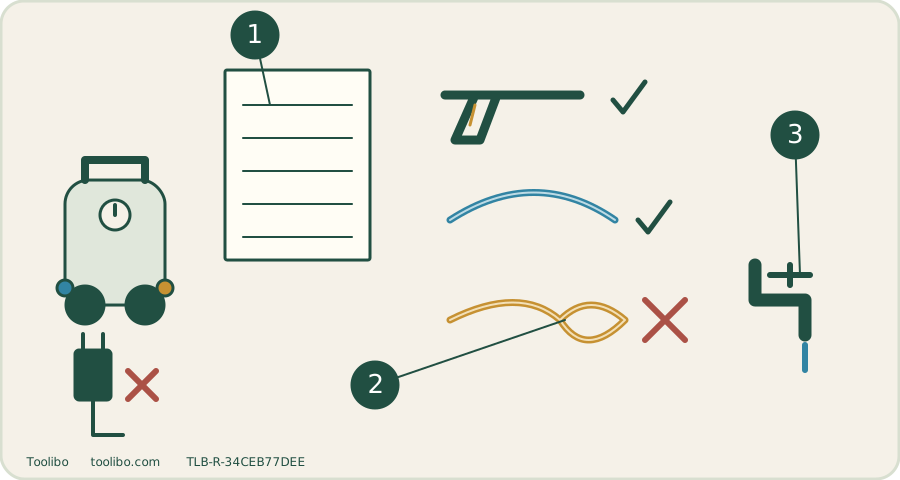
Identity
Match manual and supplied kit.
Condition
Inspect the entire disconnected hose and controls.
Demonstration
Require correct supply and safe operation.
A safe demonstration follows inspection; it does not prove future pump life.
Agree on what you are accepting
Ask for the exact model and regional manual before collection. List the supplied gun, lance, nozzle, pressure hose, inlet filter and any optional accessories. For a rental, ask the provider to explain setup, shutdown and the return condition. Clarify who to contact if the machine faults during the job.
For a used purchase, ask whether the machine has frozen, leaked or been modified. Answers help direct questions but do not prove its internal condition. Do not promise yourself that a clean casing means a healthy pump.
Inspect while disconnected
Place the machine on stable ground with power disconnected and pressure released. Inspect the whole cable and plug without opening them. Look along the complete pressure hose, including bends near its ends, for cuts, bulges, flattened sections, exposed reinforcement or improvised repairs. A taped hose is not an acceptable high-pressure hose.
Check that the gun, trigger lock and connectors are complete and show no obvious damage. Ask the provider to demonstrate the intended control movement while isolated. Do not bind a trigger open, defeat a lock or force a stiff coupling. Inspect accessible inlet parts using the manual’s procedure; missing or damaged filters need correction before a test.
Swipe or scroll horizontally to see all columns.
| Observation | Acceptance decision |
|---|---|
| Missing label or unmatched manual | Pause until exact identity is established |
| Damaged cable, bulged hose, defeated safety control | Reject operation; provider must arrange proper repair |
| Unidentified adapter or replacement gun | Require exact approved compatibility evidence |
| Cosmetic dirt only | Clean external surfaces as permitted, then inspect again |
Request a useful demonstration
Only proceed after the visible inspection passes. The competent provider should set up the correct water supply and approved electrical arrangement, purge and start according to that model, then demonstrate from a stable stance toward a suitable safe surface. Keep bystanders away. Never accept a dry-running demonstration in a shop aisle as proof that the pump works.
Observe from a safe position: does the chosen spray remain consistent, does water appear where it should not, and does the machine behave as its controls require? Do not touch or search for a live high-pressure leak with a hand. Unexpected leakage, repeated cycling after trigger release, unusual noise or protective tripping ends the test. Record the observation and ask for repair or another machine, not repeated restarts.
Keep a handover record
Write down existing external damage, included accessories, the demonstrated configuration and any issue raised. For a rental, agree on the pressure-hose condition and filter presence before leaving. Keep serial details and receipts private. This avoids confusing a pre-existing problem with damage during your job.
A short successful demonstration establishes only what was observed under those conditions. It cannot certify hidden electrical safety, future pump life or frost damage that has not become visible. If the provider refuses a safe inspection or insists that a known defect is normal, choose another machine. The right outcome may be walking away.