
The nameplate must match the intended supply
Machine points to a 230 V 50 Hz card; a different 120 V 60 Hz card is crossed as a mismatched example.
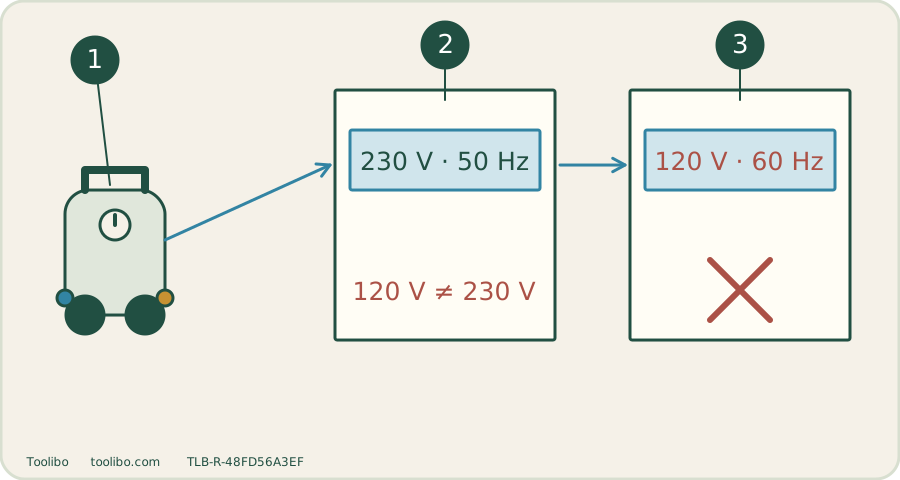
Identity
Read the actual machine label.
Match
Compare exact voltage, frequency and regional manual.
Reject mismatch
Leave unclear supply or identity unresolved.
Illustrative label fields are not a conversion instruction.
Ask for evidence of the actual unit
Request a clear photograph of the rating plate and the carton model label from the seller. Record the complete model/type number, regional suffix, voltage, frequency and input rating. Keep the serial number in your private purchase records, not a public review. A stock image from another listing cannot confirm the unit being sold.
Ask which regional instruction manual comes with it. A manual in English is not necessarily a UK manual; Spanish does not automatically mean the machine is approved for every American market. Article language and machine market are separate pieces of information.
Use a five-field acceptance sheet
Swipe or scroll horizontally to see all columns.
| Field | Evidence to compare | Result that needs clarification |
|---|---|---|
| Identity | Physical type/model label against the manual cover and applicability table | Similar name but different suffix or revision |
| Supply | Label voltage and frequency against the intended installation | Missing frequency, incompatible voltage or uncertain supply |
| Package | Carton SKU and itemized included accessories | A pictured brush or reel absent from the box list |
| Replacement parts | Exact approved hose, gun, nozzle and filter references | Seller says only “universal” |
| Local support | Named service channel and written warranty terms | Overseas-only support or no clear return route |
Leave unknown fields unresolved. Do not turn a seller’s claim that it “works anywhere” into a verified specification.
Why matching the name is not enough
The current STIHL RE 90.0 instruction manual includes several voltage versions. Its 220–240 V section and its 100 V section do not have the same working-pressure figures. Copying the familiar name and then choosing the most attractive number from each table would create a machine that does not exist.
A label saying 230 V, 50 Hz should therefore be compared with the actual supply and the matching regional manual, not assumed compatible because the plug can be made to fit. Those numbers here illustrate how to read fields; they are not a recommendation to convert a different appliance. Do not infer suitability from a travel adapter or assume a transformer solves frequency, protection, starting-load and approval questions.
Check the purchase as a complete system
Work backward from the job. Will the included hose reach without an unapproved extension? Is the optional surface cleaner genuinely listed for that revision? Can you obtain an intact replacement pressure hose locally? Will the seller accept a return if the delivered label differs?
For example, two offers with the same headline model may have different country suffixes and accessory packages. Choose neither until both identities are clear. A lower price is not comparable if it excludes the correct gun, requires unsupported adapters or leaves no practical service route.
Inspect again on delivery
Before connecting anything, compare the received rating plate, plug and box contents with the saved acceptance sheet. Photograph discrepancies while the machine remains unpowered. If the label is missing, altered or incompatible, arrange clarification or return rather than a demonstration. Never energize an uncertain imported machine simply to see whether it runs.