
Four checks before a purchase decision
Four panels show identity documents with body and power equipment, disconnected power and a schematic holder inspection, missing components plus documented cost, and reject/pause/documentary-consider branches.
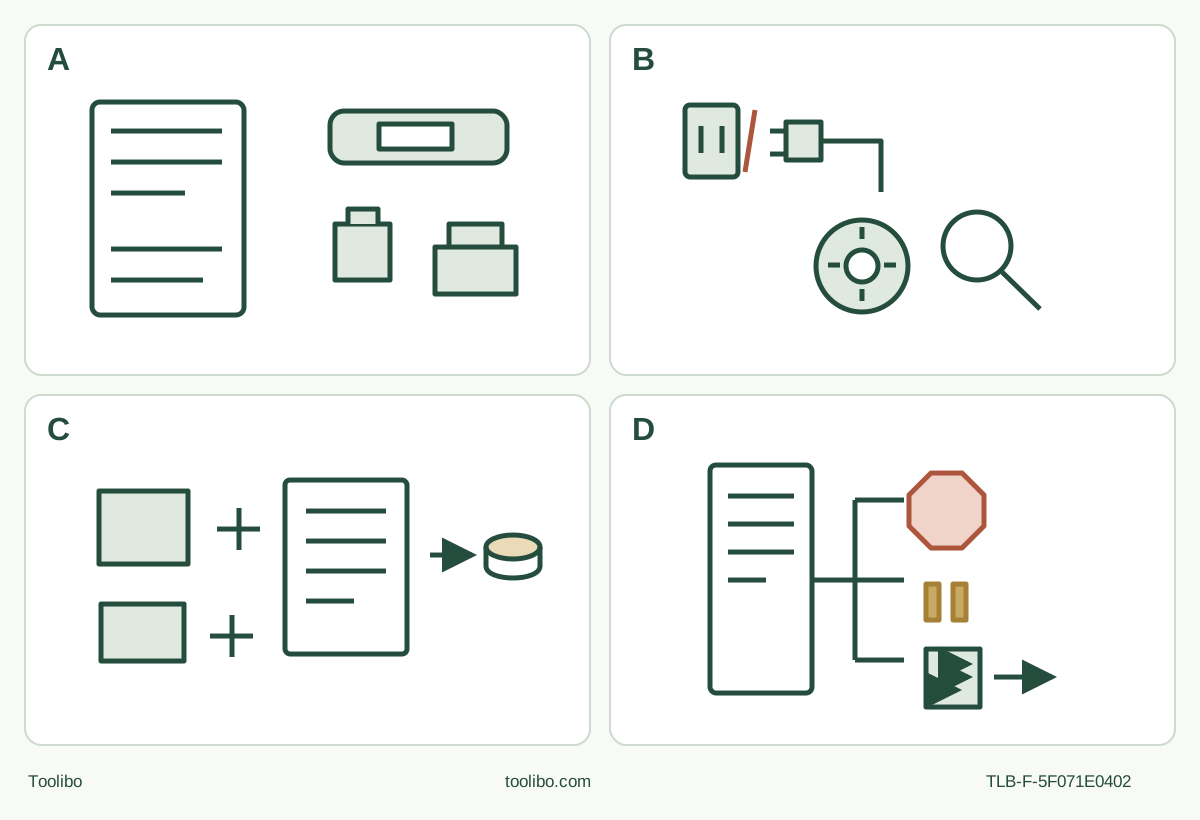
A · Identify every component
Match the actual regional tool, battery and charger to manufacturer documents and record seller history and applicable notice evidence.
B · Inspect only while isolated
Unplug or remove the pack before external holder and condition inspection. Do not open the housing, probe terminals or power a suspect system.
C · Price a complete approved system
Include exact missing parts, approved accessories and power equipment, plus qualified assessment or repair—not just the advertised body price.
D · Choose a documented outcome
Reject unsafe or unidentified offers, pause unresolved issues for qualified evidence, or consider a verified whole system without claiming it is certified safe.
Original schematic freshly reviewed. B is an uncounted generic holder icon, not an interface or wear specification; the cord is disconnected. D ends at a purchasing decision, not a safety certificate or immediate permission to operate.
Buy a documented system, not a spinning body
A used oscillating multi-tool can be inexpensive to acquire and expensive to make complete. A missing proprietary clamp component, incompatible battery or damaged cord can change the decision before any cutting starts. This guide ends with one of three outcomes: reject the offered system, pause for qualified-service evidence and a written completion quote, or consider purchasing an identified complete system. None is a certificate that a used tool is electrically safe or has useful remaining life.
The examples are deliberately specific: the US Dremel MM35 under its August 2018 manual, FLEX FX4111 under its matched US instructions, and Bosch GOP18V-34 under its March 2023 US manual and listed power-system document. They illustrate different mechanisms, not interchangeable parts. A different regional body or revision needs its own documentation. This is a pre-purchase documentary and isolated visual screen, not a powered fault-finding procedure or a hands-on review of a particular seller’s tool.
Ask for identity and history before arranging a demonstration
Request clear photographs of the whole body, readable nameplate, model and regional voltage information, and the accessory holder with power disconnected. For a cordless offer, obtain separate pictures and identifiers for every battery and charger, including the charger input rating. Ask what is actually included: the body, clamp components, specified adapters, blades, sanding pad, extraction parts, power equipment and instructions. A case full of blades is not proof that any one blade is approved for the tool.
Ask about drops, liquid exposure, overheating, intermittent operation, repairs, replaced cords or switches, and any missing parts. Request available purchase and service documents. A seller’s answer is evidence to record, not a diagnosis to accept. If photographs hide the identity label, disagree with the offered model, or cannot establish what is included, pause before comparing prices. Do not infer authenticity from branding, a serial-number photograph, a clean housing or a charging light.
Retrieve the exact manufacturer manual yourself and compare the pictured controls and holder with its actual figures. A current product page may help locate a manual, but it does not make a 2018 MM35 document the latest supplied revision. If the seller’s unit differs, stop applying the example’s assembly instructions and obtain the matching document.
For a US offer, consult the official CPSC recall and product-safety-warning search and the manufacturer’s notices using the actual tool, battery and charger identifiers. Read any potentially applicable notice for affected identifiers and the prescribed remedy; keep a dated record of the evidence. The CPSC service is a search resource, not a statement here that any of these three models is recalled or free of recalls. An empty search, an incomplete identifier or a seller’s screenshot cannot establish that no recall applies. Outside the US, use the relevant regulator and manufacturer route for that market. An unresolved possible match is a reason to pause, not to perform a trial run.
Make isolation a condition of the inspection
The seller should switch the tool OFF and unplug a corded tool or remove the cordless pack before holder inspection or accessory handling. A worklight-only position on the GOP18V-34 is not isolation. Do not depend on a lock, a depleted battery or an electronic protection feature. Allow hot accessories to cool and protect hands against sharp edges. If safe isolation cannot be established, do not proceed with a close inspection.
Look without opening the housing: cracks, missing screws, damaged grip surfaces, blocked vents, evidence of liquid ingress, heat damage and visibly damaged switches all need resolution. Inspect an unplugged cord, plug and strain relief for cuts, exposed conductors, crushed sections, scorching or improvised repairs. Tape is not evidence of a qualified cord replacement. For batteries and chargers, externally visible damage, leakage, deformation, damaged contacts or heat effects are stop signs, not invitations to charge and see what happens.
Do not open a battery, probe terminals, bypass a latch, defeat protection, open the motor or energize a damaged cord. This screen cannot reveal all internal defects. A seller’s video of a running tool does not supply electrical testing, load endurance or battery-capacity evidence.
Compare the actual holder with its own mechanism
Use the manufacturer’s complete assembly instructions only for a clearly matched, undamaged, isolated unit and a known approved accessory. If you are not competent to handle it safely, ask qualified service to inspect it. Do not force a stuck mechanism or invent a wear tolerance. Visible cracking, distorted engagement features, unexplained movement after correct assembly, a lever that will not reach its specified position or missing proprietary parts is enough to stop considering it a ready-to-use system.
MM35: a spring-held blade is not a fully clamped blade. The 2018 mechanism loosens counterclockwise, then the knob is pressed to extend the flange. The approved accessory must engage all holder pins and lie flush. Releasing pressure lets the spring temporarily hold it; the knob still needs complete clockwise hand-tightening as instructed. Inspect whether the actual knob, flange and engagement features are present and undamaged. Do not accept a seller’s demonstration of magnetic or spring retention as proof of the final clamp. Do not add pliers or a substitute fastener to rescue a suspect holder. The matched manual restricts use to Dremel accessories rated at least 21,000 OPM.
FX4111: jaw appearance must be read in the correct state. With the pack removed, the release lever goes counterclockwise through two clicks; at the second, the jaws are closed for accessory changing. With the accessory supported on a flat surface and its star interface aligned, returning the lever clockwise to its original position opens the jaws and locks the accessory. “Open jaws” therefore does not automatically mean “unlocked” on this body. The manual forbids a backward-facing accessory and specifies FLEX accessories rated at least 20,000 OPM. Missing or damaged holder parts cannot be corrected by borrowing the MM35 method or assuming every star-shaped blade fits.
GOP18V-34: snap-in installation is not a bolt assembly. The matched accessory is positioned with its model number facing the holder, then the tool is pressed into it until the jaws snap in; the release lever need not be opened for installation. Opening that lever releases and ejects the accessory, so keep hands and surroundings clear of sharp falling parts. The manual allows the OSL and OSP ranges, not OSM, and specifies Bosch accessories rated at least 21,000 OPM. A seller’s “universal Starlock” description is insufficient. Cleanliness matters to engagement, but aggressive filing or reshaping of jaws is not an acceptable buyer adjustment.
These are comparisons of documented normal assembly. They do not authorize a powered wobble test, deliberate stall, side-loading test or repeated cycling of damaged parts. An uncertain interface belongs in the service-evidence route.
Calculate what the offer really costs
Write an itemized completion list beside the offered price. Include the exact approved accessory for your first known-material task; any required proprietary clamp component or adapter; the complete sanding extraction system if sanding is intended; a qualified service assessment and any quoted repair; and the approved battery/charger system if it is absent or unsuitable. Check actual parts availability before assuming a cheap missing item can be replaced. Do not publish a guessed repair price or treat a generic washer as an equivalent part.
For a cordless tool, match the exact pack and charger through the manufacturer documents, not merely their nominal voltage or shared-looking rail. The reviewed FLEX and Bosch examples use separately qualified listed power systems. Their body manuals are not permission to buy an unidentified third-party charger. The MM35 example instead requires the correct US 120 V, 60 Hz supply and an intact appropriate corded system; a travel adapter does not establish regional electrical compatibility.
Distinguish an indicator reading from a capacity assessment. Steady charge lights, successful charging or a brief run cannot demonstrate remaining runtime, cell health, authenticity or absence of hidden damage. If dependable battery endurance materially affects the purchase, require appropriate qualified evidence or price the uncertainty as unresolved; do not devise a home discharge or overheating test. Ask separately about the actual sale terms and any applicable service or warranty arrangements rather than assuming they transfer.
Record a decision before handing over money
Reject the offered ready-to-use system when identity cannot be established, unsafe condition is apparent, required parts have been improvised, the seller will not permit safe isolation, or material facts remain inconsistent. Do not negotiate yourself into performing a risky test merely because the price is low. A suspect battery or electrical assembly is not a repair-learning project under this guide.
Pause for qualified evidence when the identity is clear but holder condition, electrical repair, approved power pairing, parts availability or a possible recall match remains unresolved. List the exact questions for manufacturer or qualified service, obtain a written scope and completion quote, and identify who will provide the evidence before purchase. A promised repair is not a completed repair. If satisfactory evidence cannot be obtained, move to rejection rather than treating the pause as approval.
Consider the documented whole system only when identity, supplied parts, approved power and accessory compatibility, external condition, relevant notices and completion cost are all adequately resolved for the proposed purchase. Keep the records with the itemized offer. This is permission to consider the transaction, not permission to begin cutting immediately: follow the matched owner manual and a controlled, known-material first project after acquisition. No photograph, checklist or this diagram guarantees safety, authenticity, remaining life or a successful future cut.
Models referenced