
Four return-to-use gates and two hold routes
Four boxes show exact identity, accessory condition, separated cord/battery supply and supported stock; arrows from uncertain accessory or supply lead to a hold/service box, with a reminder that zero standby is not battery removal.
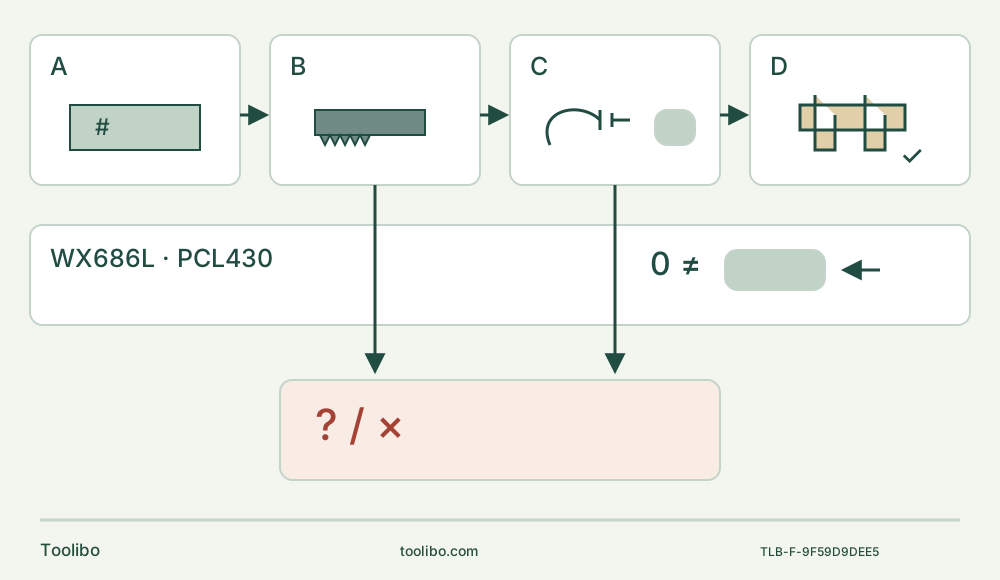
A · Rebuild identity
Match the actual body, manual, supply prerequisite and next material. Old case labels and last year’s operation do not establish current readiness.
B · Check the exact attachment
Identify the blade and required mounting hardware while isolated. Unknown, damaged or incomplete parts stay on hold; perform only the documented wrench or screw/washer route.
C · Qualify supply without energizing a fault
WX686L needs a sound matched cord/supply; PCL430 needs the actual commissioned listed battery/charger evidence. Zero standby and a dark LED are not physical isolation.
D · Enter ordinary work only after every gate
Establish stable stock/waste support, full clearance, PPE and correct control state. Use the normal owner workflow and isolate for result acceptance; unresolved faults require evidence or service, not a trial start.
Original schematic narrowed to WX686L and PCL430. The flow is a decision checklist, not a sequence authorizing power before inspection. C depicts isolated supply alternatives, not a charger pairing or plug adapter. The zero reminder applies to PCL430 standby; its pack must still be removed and lock-on cleared before later insertion. D is a fully qualified normal-job decision, not a powered safety test or certification.
Return a complete system to use, not just a body to power
A tool taken from storage may still wear the blade from its last job, have a retained control setting, or share a case with an unrelated charger or fastener. “It worked last year” does not establish today’s accessory, supply or condition. This workflow ends with one of three decisions: a complete supported system can enter an ordinary known-material job; an exact document or part must be obtained first; or the isolated equipment needs qualified service.
The two bounded examples are US Worx WX686L under AR01339301 and Ryobi PCL430 under REV 05 instructions 998000591. The PCL430 route is document-matched existing-owner scope: the exact current product-to-REV-05 manual backlink remains unclosed here. The physical body and actual supplied instructions must agree. No current kit, newer revision, battery health or warranty claim is made.
Open the case without starting the tool
Keep the power disconnected. For WX686L, confirm the slide is rearward OFF and the plug is out of the outlet. For PCL430, remove the battery; with power removed, depress and release the trigger to clear lock-on, release it and turn the speed dial fully clockwise into the 0 detent. Zero is standby, not physical isolation. Do not leave lock-on engaged merely because the dial is at 0.
Do not squeeze a trigger, plug in a cord or insert a pack to see whether storage has “hurt” the tool. First inspect the isolated body, its labels and the stored parts. Allow any recently used hot accessory to cool and wear protective gloves before handling sharp edges. Keep loose batteries away from keys, screws and other objects that can bridge their terminals.
If the case shows evidence of liquid intrusion, impact damage, unsafe contamination or a damaged battery, ordinary exterior cleaning is not a clearance procedure. Stop the return-to-use process and obtain appropriate manufacturer or qualified-service instructions. Do not open a battery, motor housing or switch to investigate. Do not reproduce an unsafe symptom for a video.
Rebuild the identity record
Put the actual model/type, document identifier, supply information and next intended task together. A blade left mounted is not necessarily suitable for the next material. Read its marking and manufacturer application information; segregate unidentifiable accessories and loose hardware rather than counting them as usable spares.
WX686L is the corded 120 V AC, 60 Hz, 2.5 A body with its removable clip-in wrench and matched flange fastener. Its manual permits appropriate accessories intended for the tool; a brand-list “Universal Fit” label is not proof of every current accessory or adapter. For a clean loose-wood example, use the identified compatible wood end-cut blade route supported by its table.
PCL430’s REV 05 accessory list identifies general-purpose plunge blade 681458028, backing pad 303590006 and 120-grit sheet 902424001. The listed blade’s table says straight cutting in wood and plastic; do not transfer the body’s broader metal applications to that blade. This return-to-use example selects the documented wood blade, not a sanding system or unknown metal cutter.
The PCL430 power prerequisite is the actual approved battery/charger combination in correlation supplement 987000-432, with both component instructions available and an already commissioned system. This article supplies no named substitute pairing. Storage time alone cannot establish charge state, remaining capacity, compatibility or a safe charging temperature. If the exact list or instructions are missing, hold the cordless route rather than inserting a pack that happens to fit.
Inspect and clean only what the instructions permit
Look for cracked or broken parts, misalignment or binding, damaged controls, missing fasteners, an insecure holder, blunt or damaged teeth, and contamination that prevents proper seating. These are observation checks, not numerical wear-tolerance measurements. Damage affecting operation requires repair before use. Do not turn the absence of visible damage into a certification of electrical insulation or internal condition.
For WX686L, inspect the full accessible cord and plug without powering it. A cut, crushed or otherwise damaged lead requires replacement by the manufacturer, service agent or suitably qualified person. Do not splice or tape it. Confirm a suitable direct outlet and a route that will keep the cable clear of the entire next job; if an extension is needed, separately qualify it under the exact instructions.
WX686L exterior care uses a dry cloth, no water or chemical cleaners, no added lubrication, and clear vents and working controls. PCL430’s general maintenance calls for clean cloths and avoiding solvents that damage plastics. Keep each method within its actual tool’s instructions. Do not convert either into a recipe for cleaning battery contacts, flooding a switch, blasting unknown dust into the room or probing ventilation slots. If contamination cannot be safely removed within the documented external care, seek service or appropriate specialist guidance.
If any control is known not to start and stop the tool correctly, do not use it. An isolated physical check is not a powered switch test, and a clean-looking trigger does not clear a previously reported fault. Keep a record of that fault for service.
Replace the old setup with the correct isolated installation
On unplugged WX686L, remove the clip-in wrench from storage, engage the flange fastener and follow the actual opening type. An approved open-slot blade can be inserted after loosening; a closed-hole blade requires fastener removal and reinstallation. Seat the correct interface fully, tighten with the wrench, then remove the wrench from the fastener and clip it back into storage. Do not substitute a Hyperlock sequence or leave an adjusting tool engaged.
On battery-out PCL430, take the hex key from its storage area. Turn the screw counterclockwise and remove the screw/washer assembly. Position the approved blade so its openings engage the raised parts of the head, reinstall the exact screw and washer, and tighten securely. Return the hex key to storage. No torque value or guessed locator count is supplied. If an adapter seems necessary, obtain the exact manufacturer’s guidance; do not solve uncertain fit with extra washers or mixed-brand hardware.
For either body, incompatible seating, incomplete tightening, damaged parts or an attachment that remains insecure means hold or qualified service. Do not power the tool to settle the mount or compare its wobble with another tool. The objective is complete documented assembly, not merely attachment retention that feels plausible.
Separate readiness from the first ordinary cut
Only after identity, condition, correct installation and complete supply are established may the owner plan normal use. Choose visible new uncoated loose wood with both faces and the entire cut region inspected, no hidden metal or services, and a cut within the actual blade’s usable reach. Clamp the retained stock and support the waste independently. Keep clamps, bench, cable if present and hands out of the full motion and breakthrough envelope. Provide eye, hearing and appropriate dust protection; PCL430 specifically requires side-shield eye protection marked ANSI Z87.1.
Before restoring power, verify the actual control state again. WX686L must be rearward OFF; its sawing table uses the high-frequency group, not an invented numbered-dial recipe. For PCL430, clear lock-on by depressing and releasing the trigger before pack insertion, keep the trigger released and dial at 0, then securely latch only the qualified pack. Select the intended speed deliberately after insertion. Do not use lock-on for work that may need a sudden stop; this small sample uses ordinary trigger control.
Start clear of the work, allow operating speed and guide with controlled light pressure, following the complete matched owner instructions. Do not force, twist or bend the blade. Any abnormal sound, smell, vibration, unexpected control behavior, shifting stock or renewed mounting doubt means stop and isolate before investigation. A first cut is not a test to clear equipment that failed an earlier gate.
For normal WX686L completion, cease contact before switching OFF, wait for complete stop, then unplug before inspection or clearing waste. For PCL430, release the trigger, return the dial fully clockwise to standby, wait for stop and remove the battery before handling the result. Verify that the intended line and size were achieved, separation is complete, and there is no uncontrolled tear-out, scorching or support movement. A failed sample calls for setup correction or advice, not a declaration that storage damage is harmless.
Put it away with the next return in mind
After use, isolate again and let accessories cool before storage handling. Keep the tool clean and dry, out of children’s reach, and prevent unfamiliar people from using it without its instructions. Protect sharp accessories from accidental contact and keep their identity and matched mounting parts together without packing them loose against battery terminals. Battery storage conditions and any charge-maintenance requirements come from the actual battery instructions, not a universal percentage or monthly schedule invented here.
Record unresolved faults, missing documents or parts clearly so the next person does not mistake a closed case for a ready system. A system awaiting the correct supplement or a service decision is a legitimate completed outcome. Preserve the matched instructions with the tool; do not carry forward a stale blade choice, remembered speed or assumption that standby equals isolation.
Source basis: WX686L general care/safety page 4, technical identity page 7, actual assembly pages 8–9 and care/application pages 10–12; PCL430 REV 05 power prerequisite page 2, storage/care page 3, controls and installation pages 6–7, cutting page 8 and maintenance/accessories page 9.
Models referenced