
Normalize the quantity, not the sales claim
Three panels show a full 3.4-degree arc, two 1.6-degree sides adding to a 3.2-degree span, and separate 18 V and 400 W quantities with a not-equal sign.
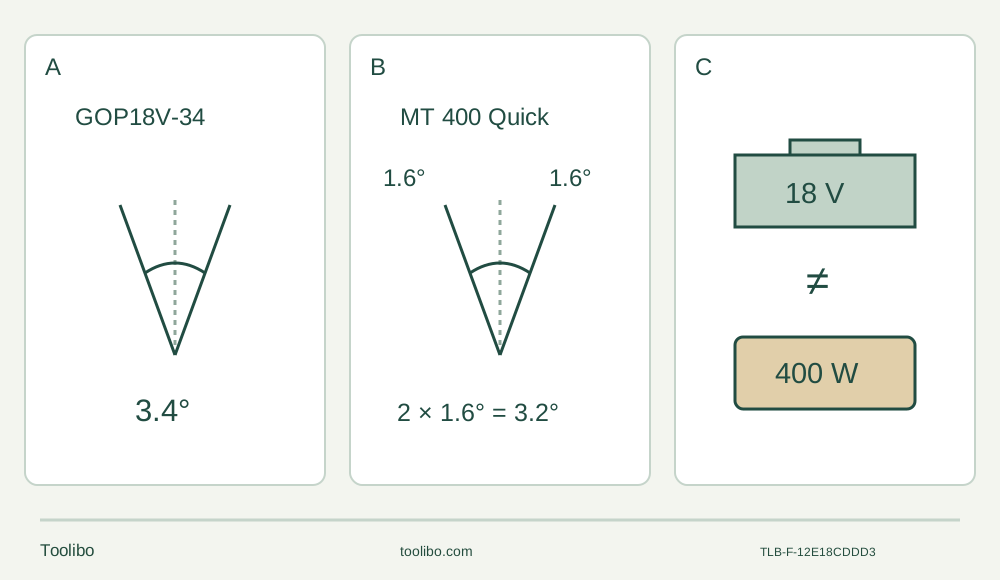
A · Preserve the original quantity
Record GOP18V-34's stated 3.4° arc and the source conditions; do not double a value already given as the arc.
B · Label any normalization
MT 400 Quick states 1.6° left/right. The editorial full-span calculation is 1.6° + 1.6° = 3.2°, not a cutting-speed result.
C · Decide from compatible evidence
Keep 18 V separate from 400 W input and 200 W output, retain configuration gaps, and finish with exclude/hold/shortlist decisions.
The arcs are exaggerated, unscaled notation diagrams, not blade paths to measure. A is Bosch's stated arc; B is an explicitly derived full-span conversion of Metabo's left/right value. C prevents comparing voltage directly with input power, not an assertion about relative tool performance.
Compare requirements before comparing numbers
A specification sheet can help exclude an unsuitable system and reveal missing evidence. It cannot, by itself, tell you which oscillating tool cuts fastest, lasts longest or feels best in your hand. A useful comparison therefore ends with a requirement-based shortlist and a list of unanswered questions, not a score assembled from unlike numbers.
This worksheet uses two exact documented systems: US Bosch GOP18V-34 under manual 16099221RZ, March 2023; and European Metabo MT 400 Quick type 01406000 under manual 170 27 4940–0122, with the actual regional nameplate governing mains supply. The source values below are manufacturer documentation, not Toolibo test results. The worked decisions are explicitly hypothetical user situations, not observations from running these machines.
Make one row for each quantity and its conditions
Begin with your non-negotiable requirements: known material and permitted operation, usable power source, approved accessory/interface, dust-control arrangement, and any access or handling constraints. Identify the actual regional tool before entering its figures. If you have not established that identity, use the separate identification workflow first; a comparison of the wrong variants is not rescued by accurate arithmetic.
For each cell write the original quantity name, number, unit, source and page, measurement basis or operating condition, and what is missing. Keep a second cell for any editorial conversion so the source statement remains visible. Mark unavailable information as “not established in this record,” not zero. Do not copy a number from a different region or a newer-looking listing to fill an inconvenient blank.
The following completed rows show the method. They do not imply that the two machines share a power system, accessory holder or operating procedure.
Swipe or scroll horizontally to see all columns.
| Worksheet field | GOP18V-34 documented value | MT 400 Quick documented value | Valid use of the row |
|---|---|---|---|
| Power supply | 18 V DC cordless system | Corded; actual nameplate voltage and frequency must match supply | Decide whether an approved power arrangement is available; do not rank power by voltage. |
| Input and output power | No matching wattage comparison established here | Input 400 W; output 200 W | Keep input and output separate; neither is comparable to the Bosch 18 V rating. |
| No-load oscillation frequency | 10,000–20,000 OPM | 11,000–18,500 OPM | Record available no-load ranges, not loaded cutting throughput. |
| Oscillation angle | 3.4° oscillating arc | 1.6° left/right | Preserve the original definitions before normalizing angle notation. |
| Accessory speed qualification | Bosch accessories rated at least 21,000 OPM | No identical numeric accessory threshold established by this comparison | Apply each manual’s actual accessory requirements; do not copy the Bosch threshold across. |
| Holder scope | OSL and OSP permitted; OSM not permitted | OIS or compatible holder; genuine Metabo accessories meeting the manual’s requirements | Identify a permitted task-specific accessory, not a universal adapter promise. |
| Mass basis | Product page states 2.7 lb without an explicit configuration basis in that field | Manual states 1.4 kg without mains cable | Retain the basis difference; do not declare the ready-to-work lighter system. |
Bosch’s specification and interface table is on page 8, and its accessory rating requirement on page 11. Metabo’s numerical table is on page 3; its definitions and mass basis are on page 9, with holder and supply requirements on pages 7–8. The Bosch product weight is a separate listing datum, not a measurement made here. GOP18V-34 manual, MT 400 Quick manual, Bosch US product.
Work through the angle calculation without inventing a winner
Metabo defines its 1.6° value as the angle to the left and right. For a worksheet column representing the full span, the explicit editorial arithmetic is 1.6° + 1.6° = 3.2°. Keep “1.6° left/right” beside it. Bosch already prints an oscillating arc of 3.4°; do not double that value merely because another manufacturer describes each side separately.
The normalized entries now describe a comparable kind of geometric quantity, but they do not prove a cutting-speed ranking. Blade reach, tooth design, material, applied load and the behavior of the complete tool can affect a cut. An accessory’s mounting orientation is also a different quantity from its small oscillating sweep. Do not substitute an indexing angle or a photograph’s blade position for the operating arc.
Similarly, 20,000 OPM is a machine’s documented upper no-load frequency here, whereas 21,000 OPM is the minimum rated accessory qualification in the Bosch instructions. They are different limits, not conflicting promises about the tool’s speed. A blade’s higher rating does not increase the machine’s operating range. Do not multiply angle by maximum OPM to manufacture a “performance index” or an untested cutting-time prediction.
Keep units, configurations and source conflicts visible
The Metabo 400 W entry is input power; 200 W is output power. Treating the first as delivered cutting power changes the quantity. Comparing either number directly with 18 V changes both unit and meaning. Battery ampere-hours would not close that gap either: this worksheet has no matched duty-cycle, pack, load and runtime measurement from which to predict cuts per charge or minutes of use. Do not invent one from nominal electrical labels.
The mass row demonstrates why unit conversion alone is insufficient. Converting pounds to kilograms would not tell us whether the Bosch listing includes a battery, a blade or another configuration. Metabo explicitly excludes the mains cable in its manual definition. Record the actual configuration needed for the proposed task—approved battery if cordless, fitted accessory and any attached extraction hardware—before making a like-for-like handling comparison. No measured balance, grip-comfort or fatigue result is available here.
Emission data need even more context. MT 400 Quick page 3 separates surface grinding, scraping, plunge-blade sawing and segment-blade sawing, each with its own uncertainty. Those are not four estimates of the same operation. Its page 9 measurement explanation refers to EN 60745, while the declaration on page 3 lists EN 62841 standards. Keep that internal documentary difference visible; do not silently rewrite the standard or create a cross-model comfort/safety ranking from it. The manual itself warns that actual exposure changes with application, tool and accessory condition and periods of lower activity. A product-page percentage improvement is likewise not a matched test between the two tools in this worksheet.
Where a source conflicts with another source, retain both document identifiers and ask the manufacturer for the applicable basis. Where a source simply omits a basis, ask for that missing condition. These are different evidence gaps, and neither is answered by averaging numbers.
Turn the rows into worked purchasing decisions
Hypothetical situation 1: no suitable mains supply at the planned work area. The task is a small, permitted dry cut in known wood, with support and dust controls to be planned. The user already owns an identified, approved and commissioned Bosch battery/charger system and can obtain the correct documented accessory. The corded MT 400 Quick fails the stated supply requirement unless a suitable mains arrangement is established. GOP18V-34 can remain on the shortlist, conditional on the exact accessory and complete owner setup. The conclusion comes from power availability, not from 20,000 being larger than 18,500 or 3.4 being larger than 3.2. It does not establish runtime or authorize a cut.
Hypothetical situation 2: small-area dry sanding at a bench with suitable mains available. Either system could remain a candidate if all its own requirements are met. Bosch’s OSC005 attachment is sanding-only and needs the specified compatible sanding arrangement and suitable vacuum. Metabo’s extraction assembly is likewise specified for the triangular sanding plate, not as a general sawing hood. Record the actual required plate, paper, extraction components, suitable extractor, power equipment and documented availability for each proposed purchase. Compare written complete-system offers, not body-only prices. If those items are unresolved, both candidates remain on hold; a lower published weight does not close the missing extraction system.
Hypothetical situation 3: the buyer demands proven faster cutting or lower exposure. These records do not answer that question. Keep both eligible candidates unranked and request appropriate comparable evidence for the intended operation, including the exact accessory, material, power configuration, method and uncertainty. Do not replace missing evidence with a home overload or stall test. If a decisive requirement cannot be established, defer the purchase or choose on a different, explicitly stated requirement—not on a fabricated test result.
Close the worksheet with a defensible shortlist
Assign one of three results to each candidate. Exclude for this task when a mandatory requirement is demonstrably not met. Hold for evidence when identity, compatibility, complete-system contents or a decisive measurement basis is unresolved. Retain on the shortlist when the documented requirements are met, while naming the performance questions the records do not answer.
Keep the original figures, your clearly labelled conversions, source dates, configuration notes and unresolved questions with the decision. For example, a defensible conclusion is “retain GOP18V-34 because an approved cordless system is already available; runtime not established.” It is not “GOP18V-34 is faster because its maximum OPM is higher.” Before use, complete the exact owner’s safety and setup process; any physical accessory comparison must be at standstill with the plug out or battery removed. The finished worksheet should explain why a candidate belongs on your shortlist without claiming it won a test that never occurred.
Models referenced