
Three identity records that must agree
Three panels show GOP18V-34N order naming linked to GOP18V-34 body naming, distinct MT 18 LTX and Q SL type/revision records, and a package with separately questioned battery and charger contents.
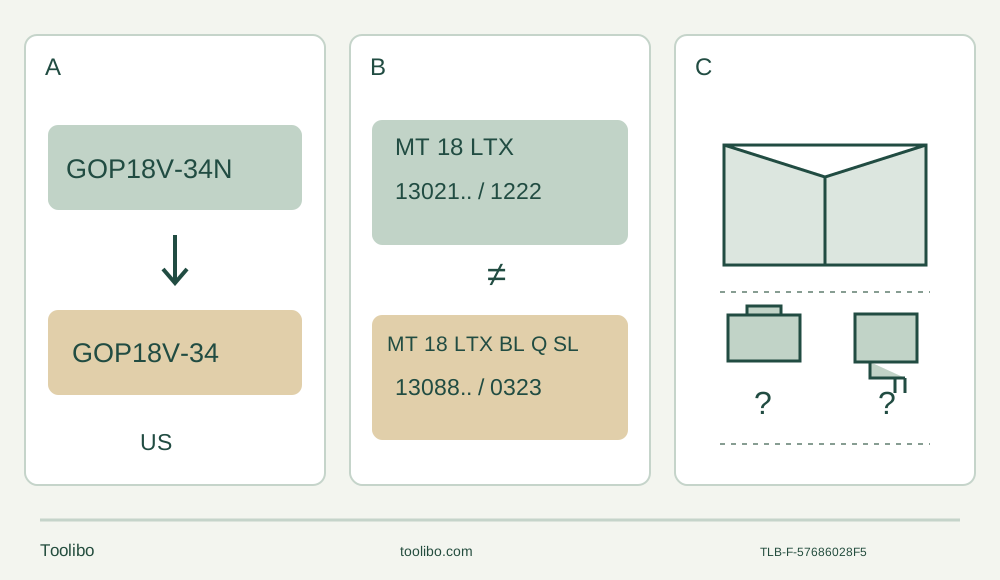
A · Separate order from body
Use the official regional route to connect the commercial order, actual nameplate/service number and exact tool manual.
B · Match the type and revision
Keep legacy 13021 / 1222 separate from Q SL 13088 / 0323; compare actual isolated controls and preserve document conflicts.
C · Verify the offered system
Itemize actual body, accessories, battery and charger; close each identity field with evidence or a stated stop, never an assumed kit.
Arrows in A connect documented identifiers, not interchangeable products. B keeps the two Metabo identity chains separate. C asks what is actually supplied; pictured or compatible power equipment is not automatically included.
Identify the machine before choosing its instructions
An oscillating-tool listing can mix a body model, a shop’s bundle name, a manufacturer’s order number and a service identifier. Similar lettering does not make them interchangeable. This workflow ends with an identity record that separates the actual machine from its sale package, identifies the applicable regional documents, and states whether you can continue to the matched owner guide or must stop for evidence. It does not assess used-tool condition or compare cutting performance.
The examples are the US Bosch GOP18V-34 system, the European legacy Metabo MT 18 LTX type 13021, and the Austrian Metabo MT 18 LTX BL Q SL product 613088840 / type family 13088. These are already documented systems, not a worldwide suffix dictionary. No letter is decoded by guesswork, and no regional alias is inferred merely from similar photographs.
Collect three sets of identifiers, not one seller title
First record the physical body: readable model text, full type or service number, serial information, supply markings and region shown on the actual label. Preserve spaces and punctuation in your record. Photograph the whole housing and controls as well as the nameplate. Switch OFF and remove the battery before handling or examining the holder; do not fit an unknown accessory to “see which system it is.” A familiar logo, connector shape or serial photograph alone does not authenticate the machine.
Next record the commercial offer: manufacturer’s exact order number if present, seller’s title, country of sale and a written list of everything promised. Put seller-added accessories in a separate column. A retailer’s bundle may contain a genuine body without being the manufacturer’s named kit. Conversely, a tool described as bare can still include a blade; “bare” must not be interpreted as “literally no accessory.” Do not derive the actual contents from a photograph showing a battery fitted for demonstration.
Finally record the documents: official regional product or service URL, the identifiers it matches, tool-manual code and revision, and the separate documents for any battery and charger. Keep the date checked distinct from the document’s issue date. A manual downloaded today can be an older, correctly matched manual; today’s retrieval does not change its revision. A cover listing several models is a reason to locate the correct row, not to merge all models’ instructions.
Use these six worksheet fields for every offer: actual body identity; market and electrical supply; commercial order; exact manual and applicability; documented versus actually offered contents; unresolved questions and decision. Retain photographs and source links with the entries. Do not replace an unknown value with the nearest catalogue match.
Worked example: a bare-tool order and its machine identity
The checked Bosch US product page names GOP18V-34N, order 06018G2010, as a bare-tool offer. Its contents list the GOP18V-34 body and OSP114F blade. The page separately gives service part number 3601HG2010 and tells readers to match the number to the actual tool. Those identifiers occupy different worksheet fields; the March 2023 manual is titled for GOP18V-34. The missing N on the manual title is therefore not, by itself, a mismatch for this exact documented route. Nor does that establish a general rule for Bosch suffixes. Exact Bosch US product and document route.
A seller’s “GOP18V-34 kit” still needs its own contents record. If it adds a battery and charger, write their exact identifiers separately and verify the actual pair against the appropriate manufacturer documents. The linked March 2023 battery/charger list is compatibility evidence, not proof that either item is included in that seller’s box, and not a complete charging manual. A photograph of a battery on the body cannot fill those gaps. GOP18V-34 power-system list 1600A02TM0.
The resulting decision can be: “body and document route matched; offered power equipment still unresolved.” That is a useful completed identity finding, but it is a stop before treating the offer as a ready-to-use cordless system. When actual body and contents are established, continue with the exact GOP18V-34 owner workflow, not instructions for another Starlock-labelled machine.
Worked example: a shared legacy title is not a new generation
Metabo service 13021000 leads to the 1222 instructions for MT 18 LTX and MT 18 LTX Compact. The manual’s technical page gives 13021.. for both headings. In this documented legacy system, “Compact” on the shared cover does not establish a second machine generation. Record the actual physical identity and configuration instead of counting or buying by the cover title alone. Legacy service route, 1222 instructions, cover and pages 2–3.
The selected legacy owner example uses an identified original 625596000 battery and qualified ASC 55 charger. That does not establish a presently sold kit, every ASC-labelled charger’s regional input, or compatibility with anything advertised as 18 V. If an offer lacks its charger label or the actual battery cannot be identified, the power-system field stays unresolved even when the body matches 13021. Do not transfer a photographed battery from one listing into the evidence for another.
Now compare the separate Austrian Q SL route: product 613088840, service 13088000, manual 0323, with 13088.. on its technical page. The names overlap with MT 18 LTX, but the identity chain and holder instructions differ. The Q SL manual specifies an additional pin-turning engagement that is not the legacy pin-only sequence. Use the drawings as a cross-check of the isolated actual machine, not as a recipe to test which mechanism a seller owns. If the nameplate points to one family and the pictured mechanism to another, stop and ask Metabo rather than averaging the two manuals.
The saved official Austrian product page lists a blade and metaBOX, without battery or charger. This is documentary scope for that specific order, not a guarantee of a seller’s inventory or a promise about another country’s package. The exact product-to-service route supports the 0323 document; it does not turn that document into instructions for legacy 13021. Austrian product 613088840, Q SL 0323 instructions.
Preserve contradictions rather than repairing the record yourself
A precise identifier can reveal a source conflict instead of eliminating it. Q SL manual page 12 calls battery 625596000, 2.0 Ah, “LiHD”; the separate 1124 battery document’s table identifies 625596000 as 18 V, 2.0 Ah, Li-Power. Keep the two source statements separate. Do not relabel the actual pack, infer a hidden version change or declare every pack with a similar capacity interchangeable. Read the actual pack label and obtain manufacturer clarification if the discrepancy affects the offered system. This identification guide does not commission a Q SL charging combination. Metabo battery document 1124, table on PDF page 2.
A service entry may carry newer general-safety instructions alongside an older tool manual. Record each separately; a 1025 safety supplement does not convert a 1222 or 0323 tool document into a new tool revision. If an online document and the supplied instructions differ, retain both and ask which applies to the actual identity. A translated cover or a matching family name is not enough to discard the discrepancy. Regional supply and charger input also need their own evidence; a plug adapter does not establish electrical suitability.
Finish with an explicit identity outcome
Matched body and documented offer: the actual identifiers, regional route, manual scope and itemized contents agree. Save the record and continue to the matched owner’s complete safety and setup instructions. This outcome does not certify authenticity, condition, electrical safety or performance, and it does not bypass separate accessory and power-system qualification.
Matched body, incomplete system: the machine is identified, but batteries, charger, accessories, regional input or actual contents remain unresolved. Keep the body finding, list the missing identifiers or documents, and pause purchase or use of the proposed complete system until those answers arrive. Do not let a confirmed model name turn unknown extras into approved components.
Conflicting or unidentifiable offer: labels are unreadable, order and body cannot be connected by official evidence, the mechanism disagrees, or a material document conflict remains unanswered. Ask for clear evidence or manufacturer identification; if it cannot be obtained, decline that offer rather than select whichever guide looks closest. The task is complete when every field has evidence or a stated stop—not when every field has been filled with a guess.
Models referenced