
Same tier boundary, different system
A shows UK 240 V with a neutral straight accessory, separate original bolt and hex key. B shows US 120 V/60 Hz with a neutral straight accessory pressing toward the snap holder. C admits Starlock and StarlockPlus and excludes StarlockMax for both.
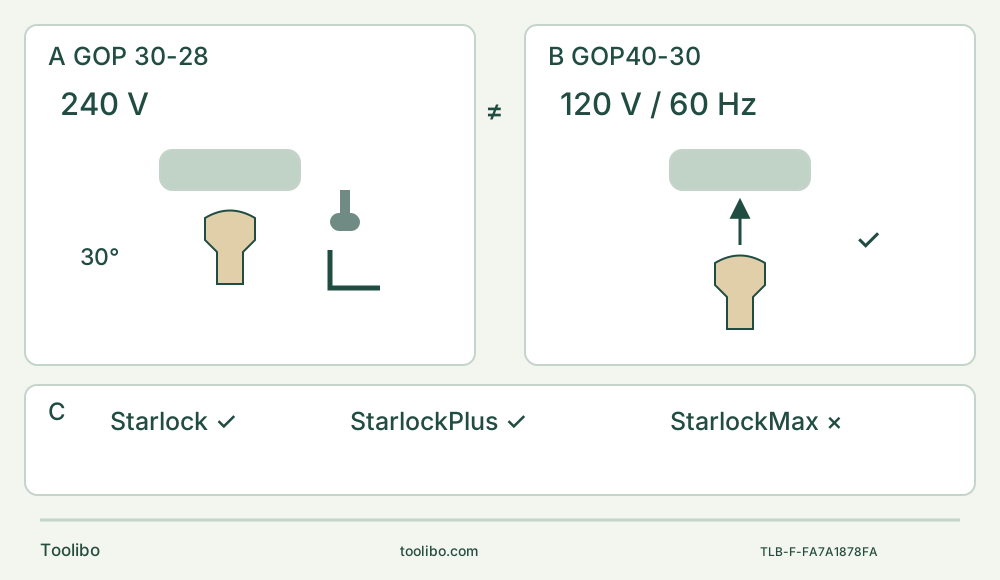
A · Complete UK retention
Magnetic positioning is not clamping. Preserve original bolt/key and the exact 240 V identity; no GOP40 lever or worklight is transferred.
B · Complete US retention
Keep 120 V AC/60 Hz separate. Press the identified blade securely into the jaws; no UK bolt is added. The light follows the run switch.
C · Shared tiers are only one gate
Both accept Starlock/StarlockPlus, not Max. Actual blade material, rating, geometry and regional electrical qualification remain independent.
Original schematic. A is a nonstacked parts inventory, not an assembled mount or counted cam layout: the original bolt must be tightened with the key until its rounded head lies flat, retention checked and key removed while unplugged. B is the separate US snap-in route, also unplugged. The arrow does not authorize cross-powering or cross-installing parts; C does not approve every blade material or reach.
Choose a regional system, not a larger model number
A used GOP 30-28 and a US GOP40-30 can both look like sensible replacements for a worn corded multi-tool. The useful decision is not which number is larger. It is whether one complete, correctly powered system can finish your visible wood cut with its actual blade, original retention parts and documented controls. A compatible-looking accessory does not qualify the supply or substitute for a missing clamp component.
This comparison selects the British 240 V GOP 30-28, order 0601237071 and service number 3601B37071, under instructions 1 609 92A E0M dated November 2025. It separately selects the US GOP40-30, 120 V AC, 60 Hz, 4 A, under instructions 2610051957 dated September 2018. The UK 110 V variant is outside this comparison. The UK manual’s technical table uses a 230 V reference and explicitly allows country/voltage differences; that does not change the selected product’s 240 V identity.
The output is a written retain the qualified UK system, retain the qualified US system, or hold both decision. It is not a recommendation to import either tool, convert its supply, replace its plug or compare cutting speed from its input rating.
Start with two separate evidence cards
For each actual tool, record its nameplate, country version, matching instructions, available supply and visible condition. With the plug disconnected, check the entire accessible cord, plug, housing, switch, holder and accessory. Reject cracked, broken, bent, dull or suspected-damaged accessories before use. A damaged cord, unreliable switch, incomplete fastener or suspected holder damage means qualified service, not a powered test to see whether the defect matters. Photograph identifiers without opening the tool.
The selected UK body needs its actual matching supply and unmodified sound plug. E0M describes a BS 1363/A plug with an ASTA-approved BS 1362 fuse; an unsuitable plug is an authorized-service issue, not an owner rewiring task. The US body requires its separate 120 V AC, 60 Hz system. A travel adapter is not evidence that either electrical system is suitable. Do not cross-plug the bodies, transfer the US extension-cord table to Britain or infer a conversion from their similar appearance. If an extension is necessary, qualify it under the exact regional instructions before proceeding.
Next list the actual blade and the retention parts belonging to that body. For this worked decision, the UK route uses an identified Bosch PAIZ 32 APB Curved-Tec Wood + Metal, 2 608 662 558. The selected product lists it and E0M’s table supports wood cutting. Its nominal 32 × 60 mm description is not guaranteed usable plunge depth. The US route uses an identified OSL114F, supported by its product and manual. The US manual additionally requires accessories rated for at least 21,000 oscillations per minute; the tool’s 20,000 maximum is not permission to ignore that accessory requirement. Do not transplant that particular numeric rule into E0M as though it were printed there.
Both selected bodies admit Starlock and StarlockPlus, not StarlockMax. Max accessories illustrated in a shared manual’s general examples do not override its model-specific matrix. That common tier boundary still does not establish every blade’s material approval, condition, usable reach, orientation or mounting procedure. The two named blades are separate qualified routes, not a claim that their cuts or dimensions are equivalent.
Worked choice A: keep the complete UK bolt-and-key system
Suppose the actual British body and supply match, the original clamping bolt and hex key are present, and the identified PAIZ blade can reach the planned cut without the holder entering the wood. Missing a worklight is not a fault on this model: the E0M feature list assigns that light to GOP40-30, not GOP30-28. Arrange adequate workplace lighting independently.
With the switch at 0 and the plug removed, let any fitted accessory cool and wear protective gloves for the sharp accessory change. Loosen the clamping bolt with the hex key and remove the old accessory. Place the new accessory with its depressed centre downward and lettering readable from above. Turn it into a useful documented position and engage the holder’s cams; the manual provides twelve positions spaced by 30 degrees.
Install the original bolt and tighten with the key until its rounded head lies flat against the accessory. Check secure seating and remove the key before any power connection. The magnet assists positioning; it does not complete retention. Do not replace this sequence with pressing until a click, add an unexplained washer, invent a torque or run the tool to test looseness. If correctly identified, clean parts will not seat securely, hold the route for service.
A complete bolt-and-key system can remain the practical choice when it already meets the task and electrical gates. The absence of a snap mount alone is not a reason to abandon it. Conversely, a missing bolt does not justify buying an unverified look-alike just to retain the body.
Worked choice B: keep the complete US snap-in system
Suppose instead that the available qualified system is the US body with its identified sound OSL114F and matching supply. Keep the switch rearward at 0 and unplug. Allow an old accessory to cool. Opening the release lever ejects it, so provide a safe receiving surface and keep hands away from the teeth; do not catch a hot blade.
Position the selected blade with its model-number face toward the holder. Choose a documented orientation that leaves the entire approach and withdrawal clear. Press the tool into the accessory until the jaws snap securely into it. The US manual says opening the release lever first is unnecessary for installation. Check retention while disconnected. This is not the UK bolt procedure: do not add its screw, key or extra hardware to the US mount.
The US slide switch runs forward at I and stops rearward at 0. Its worklight switches with the tool; it is not an independently selected inspection mode or proof of secure attachment. Do not look directly into it. The UK switch also uses I/0, but the body does not inherit the light. On either body, the switch must remain reachable without giving up control of the grip.
Choose this US route only because the complete system and task qualify, not because a snap mount or lamp proves a faster, more accurate or safer cut. If the supply or blade identity is unresolved, the UK alternative does not automatically qualify either: assess its own evidence card.
Complete one visible sample, not a timed competition
Use new, uncoated, loose softwood with every face accessible. Mark a short straight separation from an open edge. Inspect the material and full route for nails, screws, foreign objects and services despite the blades’ broader descriptions. This project excludes installed trim, hidden wiring, pipes and structural work. Verify actual blade reach, the entire oscillating envelope and clearance below the stock before choosing either system.
Clamp the retained part to a stable platform. Independently support the waste so it can separate without falling onto the blade or closing the kerf; do not rigidly trap it. Keep supports, clamps and the cord out of the entire cut. Preserve room for two hands on insulated gripping surfaces, ventilation and a reachable stop switch. Never support the piece by hand or catch waste underneath.
Wear eye and hearing protection and suitable respiratory protection, provide ventilation and use appropriate dust-reducing measures under the actual equipment instructions. The US manual requires protective gloves for all work as well as accessory changes, including thick cushioned gloves and frequent rest breaks for vibration precautions; keep gloves, clothing and hair away from moving parts. Neither model’s sanding hood is saw-blade dust capture. If dust controls cannot be qualified, hold the sample rather than treating a small cut as exempt.
Keep settings separate. E0M recommends no higher than level 6 for wood and requires compliance with any lower accessory limit; it does not supply the US six-position rate table. The US manual gives approximate rates and specifically calls for medium speed during initial plunge entry before increasing as needed. Do not turn a UK maximum into a universal starting command or assume equal dial numbers mean equal speed. Select and adjust deliberately with the tool stopped and unplugged for this project, then reconnect only after the setup is ready and the switch is OFF.
With the blade clear of the stock, hold both insulated gripping surfaces firmly and slide the switch forward to I. Only then contact the wood. Keep hands clear of the cutting area and underside, and guide the chosen tool away from the body with light, even pressure and controlled back-and-forth passes. Do not force full depth at once, twist a blade in the cut or use it as a lever to snap a remaining bridge. Stop for movement of the stock, binding, abnormal heat or behavior, or a threatened cord path; wait for standstill and unplug before correction. Do not reproduce faults under power.
After full separation, switch to 0, wait for complete stop, withdraw on the clear path and set down safely. Unplug before inspecting both faces. Accept the sample only if the intended line and size, full separation and support control are satisfactory, without uncontrolled tear-out or scorching. No invented tolerance or timed ranking is needed. A documented setup problem can be corrected while isolated; unexplained mechanical behavior requires qualified service.
A later sanding job is another system decision
The wood cut does not qualify sanding. The UK E0M route requires the actual matched Bosch pad and sheets, dry sanding only, maximum level 4, and extraction providing at least 230 mbar AND 36 L/s at the tool connection. A vacuum’s advertised rating is not proof of installed performance. Its two illustrated hood connection forms are not interchangeable instructions; match the actual form, hose and extractor manual. Avoid overheating and empty collected dust before breaks under those equipment instructions.
For the selected US document, the old OSL350SD pad reference and current OSL350SPD product identity remain an unresolved substitution boundary in this comparison. Do not solve that by using the UK pad or importing the UK’s extraction numbers. OSC005 is sanding-only, not a cutting hood. Hold an incomplete sanding system even when the wood-cutting system passed.
Finish the evidence cards with the selected body, exact blade, complete retention parts, regional supply and accepted task. If either card still contains an unidentified component, incompatible supply or service concern, mark it held. The useful result may be retaining one complete system—or declining both—rather than buying a superficially similar body.
Source basis: GOP 30-28 E0M, English 17–26 and figures 3/6; exact UK product identity and PAIZ listing. GOP40-30/GOP55-36 2610051957, English 1–20, especially 7–8, 11, 15 and 17; exact US GOP40-30 product. These are document-based decisions, not hands-on performance tests.
Models referenced