
Identity, fasteners, condition and the recorded next step
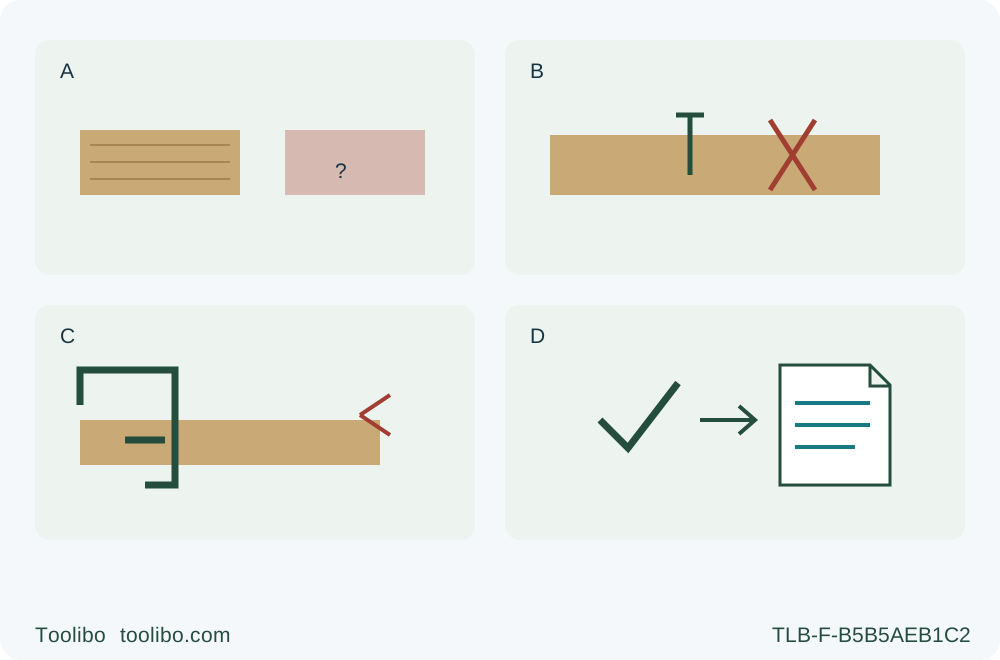
A contrasts an identified board with an unknown piece; B marks a fastener hold; C combines clamping feasibility and a damaged end; D points from completed intake checks to a written decision.
A · Establish the actual material
Use reliable identity and history, including facing, coating or treatment information. Unknown composition remains on hold; do not cut a sample to discover it.
B · Resolve fastening uncertainty
Inspect the actual piece and require a verified clear intended path after safe correction. Nail-tolerance marketing does not override the manual’s removal rule.
C · Qualify condition and support
Assess splits, loose parts, layer separation and stability. Securely clamp the retained work, independently support both portions outside the blade path, and leave waste free to separate without closing or pinching the kerf. Otherwise hold this operation.
D · Label the safe next action
Record proceed-to-setup, information/correction hold, or do-not-cut-under-this-plan. A passed intake is not immediate trigger permission or a structural rating.
This conceptual intake does not identify material chemistry by appearance. A holds unresolved identity; B does not promise that one glance or detector proves a clear interior. C asks whether the actual condition can be supported and clamped, not whether clamping repairs damage. D leads to a documented next-stage decision, not directly to a spinning blade. Accepted material still requires exact tool, blade, protection and isolated setup checks; no powered test is depicted.
“Wood” is not a complete cutting specification. A clean board with known history, an unidentified coated offcut and a loose panel with separated layers can require different decisions even when all three fit under the same saw. This guide sorts actual workpieces before layout or blade selection so that uncertainty is resolved before a motor starts.
The bounded example is a US Makita 5007MG matching instructions 884671-946 and retaining its correctly installed original approved wood-cutting assembly. The exact manufacturer’s product page includes dimensional and engineered wood and names plywood ripping, but that does not authorize every material sold as board or every installed blade. The manual’s nail-removal, material-safety, support and blade-condition rules still apply.
The outcome is a labeled decision for each loose workpiece: proceed to model-specific setup, hold for missing information or correction, or do not cut it under this workflow. This is not a material-identification laboratory, a structural grading method, a hazardous-coating removal procedure or permission to cut installed building fabric. No powered “test cut” is used to discover what an unknown material contains.
Establish identity and history first
Keep the saw unplugged while sorting. Identify the actual material through reliable labeling, supplier information or an established history, not appearance alone. Record whether it is solid wood or a known wood-based panel, its actual thickness and condition, and whether it has been coated, treated, repaired or previously installed.
A familiar surface does not establish the interior. Do not assume that a panel’s core, adhesive, facing or embedded reinforcement matches another product that looked similar. If the material cannot be identified sufficiently to determine its cutting and dust precautions, mark it on hold and obtain the supplier’s information or competent assessment. Cutting a corner off to inspect the core would bypass that gate.
For reclaimed or previously installed material, identify where it came from and what could have been attached to it. This workflow admits loose, inspectable work only. A board still attached to a wall, door frame or unknown assembly is not equivalent: hidden services, fastenings and support conditions have not been established. Choose the appropriate separate work plan rather than treating it as another loose offcut.
Inspect for fasteners and visible condition
Inspect both faces, edges and ends under good light. Look for visible nails, screws, staples, hardware remnants and signs of previous fixings. The manual requires inspection and removal of nails before cutting. A product-page claim about a blade tolerating nail-embedded wood does not override that operating instruction.
If a fastener is found, keep the piece out of the cutting queue until it has been safely removed and the intended blade path can be verified clear. This guide does not teach extraction of buried metal or certify that a detector, one surface scan or a visual glance proves the entire piece metal-free. If hidden fastening remains plausible and unresolved, retain the hold or choose known material instead.
Check for splits, loose knots, severe bow or twist, damaged edges and separated panel layers. The practical question is whether the actual piece can remain stable, supported and securely clamped throughout the cut and after separation. A clean-looking retained area does not make a loose, unstable waste section harmless.
Do not use clamps to conceal a condition you have not understood. Forcing a warped panel flat may change what happens when it is cut or released. If sound support and a predictable cut cannot be established, choose another piece or obtain an appropriate assessment; this intake guide does not assign a structural grade or prescribe a repair.
Separate material precautions from tool marketing
The manual warns that some materials contain chemicals and instructs the owner to follow material-supplier safety data while avoiding dust inhalation and skin contact. Obtain the actual information for the workpiece, including any coating or treatment, before deciding that the available workspace and protection are adequate.
An unknown paint, finish or treatment is a reason to hold this task, not a reason to scrape, sand, burn or cut a sample to identify it. This guide does not classify the chemical hazard or provide a removal method. Do not infer that a general dust mask, a visible dust blower or a vacuum that happens to fit solves every material-specific requirement.
The manual discusses extra caution with damp wood, pressure-treated lumber and knots. That is not a blanket prohibition of every such piece. However, this simple intake workflow sends those conditions to a separate, fully qualified task assessment rather than using them as the first ordinary sample. Mark that boundary honestly as this guide’s conservative scope, not as a manufacturer ban.
If the actual material precautions cannot be met in the proposed location, the result is “not ready here,” even if the tool can physically reach through the thickness. Change the location or process only after its requirements are established; do not reduce precautions to preserve the original schedule.
Match the actual material to the already qualified assembly
Only after identity and condition are established should you ask whether the installed approved blade and exact saw are suitable. Confirm application, diameter, mounting identity, speed rating, condition and the original assembly’s documented status. The separate blade-qualification guide addresses those dimensions; this intake does not replace it or instruct a blade change.
A known plywood panel is not automatically qualified just because the 5007MG product page lists plywood ripping. The actual blade must suit that panel and the required finish, and the panel must fit the supported task. Conversely, a clean solid-wood board does not permit a damaged or dull blade. Tool qualification and workpiece qualification are separate gates, and both must pass.
Metal, masonry, plastics and unknown mixed construction are outside this bounded wood workflow. That statement does not claim that every circular saw is incapable of cutting those materials. It means this exact approved wood assembly and these instructions do not establish the requested operation. Do not broaden the task by fitting an abrasive wheel or a blade described only as “multi-material.”
Measure the real thickness and intended cut length. Capacity numbers do not establish a safe support arrangement or authorize an improvised two-sided cut. If the material exceeds the complete documented task, choose a separately supported method. Keep the blade unpowered while deciding; suitability is not discovered by seeing whether the motor struggles.
Admit the piece only with a complete support plan
For a piece that passes the identity, condition, material-precaution and assembly gates, mark the intended retained portion and waste. Establish a stable platform, suitable clamps, clear underside blade corridor and control of both parts at separation. The manual requires the wider base on the supported retained section and warns against holding short pieces by hand.
A tiny offcut may be known clean wood yet still unsuitable for this saw-and-clamp layout. A large panel may need different support and working space from a board. Do not interpret an “accepted material” label as permission to skip those geometry decisions. If the complete travel cannot be supported without reaching across the blade line or catching the waste, the piece stays on hold for this operation.
Record the decision in plain language. For example: “Known untreated board, inspected and clear path, sound condition, approved original blade, support plan available—proceed to isolated setup.” That is a prerequisite result, not clearance to pull the trigger immediately. Complete the model’s guard, supply, depth, bevel, guide, protection and rehearsal checks before an ordinary sample.
Keep holds specific and reversible only with evidence
Three hypothetical intake results show the distinction. A known sound board with a qualified blade and feasible support can move to setup. A painted reclaimed board of unknown history remains on hold for material and fastening information; a trial cut is not the next step. A known panel with separated layers or no stable clamping arrangement is not admitted under the current plan, even if its material name appears in the product description.
Write what evidence would change a hold: reliable material identification, a verified clear cut path after safe correction, a suitable qualified assembly, complete material precautions or a workable support plan. Do not write “try slowly” as the missing evidence. If the issue cannot be resolved, select different known material or a properly specified alternative process.
Keep the label with the piece so it does not return to the ready pile by accident. Reassess if the material is modified, newly exposed fixings appear or the planned cut changes. The complete result is a documented workpiece decision with a safe next action—not a promise that every item called wood is ready for the same circular saw.
Models referenced