
A functional map, not a clearance standard
An unscaled workspace plan marking the work area, operator route, separate cord and setdown planning, and a controlled entrance boundary.
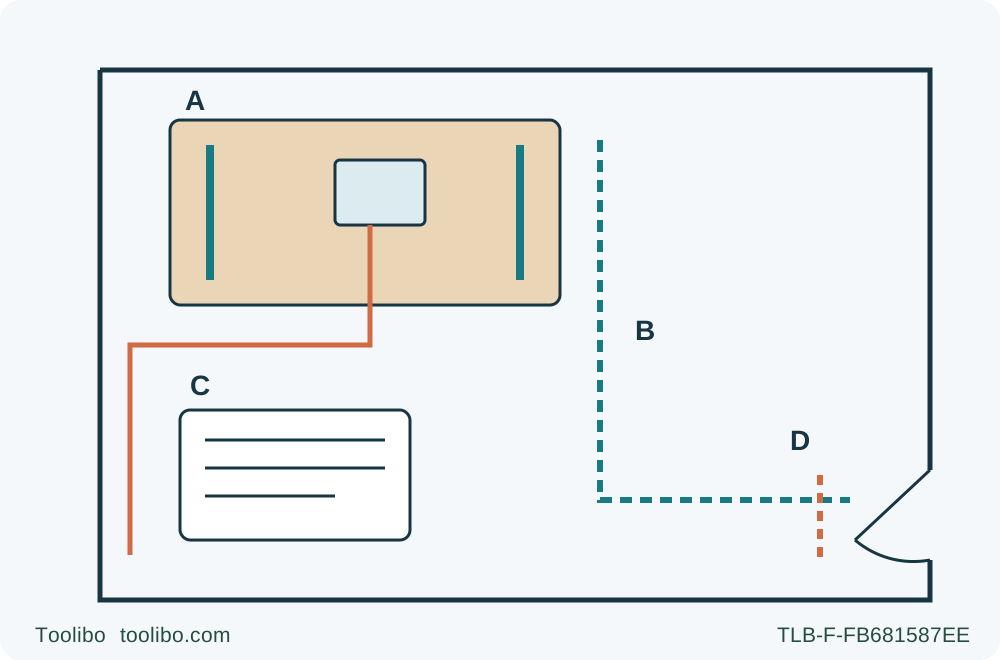
A · Map both final pieces
Locate the retained work and waste supports through separation, outside the blade path, with retained work securely clamped and waste free to separate.
B · Assess the whole reach
While unplugged, check entry, middle and exit beside or safely above the path; no tooth contact, forced guard or live rehearsal.
C · Qualify the route and finish
Plan an actual suitable supply, snag-free cord route and stable guarded setdown point; unresolved electrical conditions remain held.
D · Control access and decide
Keep bystanders away and evaluate light, footing and environmental controls. Record ready for owner setup, change and reassess, or not here.
The drawing is an unscaled planning map, not a running-cut or blade-side diagram. A marks the work/support area; B represents the route whose reach must be assessed while unplugged with the blade guarded and clear of stock. C records supply and guarded setdown planning, not an electrical installation. D marks controlled access without prescribing a universal distance. No room layout is approved by this picture alone.
A room that has enough space to store a circular saw may not have enough space to use it. The workpiece, retained piece, waste, operator, guide, clamps and cord all need a workable arrangement through the end of the cut. This admission check asks whether one planned job can be performed in one actual location before the saw is connected.
The example is an existing US Makita 5007MG under manual 884671-946, with a qualified original wood blade and assembly. The planned work is a normal square, edge-start cut in known loose wood. This is a location decision, not a building-code inspection, electrical installation assessment or permission to cut an installed wall, door or concealed service. A different model or task requires its own instructions and another assessment.
The deliverable is a simple workspace sketch and a decision: ready for the complete owner setup, change the arrangement and reassess, or do not perform this task here. A location check cannot certify a damaged saw, unsuitable material or unqualified accessory. Resolve those separately; do not use an empty floor as evidence that the whole system is safe.
Start with the actual work and its final pieces
Write the material, full starting dimensions, intended cut and resulting retained and waste portions. Draw the starting workpiece and the two separated pieces on paper. The question is not merely whether the uncut board fits through a doorway. Ask where each piece will be supported when the cut finishes and whether anything will fall, twist or close the kerf.
Identify the reference edge, guide contact and intended operator side. The Makita instructions place the saw on the larger supported portion rather than the smaller offcut. Keep the body to either side of the blade line, not in line with it. Do not choose an operator position solely because it gives a convenient view of a mark; two-hand control and balance must remain possible throughout.
If the board needs someone to hold a free end by hand to keep it from moving, the arrangement is not established by this guide. Plan appropriate independent support and secure the retained work. Support both portions outside the blade path while allowing the waste to separate without pinching the kerf. Never plan to support stock across a leg or with the hand that should be on the saw.
Admit the surroundings before placing the tool
The manual requires a clean, well-lit work area, excludes explosive atmospheres containing flammable liquids, gases or dust, and keeps bystanders, children and visitors away during operation. Translate that into the actual household situation. A shared passage that people must use during the cut is not controlled merely because you intend to ask them to wait.
Clear clutter and identify who can enter the area. Arrange a way to prevent an unexpected person or pet crossing the operating zone without creating another obstruction. This article gives no universal exclusion distance or fire-safety clearance. If access cannot be controlled for the whole operation, choose a different location or postpone the task.
Check the floor and the operator’s intended stance. The manual requires proper footing and balance and warns against overreaching. An awkward reach caused by stored objects, a slippery surface or a step in the middle of travel does not become acceptable because the cut is short. Do not stand on improvised furniture to reach a high workpiece. Change the work arrangement rather than compensating with body position.
Provide adequate light to see the reference, clamps and route without relying on a powered saw lamp during setup. Consider shadows from your own body and the workpiece. The 5007MG’s connected-tool light is not a reason to leave it plugged in for inspection. Keep the plug out while laying out and checking the area.
Prove support and travel without a live rehearsal
Use the actual workpiece and proposed supports to assess the arrangement while the saw is unplugged. Confirm that the support is stable, the retained work can be securely clamped and both pieces remain controlled through separation. Supports must not occupy the blade path or allow the blade to contact a bench or floor. Do not invent a load rating for a stool, table or improvised stand.
Assess the guide and clamp positions over the complete intended travel, not only at the starting edge. A clamp that clears the front of the tool may still obstruct the motor, rear handle or cord. Plan where the saw can be set down after complete standstill with the guard covering the blade, without resting it on waste, a trailing lead or an unstable edge.
Check reach at entry, middle and exit beside or safely above the intended path. Keep the stopped blade guarded and the teeth clear of uncut material. This is not a push-through rehearsal with a projecting blade in the stock, and it does not permit forcing the guard open. If you cannot assess reach and clearance safely while isolated, hold the arrangement.
Ask whether the whole cut can be completed with a stable stance and the required grips, without moving a support, stepping over a cord or changing hands mid-cut. Do not plan an interrupted-cut restart as the solution to a cramped room. The separate complete owner workflow comes only after the physical arrangement is accepted.
Treat the supply route as part of the workspace
Use the actual nameplate-approved supply and an undamaged original cord and plug. The manual prohibits exposing the tool to rain or wet conditions and keeping the cord near heat, oil, sharp edges or moving parts. If the outlet or plug is unsuitable, do not modify either to make the location work. Obtain appropriate qualified assistance or use another qualified arrangement.
Route the cord away from the cut so that it cannot catch the workpiece, guide or clamps. Check the entire travel allowance, not just whether the plug reaches the socket. A lead crossing the operator’s intended footpath or a household passage needs a different route; do not assume you can step over it safely while holding a running saw.
If an extension cord is necessary, its condition, actual length, current capacity and intended environment must satisfy the complete manual requirements. This workspace check does not supply an extension-sizing shortcut, outlet test or wiring procedure. An unresolved electrical condition means the location is not yet admitted, even if the workbench is otherwise suitable.
Keep the means of disconnection accessible without reaching over the blade or moving unsupported material. This is an isolation-planning requirement, not a recommendation to pull a plug by its cord. The operator must still follow the proper trigger-release, standstill and guarding sequence; access to an outlet does not replace control of the saw.
Include dust, other people and end-of-work handling
Identify the material’s dust precautions before choosing the location. The manual calls for suitable protective equipment and warns about hazardous dust. Plan appropriate eye, hearing and respiratory protection and suitable ventilation and dust controls for the actual work. An open window, visible lack of dust or a dust mask alone is not a certificate that an occupied room is suitable.
Do not direct chips or dust toward people, food preparation, stored belongings or a route others must use. This is a conservative household planning rule, not a numerical exposure assessment. If appropriate controls or material information are unavailable, hold the task. Do not add an unverified extractor connection to the Makita just because another model has one, and do not transfer another saw’s numeric suction requirements to it.
Plan how stopped offcuts and debris will be collected without reaching near a moving blade. The manual warns that blades coast after release and requires waiting before grasping cut material. After normal completion, release the trigger, maintain control until full standstill and guard coverage, set the tool down securely and unplug before inspection or clearing the arrangement. Binding or an interrupted cut requires its separate stop-and-assess response, not hurried cleanup.
Sign off one arrangement, not the room forever
On the sketch, mark the work/support area, operator travel, cord route, bystander boundary and guarded setdown point. These are functional areas, not scale-based clearance prescriptions. Beside each, record what was actually checked and what remains unresolved. Name the change needed if the layout is held: another support, a different work orientation, a qualified supply or a location where access can be controlled.
Choose “ready for owner setup” only when the actual task has stable support, safe reach, clear travel, a qualified supply and appropriate environmental and people controls. Choose “change and reassess” when a specific arrangement issue can be resolved without inventing a technique. Choose “not here” when the task cannot be accommodated. Moving the job is a complete and useful decision, not a failed attempt at sawing.
Repeat this admission check when the workpiece length, cut, support, guide, cord route or occupancy changes. A room accepted for one short supported cut is not automatically suitable for a full sheet or another tool. The check ends before energizing the saw; the exact owner’s inspection, depth and bevel setting, sample and acceptance requirements still follow. A clear location plan makes those next steps possible instead of forcing the operator to improvise around the room.
Models referenced