
A single-variable trial log
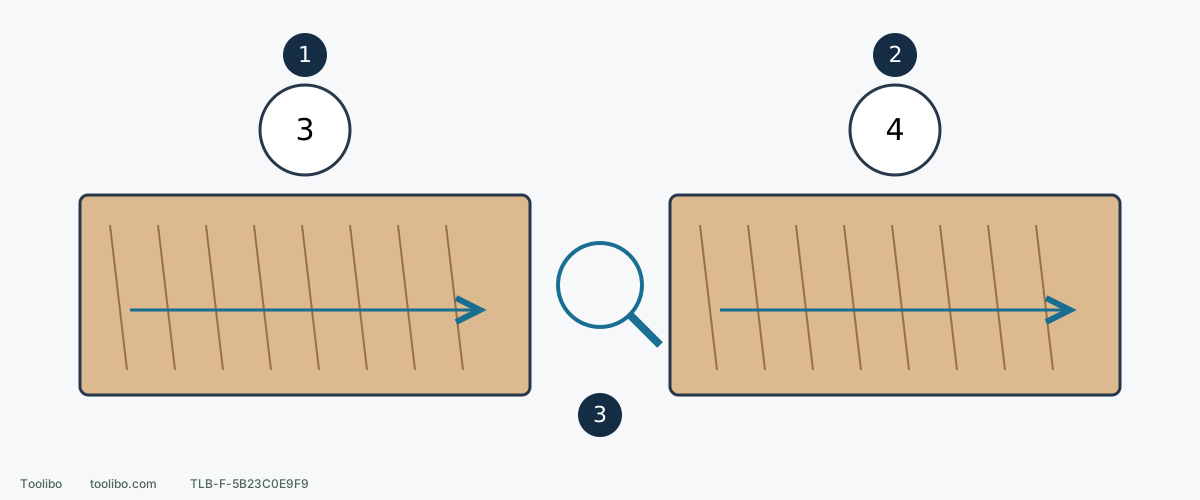
Matching wood samples show dial 3 and dial 4 with the same travel arrows and a shared inspection symbol.
1. Record a baseline
Note wood, abrasive product, grit, pad and the first controllable setting.
2. Change speed alone
Keep abrasive and travel comparable; switch off, wait and remove the battery before adjustment.
3. Compare before accepting
More heat, smearing or poorer control rejects the change even if removal is faster.
These dial numbers illustrate record keeping, not recommended wood settings or measured results.
Identify the dial and switch
The 2648-20 dial runs from 1 to 6, with 1 low and 6 high. Its stated range is 7,000–12,000 orbits per minute. These numbers are not actual pad-rotation RPM, and each mark does not need an invented precise OPM value. The I/O switch starts and stops the tool; the dial is not an off switch.
Before adjusting, switch off, wait for the pad to stop and remove the battery. Check abrasive fit, open extraction holes and the dust connection. Resolve pad damage, lifting paper or unusual looseness first. Lower speed is not permission to continue with a defect.
Define the question for this trial
Write a target such as an even scratch pattern on adequately thick bare wood before moving to the next grit. Removing deep planer marks, sanding thin veneer and working on old paint are different tasks. A thin layer may lack removal allowance; assess an unknown coating before sanding rather than using a trial to discover its hazards.
Secure a same-wood offcut with similar surface condition and suitable support, collection and protection. Choose abrasive for the defect and material, with the eventual final grit determined by the finishing system. Speed adjustment does not replace these choices. Select an initial speed compatible with abrasive, material and tool requirements that remains controllable on the sample. No single setting suits all wood.
Complete the first trial consistently
- With the battery removed, fit the abrasive and record its product, grit, pad and dial position. Confirm OFF before refitting the battery.
- Place the pad flat on the sample, then switch to I. The 2648-20 starts in contact; do not copy another model’s free-air start and lowering sequence.
- Keep the pad flat and cover a small area with continuous, fairly long sweeping strokes. Use light pressure for fine work and moderate pressure for rough work; excessive pressure restricts pad rotation.
- Do not dwell over a deep scratch or tip the edge to chase it. Keep travel and pressure comparable to isolate the effect of speed.
- Finish the trial according to this model’s operating instructions and switch to O. Wait for a complete stop, then remove the battery before inspecting paper and surface or changing the setup.
Use a record to choose the next trial
This is a hypothetical log, not a measured tool test or a recommended wood setting: same bare-wood sample / same abrasive product and grit / initial dial 3 / light pressure and continuous travel / slow removal but even scratches and no loading. Check that the paper still cuts and is undamaged before deciding to change only speed to 4. Leave the other conditions unchanged.
If the next trial removes material more usefully while remaining even and controlled, retain that combination. More heat, smearing or poorer control is not improvement. Stop and investigate, returning to the previous useful setting where appropriate. The numbers 3 and 4 illustrate tracking a change, not calibrated speeds or guaranteed results.
If the first trial reveals loaded or dull paper, do not raise speed first. Fitting suitable fresh paper creates a new baseline. Changing both paper and speed prevents you from identifying which change helped.
Know when to stop testing
Sudden vibration, lifting paper, a new isolated groove, noticeable heat or moving work calls for stopping, waiting and removing the battery before inspection. Do not press harder to suppress bouncing or touch a running pad. Success means controlled removal, even scratches and no new damage, not merely a smooth motor sound. Recheck the target when wood, abrasive range, pad or finishing system changes.
Models referenced