
Match the standard eight-hole dust path
Schematic of the standard 51-36-7100 hook-and-loop pad and matching disc. The eight peripheral holes are dust passages, not mounting screws. This is not a cutting template or approval for every aftermarket product.
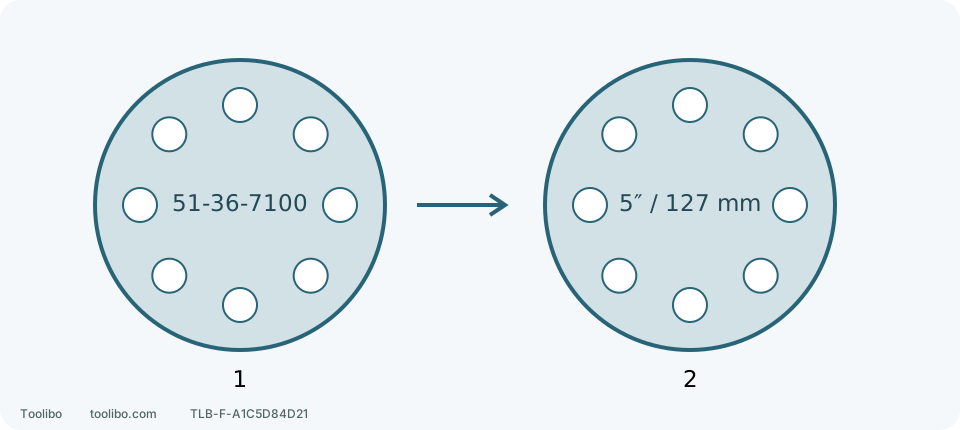
1 · Standard pad identity
Confirm tool, serial and fitted configuration before buying.
2 · Matching abrasive disc
Match diameter, fuzzy backing, hole positions and task-appropriate grit.
Schematic of the standard 51-36-7100 hook-and-loop pad and matching disc. The eight peripheral holes are dust passages, not mounting screws. This is not a cutting template or approval for every aftermarket product.
Separate the disc from the backing pad
The disc is the thin consumable abrasive. The backing pad supports and retains it. The brake above the pad is neither sandpaper nor a soft interface cushion. Sellers sometimes call all these a replacement sanding pad, so identify the component before ordering.
The US 2648-20 J49A and J49B parts lists both identify item 25 as standard 5-inch hook-and-loop disc assembly 51-36-7100. Item 27 is the abrasive: three standard 80-grit hook-and-loop discs. Both drawings show eight peripheral dust holes in that standard disc. These are not the pad mounting-screw holes. A part number helps identify the factory setup, not prove what a previous owner fitted.
Write a complete shopping specification
Swipe or scroll horizontally to see all columns.
| Item | Standard starting point | If it does not match |
|---|---|---|
| Diameter | 5 inches, approximately 127 mm | Do not expose the pad with a small disc or trim an oversized one by running it |
| Backing | Fuzzy disc back against a hook-and-loop pad | PSA adhesive is a different attachment system |
| Dust path | Eight peripheral holes matching the fitted pad | Count alone is insufficient; check positions and approved fit |
| Grit and abrasive | Match material, existing scratches and finishing plan | Included 80 grit is not a universal finishing choice |
| Pad identity | Standard 51-36-7100, checked against tool and serial | Resolve modification, wear or uncertain identity first |
A concrete combination is a confirmed, sound 51-36-7100 pad with an approved 5-inch eight-hole hook-and-loop disc in the grit your task needs. Eight holes describes the standard drawing; it does not approve every aftermarket pad, mesh abrasive or universal multi-hole product.
Inspect the first disc in five steps
If a battery is smoking, leaking or persistently abnormally hot, do not approach, touch or remove it to identify or inspect equipment. Keep away and seek local emergency guidance. The following applies only to stable equipment safe to handle.
- Switch off, wait for a complete stop and remove the battery. Keep it removed throughout inspection.
- Remove the old disc and identify hooks versus a confirmed PSA setup. Check visible cracking, looseness and severely worn hooks; stop using defective equipment.
- Check that the new disc has a fuzzy back, is not torn, distorted or contaminated, and matches the diameter when laid against the pad. Do not run an incorrect disc to make it fit.
- Align each dust opening, centre and press the disc firmly over its surface. Check the whole edge for lifting. Do not cut or punch unapproved holes to compensate for a mismatch.
- Confirm package grit and material suitability. This is static purchase acceptance only, not an instruction to start the tool immediately. A failed static fit is never a reason for a powered trial.
PSA needs a different attachment system
The operator manual describes a pressure-sensitive-adhesive pad option that is not supplied with the standard tool. A PSA disc requires the correct approved PSA pad. Its adhesive does not repair worn hooks, and extra glue is not a safe answer to a loose disc.
These two parts lists do not establish a PSA pad ordering number for this guide. If changing systems is genuinely necessary, give Milwaukee the catalogue number, full serial and fitted-pad identity to confirm the appropriate part and installation instructions before buying. A functioning hook-and-loop setup normally does not need conversion just to buy another pack of abrasives.
Separate grit progression from retention faults
The manual groups 60/80 as coarse, 100/120 as intermediate and 150/180/220 as fine. These are application groups, not a compulsory recipe for every surface. Start only as coarse as the defect requires, then refine progressively. Thin veneer and between-coat work especially should not inherit a rough-stock starting grit. Unknown coatings or suspected lead/asbestos require qualified assessment before sanding, not a trial to identify them.
If the old disc will not hold but a sound, correct new one does, retire the old consumable. If the correct new disc also fails to hold, investigate pad identity, cleanliness and wear. Do not repeat powered tests of a disc-ejection risk or hide the problem with stronger adhesive. Give service the abrasive packaging, pad details and external photographs rather than only saying that five-inch paper falls off.
Models referenced