
Same collection format, different power branches
Original comparison diagram shows two similarly sized tanks, one with a battery branch and one with battery plus mains branches; charging is crossed out.
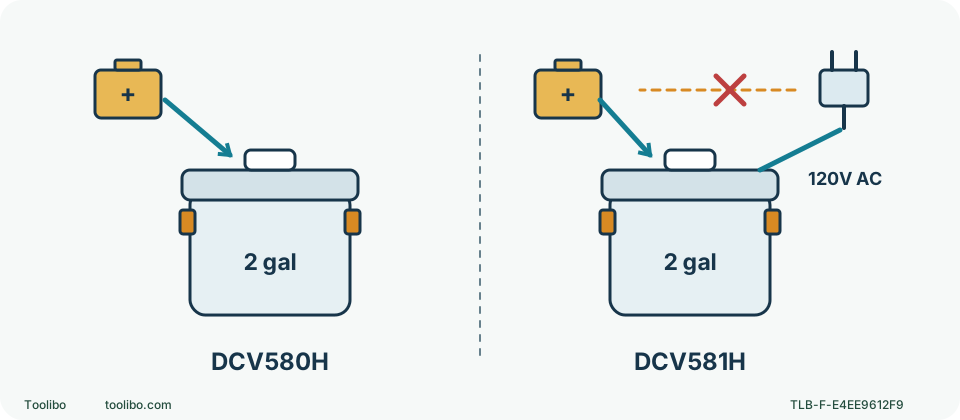
DCV580H
- DCV580H Type 11; NA130652 manual family.
- Compatible 20V MAX* lithium-ion battery; no mains operating input.
DCV581H
- DCV581H Type 2; NA131128 manual family.
- Compatible 20V MAX* battery or 120V AC; AC does not charge the installed battery.
DCV580H
Battery-only operation.
DCV581H
Battery or the specified US mains supply.
Both
Check the exact filter, type and complete package.
The comparison isolates the documented power difference without implying measured performance or usable liquid capacity.
Compare a completed job, not one extra feature
These two compact DEWALT vacuums look similar and share a nominal 2-gallon format, but the useful buying distinction is their power arrangement. DCV580H is battery-only; DCV581H also accepts the specified US 120V AC supply. Decide whether that extra option helps at the places you actually clean. An outlet on the other side of a wet doorway may be less useful than a well-planned battery session.
Start with a simple floor plan and mark where the vacuum will stand. Add the available dry supply points, the objects that obstruct a lead and the route to the emptying location. A five-minute task in several separated rooms and a repeated cleanup beside one suitable outlet create different priorities. These are planning examples, not promises about either machine’s runtime.
Keep the common features in the comparison
Both selected listings describe a 5 ft, 1-1/4 in hose and onboard accessories. Both selected manuals retain the correct wet/dry filter for both collection modes. Neither point means the two machines are identical internally or that every replacement part may be exchanged. Match the actual model, type and approved replacement identity, particularly when buying used equipment.
Swipe or scroll horizontally to see all columns.
| Decision | DCV580H Type 11 | DCV581H Type 2 |
|---|---|---|
| Operating supply | Compatible 20V MAX* battery | Compatible 20V MAX* battery or 120V AC |
| Battery charging in the vacuum | No charging function | AC operation does not charge the pack |
| Nominal tank | 2 gallons | 2 gallons |
| Handling before maintenance | Switch off and remove battery | Switch off, unplug and remove battery |
| Wet filter rule | Retain the matched wet/dry filter | Retain the matched wet/dry filter |
Do not read the common tank figure as a guaranteed recoverable liquid quantity. Usable collection and manageable carrying are separate questions. A power option does not enlarge the tank, remove the need to empty it or turn the vacuum into a continuous pump.
Price the configuration rather than the bare body
Each bare-tool choice needs an appropriate battery and charger if battery operation matters. Record what you already own, its exact compatibility and whether it will be available during the cleanup. A battery shared with a drill may be occupied precisely when a workshop needs tidying. Do not silently count it twice in the plan.
For DCV581H, include the time and practical arrangement required to use the mains lead safely. A mains option can reduce dependence on a battery for a suitable stationary task, but cannot replenish it for the next room. For either model, check the correct filter and essential nozzle availability locally before relying on a lower advertised tool-only price. No current price or stock ranking is implied here.
Make the choice from a concrete scenario
If you mostly collect permitted debris in short, separated locations and already have a suitable battery setup, DCV580H’s battery-only arrangement may meet the need without adding an unused feature. If you also spend meaningful time beside a suitable US supply, DCV581H can offer a useful alternative operating source. That is a convenience distinction, not evidence that it cleans every surface faster.
Neither is an automatic answer for bulk liquid recovery, repeated unknown renovation dust or material requiring a separately assessed extraction system. If the task exceeds the collection category, stop the comparison and choose the right process first. Purchasing the model with more power options does not solve a material-safety mismatch.
Check the used-tool and import traps
Read the type label, not merely the advertisement headline. An older manual can mention battery interfaces absent from the revisions compared here. A listing for another country’s similarly named model may also have a different electrical configuration. For the selected DCV581H, a plug adapter does not make 120V compatible with 220–240V mains.
At inspection, look for damaged latches, missing or incorrect filters, split hoses, wet battery areas and visible cord damage where applicable. Do not test a suspect electrical item to prove it still runs. Record the reasons for rejecting it before discussing accessories. The right purchase is the complete, documented configuration that fits your route and task, not simply the one with the longer feature list.
Models referenced