
Five conditions that require stopping
Pictograms show moving work, trapped hand clearance, abnormal battery heat, a bound bit and hidden services.
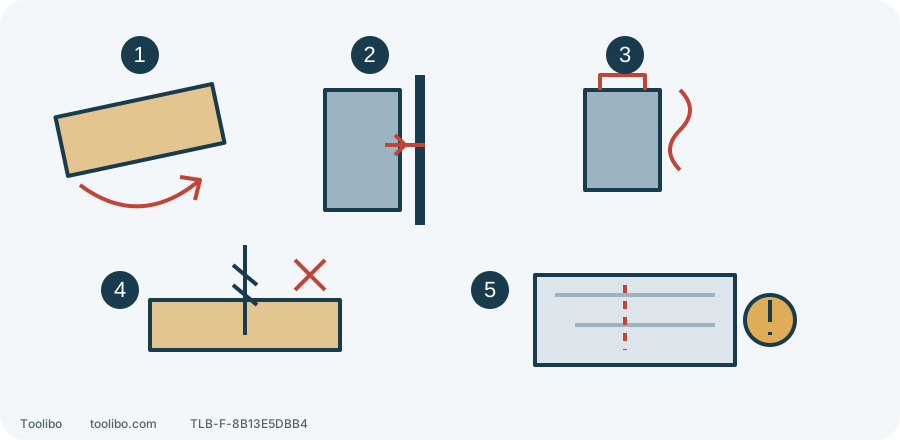
1. Moving work
Do not catch it; repair the restraint chain.
2. Trapped clearance
Reposition instead of bracing with the body.
3. Abnormal heat
Active smoke or leakage is not a routine removal task.
4. Bound accessory
No repeated powered pulses to force release.
5. Unknown target
Identify the target before a trial hole.
Recognize observed hazards; do not recreate them. Release first, then isolate only when stopped and safe to approach.
Separate stopping, isolation and restarting
Releasing the trigger stops driving; removing the battery or unplugging after complete standstill, with stable equipment safe to approach, isolates the tool for adjustments. Centre lock, low clutch and a flashing protection light are not isolation. Do not hold an accessory that could move while looking for a switch.
These branches cover ordinary handheld drilling and use observations already made, not recreated binding or overheating. A smoking, leaking or persistently abnormally hot battery is an exception: do not approach to remove or trial it. Move away from danger and follow site emergency arrangements. Ordinary checks apply only to stable equipment safe to approach.
Moving work: stop rather than grab
A spinning small part, sliding board or lifting clamp-and-backing assembly has lost restraint. Release immediately. Do not catch rotating stock or support it from underneath to finish. Wait and isolate before rearranging.
Check the whole chain: work secured to support, support secured to bench, and an exit path clear of clamps, bench and hands. While isolated, gently check for sliding, turning or lifting. Continue only after the arrangement actually prevents movement and the material remains sound. Without safe restraint, change fixture or method.
Lost hand or body clearance: change position
A wall beside the grip, an obstruction in the possible hand-swing path or a reach requiring tiptoes is not solved by gripping harder. Pause before starting, or release and wait if already running; reorganize stance, height and orientation.
A hand is not a clamp, and the other hand must not support the exit side. Fit the matched auxiliary handle when required. If access demands removing a required handle, trapping the body or abandoning stable footing, the present tool arrangement is unsuitable.
New noise, looseness or abnormal heat: no test hole
Record what was already observed and whether it occurred loaded or unloaded. Do not recreate it for a fuller report. Stop and isolate, then inspect only safely visible accessory retention, workholding, housing and vents. Allow hot accessories to cool naturally rather than touching to test temperature.
An incorrectly seated accessory discovered during normal preparation may be refitted by the model’s instructions. Cracks, unequal jaws, damaged housing, burning smell, an unstable selector or an unexplained abnormality require stopping and inspection/service. Protective shutdown is not proof of repair; repeated trigger pulls do not establish fitness.
A bound bit or sudden twist: remove drive first
Release immediately while controlling the tool without moving hands toward the accessory. Do not pulse forward/reverse or brace the tool with your body to force progress. When stopped and safe to handle, isolate before inspecting restraint, bit and obstruction.
A bit trapped in work is not an ordinary bit change. Tool, work and accessory need support against sudden falling or movement. If normal safe manual handling cannot release it, obtain competent assistance rather than adding bars, hammer blows or liquid. Resume preparation only after the cause is removed, equipment is sound and the task remains permitted, not merely after resetting the trigger.
An unknown target: stop the drilling plan
Hidden wiring, pipes or structural members, hazardous dust and accessory/material compatibility cannot be established by a trial hole. Unknown walls, suspect old coatings and structural or specified-torque connections may require identification, permission or a different professional method.
Obtain reliable target information and an applicable plan rather than a sharper bit. A restart decision should name the removed cause and how that was confirmed, not simply say it looks fine. Stopping preserves the opportunity to correct the setup before failure. The next hole is not a diagnostic experiment.